Quotes & Sayings


We, and creation itself, actualize the possibilities of the God who sustains the world, towards becoming in the world in a fuller, more deeper way. - R.E. Slater

There is urgency in coming to see the world as a web of interrelated processes of which we are integral parts, so that all of our choices and actions have [consequential effects upon] the world around us. - Process Metaphysician Alfred North Whitehead

Kurt Gödel's Incompleteness Theorem says (i) all closed systems are unprovable within themselves and, that (ii) all open systems are rightly understood as incomplete. - R.E. Slater

The most true thing about you is what God has said to you in Christ, "You are My Beloved." - Tripp Fuller

The God among us is the God who refuses to be God without us, so great is God's Love. - Tripp Fuller

According to some Christian outlooks we were made for another world. Perhaps, rather, we were made for this world to recreate, reclaim, redeem, and renew unto God's future aspiration by the power of His Spirit. - R.E. Slater

Our eschatological ethos is to love. To stand with those who are oppressed. To stand against those who are oppressing. It is that simple. Love is our only calling and Christian Hope. - R.E. Slater

Secularization theory has been massively falsified. We don't live in an age of secularity. We live in an age of explosive, pervasive religiosity... an age of religious pluralism. - Peter L. Berger

Exploring the edge of life and faith in a post-everything world. - Todd Littleton

I don't need another reason to believe, your love is all around for me to see. – Anon

Thou art our need; and in giving us more of thyself thou givest us all. - Khalil Gibran, Prayer XXIII

Be careful what you pretend to be. You become what you pretend to be. - Kurt Vonnegut

Religious beliefs, far from being primary, are often shaped and adjusted by our social goals. - Jim Forest

We become who we are by what we believe and can justify. - R.E. Slater

People, even more than things, need to be restored, renewed, revived, reclaimed, and redeemed; never throw out anyone. – Anon

Certainly, God's love has made fools of us all. - R.E. Slater

An apocalyptic Christian faith doesn't wait for Jesus to come, but for Jesus to become in our midst. - R.E. Slater

Christian belief in God begins with the cross and resurrection of Jesus, not with rational apologetics. - Eberhard Jüngel, Jürgen Moltmann

Our knowledge of God is through the 'I-Thou' encounter, not in finding God at the end of a syllogism or argument. There is a grave danger in any Christian treatment of God as an object. The God of Jesus Christ and Scripture is irreducibly subject and never made as an object, a force, a power, or a principle that can be manipulated. - Emil Brunner

“Ehyeh Asher Ehyeh” means "I will be that who I have yet to become." - God (Ex 3.14) or, conversely, “I AM who I AM Becoming.”

Our job is to love others without stopping to inquire whether or not they are worthy. - Thomas Merton

The church is God's world-changing social experiment of bringing unlikes and differents to the Eucharist/Communion table to share life with one another as a new kind of family. When this happens, we show to the world what love, justice, peace, reconciliation, and life together is designed by God to be. The church is God's show-and-tell for the world to see how God wants us to live as a blended, global, polypluralistic family united with one will, by one Lord, and baptized by one Spirit. – Anon

The cross that is planted at the heart of the history of the world cannot be uprooted. - Jacques Ellul

The Unity in whose loving presence the universe unfolds is inside each person as a call to welcome the stranger, protect animals and the earth, respect the dignity of each person, think new thoughts, and help bring about ecological civilizations. - John Cobb & Farhan A. Shah

If you board the wrong train it is of no use running along the corridors of the train in the other direction. - Dietrich Bonhoeffer

God's justice is restorative rather than punitive; His discipline is merciful rather than punishing; His power is made perfect in weakness; and His grace is sufficient for all. – Anon

Our little [biblical] systems have their day; they have their day and cease to be. They are but broken lights of Thee, and Thou, O God art more than they. - Alfred Lord Tennyson

We can’t control God; God is uncontrollable. God can’t control us; God’s love is uncontrolling! - Thomas Jay Oord

Life in perspective but always in process... as we are relational beings in process to one another, so life events are in process in relation to each event... as God is to Self, is to world, is to us... like Father, like sons and daughters, like events... life in process yet always in perspective. - R.E. Slater

To promote societal transition to sustainable ways of living and a global society founded on a shared ethical framework which includes respect and care for the community of life, ecological integrity, universal human rights, respect for diversity, economic justice, democracy, and a culture of peace. - The Earth Charter Mission Statement

Christian humanism is the belief that human freedom, individual conscience, and unencumbered rational inquiry are compatible with the practice of Christianity or even intrinsic in its doctrine. It represents a philosophical union of Christian faith and classical humanist principles. - Scott Postma

It is never wise to have a self-appointed religious institution determine a nation's moral code. The opportunities for moral compromise and failure are high; the moral codes and creeds assuredly racist, discriminatory, or subjectively and religiously defined; and the pronouncement of inhumanitarian political objectives quite predictable. - R.E. Slater

God's love must both center and define the Christian faith and all religious or human faiths seeking human and ecological balance in worlds of subtraction, harm, tragedy, and evil. - R.E. Slater

In Whitehead’s process ontology, we can think of the experiential ground of reality as an eternal pulse whereby what is objectively public in one moment becomes subjectively prehended in the next, and whereby the subject that emerges from its feelings then perishes into public expression as an object (or “superject”) aiming for novelty. There is a rhythm of Being between object and subject, not an ontological division. This rhythm powers the creative growth of the universe from one occasion of experience to the next. This is the Whiteheadian mantra: “The many become one and are increased by one.” - Matthew Segall

Without Love there is no Truth. And True Truth is always Loving. There is no dichotomy between these terms but only seamless integration. This is the premier centering focus of a Processual Theology of Love. - R.E. Slater

-----

Note: Generally I do not respond to commentary. I may read the comments but wish to reserve my time to write (or write from the comments I read). Instead, I'd like to see our community help one another and in the helping encourage and exhort each of us towards Christian love in Christ Jesus our Lord and Savior. - re slater

Thursday, January 8, 2026

Final Outline for "Evolution of Worship & Religion" by R.E. Slater


For today's newest and final essay click here -


This concludes our current series as outlined below. Should there be any errors or errata or links which don't work please provide commentary. Thank you, R.E. Slater
---

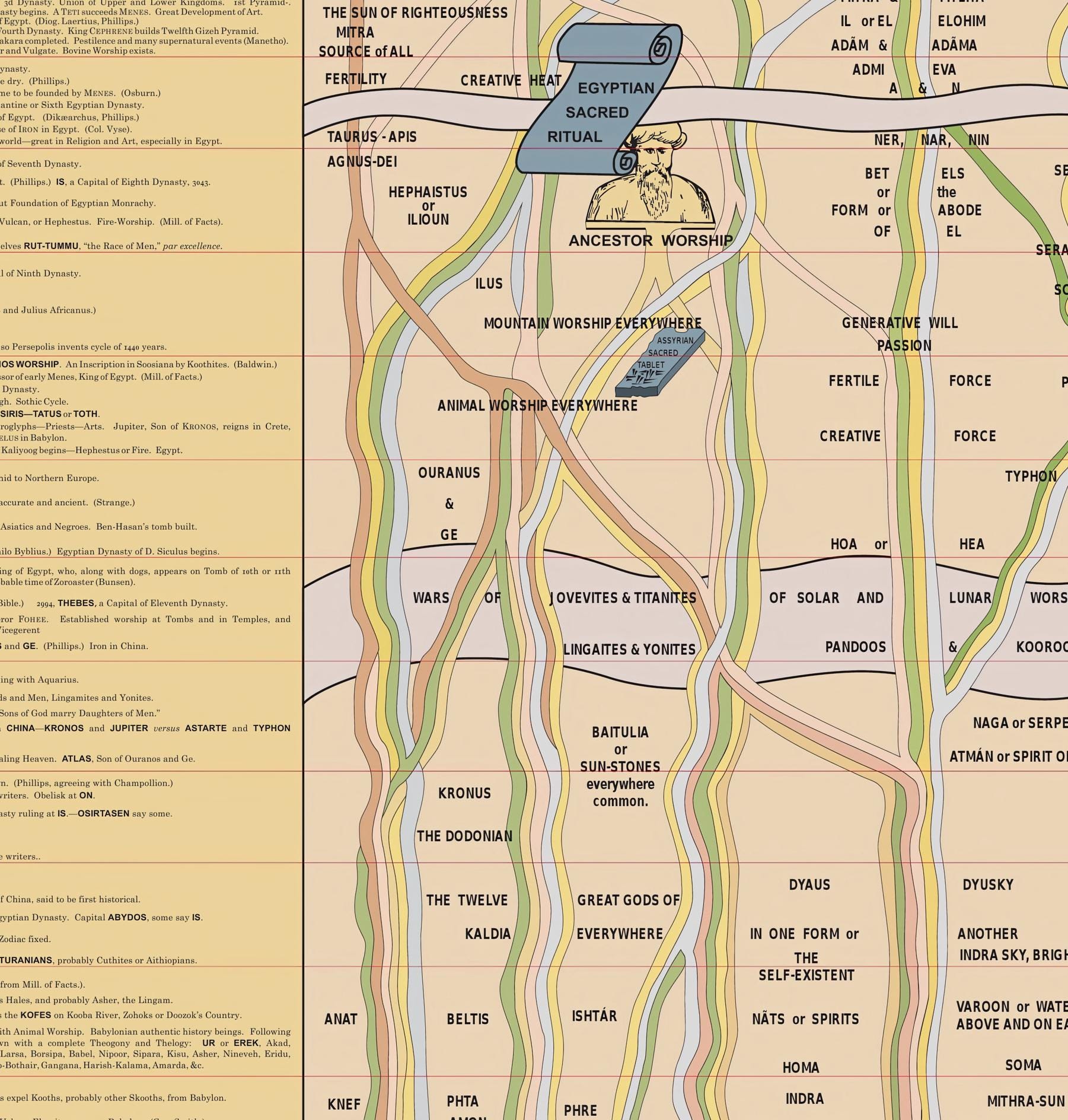
Evolution of Worship & Religion


Re-illustrated Chronologically by ChatGPT


Monday, January 5, 2026

Evolution of Worship and Religions: Part V - Becoming Aligned with the Sacred (15)


The Evolution of Worship and Religion:
From Cosmic Awe to Processual Faith

A Metamodern Journey through the History of the Sacred


FROM BELIEF TO TRANSFORMATION
PART V - ESSAY  15

by R.E. Slater & ChatGPT-5

The sacred is not what we believe about the world,
but what the world invites us to become in response.


Essay 15

Becoming Aligned with the Sacred

Beyond Belief & Toward Participation


Preface: Locating the Sacred in Religious Evolution

Across the long arc traced in Evolution of Worship and Religion, one pattern recurs with remarkable consistency: the sacred is never static. From animistic participation in natural forces, through axial metaphysical abstraction, to later institutionalized belief systems and modern secular critiques, religious life continually reconfigures how humans relate to what they name as ultimate, holy, or the Sacred-divine.

This essay emerges from that historical trajectory. It does not seek to introduce a new doctrine of the sacred, nor to defend a particular religious tradition. Instead, it proposes a processual reframingthat alignment with the sacred is best understood not as belief in fixed propositions, but as participatory orientation within an evolving relational world.

Such a reframing is neither antiquarian nor reactionary. It is a constructive response to the historical exhaustion of belief-centered religion and the simultaneous insufficiency of purely secular disenchantment. What follows situates the Sacred not behind us, nor above us, but within the ongoing processes of becoming that constitutes reality itself.


Introduction: Beyond Belief

In much of Western religious history, alignment with the sacred has been treated primarily as a matter of correct belief and ritualized orthodoxy. That is, correct ideas held about God, about the cosmos, morality, or what constitutes effectuating salvation. Historic Orthodoxy has functioned both  as compass and boundary, defining who was “in alignment with the Sacred” and who was not. While such frameworks offered coherence and continuity, they also produced rigidity, exclusion, and frequent dissonance with lived experience.

Modernity exposed these tensions. Scientific cosmology, historical criticism, and corporate pluralism and blending rendered many inherited belief structures increasingly fragile. Yet the collapse of certainty did not erase the human orientation toward the sacred; it merely displaced it. The persistence of longing, meaning-making, and moral imagination suggests that the sacred was never reducible to belief alone.

Process philosophy offers a constructive alternative. Rather than asking what must be believed, it asks how reality becomes. Within this framework, the sacred is not a static object of assent but a dynamic depth-dimension of relational becoming. Alignment, therefore, is not achieved through cognitive agreement, but through participatory responsiveness.


I. The Sacred as Process, Not Object

At the heart of process thought lies a decisive metaphysical shift: reality is composed not of enduring substances but of events, relations, and ongoing processes. Nothing simply is; everything becomes. Applied to religious reflection, this means the sacred cannot be adequately conceived as a fixed entity standing apart from (or over-and-above) the world of creation.

Instead, the sacred relates to creation as its lure toward coherence, intensity, and value within becoming itself. It is not imposed from without but arises through relational interaction. In Whiteheadian terms, it functions persuasively rather than coercively, inviting participation rather than demanding submission.

This understanding resonates with earlier stages of religious evolution - particularly animistic and indigenous traditions - while avoiding their cosmological limitations. The sacred is neither anthropomorphized nor abstracted into metaphysical remoteness. It is encountered where relations deepen, where novelty emerges, and where shared flourishing becomes possible.


II. Alignment as Orientation Rather Than Assent

If the sacred is processual, alignment cannot be defined as assent to timeless truths. Alignment becomes a matter of orientation - how one is situated within the flow of becoming.

Orientation is inherently provisional. It adjusts as contexts shift, as histories accumulate, and as new possibilities emerge. This distinguishes alignment from obedience. Obedience presumes a fixed command structure; alignment presumes responsiveness to evolving conditions.

Such responsiveness is ethical as well as metaphysical. To be aligned with the sacred is to cultivate attentiveness, care, and creative participation. It is to live with the world rather than over it, where recognizing that every action contributes - however modestly—to the direction reality takes.


III. Participation Over Possession

Belief-centered religion tends toward possession: truth is something one has. Participatory-centered spirituality emphasizes entry; whereas truth is something one joins. This shift carries significant implications.

Participation reframes worship as:

  • engagement rather than compliance;
  • ethics as relational responsibility rather than rule enforcement; and,
  • theology as interpretive practice rather than final explanation.

Communities shaped by participation remain open to revision, dialogue, and growth, resisting the closure that often accompanies doctrinal fixity and finality.

In evolutionary terms, this marks a maturation of religious consciousnessThe Sacred is no longer secured by institutional authority alone, nor dismissed by secular critique, but encountered through lived relationality.


IV. Misalignment, Suffering, and Creative Reorientation

A processual account of alignment does not deny suffering or failure. On the contrary, it takes them seriously as intrinsic to unfinished becomingMisalignment is not primarily moral transgression; it is incongruence within evolving relational fields.

Where classical theologies often interpret misalignment as sin requiring correction, process theology interprets it as a call to reorientationSuffering becomes a site of potential transformation - not because it is divinely willed, but because new possibilities can emerge from fractured coherence.

Alignment, therefore, is not linear progression. It is a continual practice of recalibration, learning to respond creatively to uncertainty and disruption rather than retreating into certainty and assurance.


V. The Sacred Without Coercion

One of the most consequential outcomes of this framework is its rejection of coercive sacred power. If the sacred operates persuasively rather than unilaterally as divine power, then domination, exclusion, and violence lose theological legitimacy. Hence, the church's teachings on divine sovereignty are appropriately reinterpreted within process theology emphasizing love and not divine enforcement.

This aligns with a broader ethical trajectory traced throughout Evolution of Worship and Religion series: as religious consciousness evolves, the sacred increasingly withdraws from authoritarian forms and reappears as relational depth, moral imagination, and participatory responsibility.

To be aligned with the sacred, in this sense, is to resist systems of oppression - whether religious, political, or ideological. Systems which suppress processually becoming outcome in favor of controlling outcome.


Conclusion: The Sacred as Ongoing Invitation

Becoming aligned with the sacred is not a final state. It is a posture of heart and mind and soul - one that is open, responsive, and unfinished. It does not promise certainty, but it offers relational, pantheistic coherence. It does not remove ambiguity, but it deepens relational, processual participation.

Within a processual worldviewthe Sacred is not what stands above becoming. It is what calls relational becoming forward. Alignment, then, is less about belief than about fidelity to relational possibility - how one listens, responds, and contributes to the world’s processual unfolding.

Beyond belief lies participation.
Beyond possession lies orientation.
Beyond static holiness lies sacred becoming.


Alignment

We did not come to so simply
believe in sacredness,
or to name the Sacred,
but to learn its nature -
how to lean into life
without enclosing it
to finality and conclusion.

The Sacred does not stand above us,
armed with certainty and despair -
but moves within the fragile grammar
of processual becoming.

We feel it when attention deepens,
when heartfelt care outpaces fear,
when the world answers our listening
with more than we had expected.

Not by command, but by invitation.
Not by cosmic portendings,
but by divine adjustments.
A quiet drawing-forward,
an allurement, reaches
through what is unfinished
to guide, to comfort, to heal.

Even now, humanity senses
divine silence and the grave,
not in denying these events,
but in the opening of
a sacred way through them.

Here, alignment is not escape.
It is staying. Remaining.
With hands and heart open.
With steps tentatively searching.
Participating in the slow courage
of what is still, and ever will,
be becoming within the
heart of the Sacred.


R.E. Slater
January 4, 2026
@copyright R.E. Slater Publications
all rights reserved


~ Continue to Part VI, SM 1 ~


Evolution of Worship & Religion


BIBLIOGRAPHY


Process Philosophy & Theology
  • Whitehead, Alfred North. Process and Reality. Corrected Edition. Free Press, 1978.

  • Whitehead, Alfred North. Religion in the Making. Fordham University Press, 1996.

  • Cobb, John B., Jr., and David Ray Griffin. Process Theology: An Introductory Exposition. Westminster Press, 1976.

  • Keller, Catherine. On the Mystery: Discerning Divinity in Process. Fortress Press, 2008.

  • Oord, Thomas Jay. The Uncontrolling Love of God. IVP Academic, 2015.

  • Suchocki, Marjorie Hewitt. God, Christ, Church: A Practical Guide to Process Theology. Chalice Press, 1989.


Sacred, Participation, and Religious Evolution
  • Eliade, Mircea. The Sacred and the Profane. Harcourt, 1959.

  • Smith, Wilfred Cantwell. The Meaning and End of Religion. Fortress Press, 1991.

  • Bellah, Robert N. Religion in Human Evolution. Harvard University Press, 2011.

  • Armstrong, Karen. The Case for God. Knopf, 2009.

  • Asad, Talal. Formations of the Secular. Stanford University Press, 2003.


Metamodern, Relational, and Participatory Thought
  • Vermeulen, Timotheus, and Robin van den Akker. “Notes on Metamodernism.” Journal of Aesthetics & Culture, 2010.

  • Connolly, William E. A World of Becoming. Duke University Press, 2011.

  • Deleuze, Gilles. Difference and Repetition. Columbia University Press, 1994.

  • Teilhard de Chardin, Pierre. The Phenomenon of Man. Harper & Row, 1959.


Optional Integrative Thread (your project lineage)
  • Slater, R. E. Evolution of Worship and Religion (Essay Series). Relevancy22 Blog Archive.

  • —— Processual Divine Coherence (working archive).


The Gnostic Mysterion: the Crisis of Sacred Becoming (SM 12)


Illustration by R.E. Slater & ChatGPT

Supplementary Materials
Part VI, SM 12

The Gnostic Mysterion:
the Crisis of Sacred Becoming

A Process-Historical Reading of Gnosticism

by R.E. Slater & ChatGPT-5

"There was a mystery kept secret for long ages,
but now disclosed—not to remove us from the world,
but to reveal what the world is becoming.”

- per Romans 16:25–26, re-voiced


Illustration by R.E. Slater & ChatGPT

Preface

This study arises from a larger inquiry into the evolution of worship and religion - an inquiry that treats religious traditions not as static deposits of timeless truth, but as living, adaptive responses to changing historical, social, psychological, cosmological, and environmental conditions.

Within that long arc, Gnosticism emerges not as a marginal curiosity nor merely as a rejected Christian heresy, but as a critical inflection point: a moment when interior consciousness, moral protest, and cosmological dissatisfaction collided with inherited religious frameworks which could no longer hold them together.

The texts commonly known as the Gnostic Gospels do not speak with one voice, nor do they form a unified movement. Yet they share a recognizable grammar - a sacred mysterion - that discloses how some early faith communities struggled to reconcile awakening, suffering, power, and transcendence in a world increasingly shaped by empire, abstraction, and alienation.

This work does not seek to rehabilitate Gnosticism wholesale, nor to dismiss it reflexively. Instead, it aims to situate Gnostic texts within the evolutionary history of religious consciousness, discerning what can be subsumed, what must be relinquished, and what remains instructive for contemporary theological and philosophical reflection - especially from a process-relational perspective.


Introduction: Why Gnosticism Appears When It Does

Gnosticism did not arise in a vacuum. It emerged at a time when:

  • Temple-centered worship was losing coherence

  • Imperial power had fused religion with domination

  • Philosophical abstraction had outpaced mythic integration

  • Interior awareness had intensified without adequate metaphysical grounding

The result was a crisis: awakening without incarnation, insight without trust in the world’s goodness.

The Gnostic response was radical. It reimagined salvation as gnosis awakening conjectures of one's true origins beyond the visible cosmos.

  • It recast creation as a mistake or deception.
  • It transformed Jesus from incarnate redeemer into revelatory demiurge messenger.
  • And it framed history NOT as a site of transformation, but as a mysterious, cryptic veil .

In this sense, the Gnostic Gospels share what can rightly be called a mysterion - a hidden truth disclosed to the awakened few. But this mysterion stands in tension with other religious developments unfolding at the same time, particularly those that would emphasize incarnation, communal participation, and the redemption of becoming itself.

This study therefore asks a guiding question:

What does Gnosticism reveal about the evolution of worship - and where does it fracture under its own metaphysical weight?


1. Gnosticism in the Long Arc of Religious Evolution

The religious movements grouped under the label Gnosticism emerged during the first centuries of the Common Era, a period marked by profound cultural, political, and cosmological upheaval. Temple-centered sacrificial systems were losing their integrative power, imperial structures increasingly fused religion with domination, and philosophical abstraction was reshaping older mythic worldviews. At the same time, interior consciousness - self-reflection, moral awareness, and existential questioning - was intensifying across the Mediterranean and Near Eastern worlds.

Within this context, the Gnostic Gospels and related texts represent neither an isolated aberration nor a fully coherent alternative Christianity. Instead, they constituted a historically intelligible response to a crisis of meaning: the inability of inherited cosmologies to reconcile emerging interior awareness with a world experienced as violent, unjust, and alienating. Gnosticism is therefore best understood as a transitional phenomenon within the broader evolution of worship and religion, one that pressed urgently real questions but resolved them through metaphysical strategies that proved unsustainable.

This essay approaches Gnosticism not primarily as a doctrinal system, but as a pattern of religious consciousness organized around what may properly be called a mysterion: a hidden truth disclosed only to the awakened, concerning the soul’s origin, the nature of the cosmos, and the means of salvation.

2. Salvation through Gnosis (Sacred Mysterion)

Knowledge, Cosmic Dualism, Demiurges, and the false Hebrew God

Despite their diversity, the Gnostic Gospels share a recognizable structure of meaning. Central to this structure is the conviction that human beings possess a divine element - a spark or seed - that originates beyond or outside the visible cosmos. Salvation consists not in forgiveness, ritual participation, or future resurrection, but in gnosis: an awakening inner consciousness/knowledge that recalls the soul to its true origin.
A process form of Christian theology will invert the Gnostic dualism inherent in its cosmology. That all creation is already sacred, not secretly or hiddenly divine. That is, creation is not divided between sacred and profane realms, but is inherently infused with divine presence already. What obscures the sacred is not human embodiment (matter v spirit) but the contingent exercise of free agency within a relational world. Because divine presence functions as a lure toward value rather than as an imposed certainty, the sacred may be disclosed through creative participation or submerged through resistant or destructive patterns of becoming. The religious (or, sacred divine) task is therefore not escape from the world, but the disciplined cooperation within the sacred that would release what is already present.
In this framework, ignorance (agnōsia) rather than sin becomes the fundamental human problem. The world, as ordinarily perceived, functions as a veil that obscures truth rather than as a medium of divine self-disclosure. Mythic cosmologies involving aeons (divine emanations from the ultimate God; this God is NOT the Jewish Creator God, considered by Gnostics as evil for the violence it brought into the world: Flood, death, etc), the Pleroma (a spiritual realm of fullness), the Demiurge (a sub-Spirit born from God's own Spirit), and archons (servants of this ultimate God that helped create material worlds trapping divine souls within who may only escape via gnosis to return to the Pleroma) articulate this alienation symbolically, portraying material reality as the product of error, ignorance, or lesser power.

Jesus, in the Gnostic Gospels, is consequently reinterpreted less as incarnate redeemer than as revelatory messenger (a demiurge of the Gnostic God). He appears as a hierophant (a Gnostic priest) who discloses hidden knowledge through riddles, dialogues, and secret teachings. Resurrection is frequently understood as a present, spiritual awakening rather than a future, bodily event. The mysterion is realized when the soul recognizes itself and remembers its divine provenance.

This initiatory logic - hidden truth, selective disclosure, and transformative insight - aligns Gnosticism structurally with Greco-Roman mystery traditions. Yet it also places Gnostic Christianity in sharp tension with Jewish creation theology and with early Christian movements that emphasized incarnation, communal life, and the redemption of history.

3. Positive Corollaries within Religious Evolution

When situated within the evolutionary history of worship and religion, Gnosticism yields several positive and enduring insights.
  • First, it represents a decisive interiorization of the sacred. Gnostic movements challenged the notion that divine access is mediated exclusively through temple, priesthood, or imperial authority. In doing so, they affirmed subjective experience and consciousness as genuine sites of religious encounter - a development continuous with prophetic interiorization in Israel and with Axial Age introspection more broadly.
  • Second, Gnosticism exhibits a profound suspicion of totalizing power structures. Its mythic portrayal of the Demiurge and archons functions as a symbolic critique of religious systems that legitimize domination and violence. In this respect, Gnostic cosmology can be read less as speculative metaphysics than as moral protest encoded in mythic form.
  • Third, the Gnostic insistence on awakening underscores that religious truth must be transformative rather than merely propositional. Salvation is not assent to correct doctrine but a reorientation of perception and self-understanding. This insight anticipates later mystical traditions and modern existential approaches to religion.
  • Finally, Gnostic texts demonstrate the enduring power of religion as a vehicle for meta-truth. Their narratives diagnose alienation, fragmentation, and longing in ways that literal pantheons and mythic cosmologies cannot. As symbolic expressions, they reveal how religious imagination responds creatively to historical, psychological, and metaphysical strain.

4. Negative Corollaries and Evolutionary Limits

At the same time, Gnosticism exhibits structural limitations that render it an evolutionary dead end rather than a viable culmination of religious development.
  • Most significantly, its metaphysical denigration of the material world undermines ethical responsibility, communal life, and historical engagement. By construing embodiment and becoming as mistakes to be escaped, Gnosticism forfeits the possibility of a redemptive vision that includes nature, society, and future generations.
  • Closely related is the problem of elitism. Gnostic salvation is typically restricted to those capable of receiving gnosis, dividing humanity into the awakened and the incapable. Such spiritual aristocracy fragments community and contradicts the more expansive trajectories of religious evolution which move toward universal participation.
  • Moreover, Gnosticism resolves suffering through withdrawal rather than transformation. Escape replaces hope; transcendence is secured by abandoning history rather than renewing it. In this respect, Gnosticism mirrors the very static perfection it sought to overcome, locating fullness in a fixed realm behind time rather than in an open, creative future.

5. Gnosticism as Threshold Movement

From an evolutionary perspective, Gnosticism is best understood as a threshold phenomenon. It arises when older mythic and cultic systems can no longer integrate emerging consciousness and moral protest, yet before a relational and incarnational synthesis becomes possible. It asks the right questions - about power, suffering, and awakening - but answers them by rejecting the world rather than reimagining it.

This explains both the intensity of early Christian resistance to Gnosticism and its enduring fascination in modern contexts. The conflict was not merely about authority or chronology, but about competing visions of what religious mystery itself entails: whether salvation consists in escaping the world or in participating in its transformation.

6. A Process-Relational Reframing

From a process-relational perspective, the Gnostic mysterion can be critically subsumed without being revived wholesale. Process thought affirms the Gnostic intuition that false totalities exist, that consciousness matters, and that awakening is essential. Yet it rejects the notion that becoming, embodiment, and history are metaphysical errors.

In this reframing, mystery is not a secret exit from the world as versus the inexhaustible depth of relational becoming within the world itself. God does not stand wholly beyond the cosmos but works persuasively within its unfolding, luring creation toward greater complexity, value, and harmony. Redemption is therefore not extraction from matter but the transformation of relations.

What Gnosticism interpreted as a prison, process theology understands as an unfinished world. What Gnosticism sought to escape, process thought seeks to heal.

7. Conclusion

The Gnostic Gospels occupy an indispensable place in the history of religious thought. They testify to a moment when awakening outpaced cosmology, when moral protest exceeded inherited theological forms. Their shared mysterion reveals both the promise and the peril of radical interiorization.

Ultimately, Gnosticism teaches that awakening alone is insufficient. Religious evolution does not culminate in secret knowledge possessed by the few, but in participatory transformation open to all. The enduring mystery is not how to flee the world, but how the sacred continues to emerge within it.

When viewed through the long lens of religious evolution, Gnosticism appears neither as an aberration nor as a lost golden path. Rather, it is best understood as a threshold movement - a necessary but incomplete mutation in humanity’s ongoing attempt to articulate the sacred.

Gnosticism saw clearly that:
  • Power can masquerade as divinity
  • Consciousness matters
  • Awakening cannot be reduced to obedience
  • Mythic symbolism can diagnose alienation
Yet it failed to trust the very medium through which religious evolution unfolds: embodied, relational becoming.

By treating the world as a prison rather than a process, Gnosticism resolved tension through escape rather than transformation. It substituted interior illumination for communal repair. It preserved transcendence by abandoning history.

From a process-relational perspective, the enduring lesson of the Gnostic Gospels is therefore not their cosmology, but their religious protest - a protest that must be carried forward without repeating their metaphysical refusal of the world.

In the larger evolution of worship and religion, Gnosticism marks the moment when humanity learned that awakening alone is insufficient. What matters is how divine-awakening participates in the unfinished work of creation.

The mystery that endures is not how to escape the world,
but how the sacred continues to emerge within it.


~ Return to Introduction ~


Evolution of Worship & Religion


BIBLIOGRAPHY


Primary Texts
  • Robinson, James M. (ed.). The Nag Hammadi Library in English. HarperOne.

  • Meyer, Marvin (ed.). The Gnostic Gospels of Jesus. HarperOne.

  • Ehrman, Bart D. Lost Scriptures. Oxford University Press.

  • Kasser, Rodolphe et al. The Gospel of Judas. National Geographic.

Historical & Theological Studies
  • Pagels, Elaine. The Gnostic Gospels. Random House.

  • King, Karen L. What Is Gnosticism? Harvard University Press.

  • Williams, Michael Allen. Rethinking “Gnosticism”. Princeton University Press.

  • Turner, John D. Sethian Gnosticism and the Platonic Tradition. Peeters.

Comparative & Process-Oriented Context
  • Whitehead, Alfred North. Religion in the Making. Macmillan.

  • Cobb, John B., Jr. Christ in a Pluralistic Age. Westminster Press.

  • Keller, Catherine. Cloud of the Impossible. Columbia University Press.

  • Oord, Thomas Jay. The Uncontrolling Love of God. IVP Academic.