 |
| Illustration by R.E. Slater and ChatGPT |
physics and biology, in which reality is understood as coherence,
Cosmic Becoming Cycle → poetic and metaphysical expansion
Embodied Process Realism → formal philosophical framework
Processual Divine Coherence → theological bridge
Preface
 |
| Illustration by R.E. Slater and ChatGPT |
“What we observe is not nature itself, but nature exposed to our method of questioning.”
- Werner Heisenberg
I. From Critique to Development
If the first essay sought to destabilize the graviton paradigm and introduce coherence as a candidate ontology, the present essay asks a further question:
whether physics itself is already moving in this direction.
In the previous essay, we proposed that gravity may be more accurately understood not as a force mediated by particles, but as the persistence of relational coherence across the unfolding of cosmic becoming. This proposal, while philosophical in form, was grounded in tensions internal to contemporary physics - particularly the difficulty of reconciling general relativity with quantum theory.
Today's essay will turn from critique to development...
For if gravity is not fundamental in the way traditionally assumed, then the question shifts:
what underlying structures give rise to the phenomena we describe as gravitational?
II. A Transformation Within Physics
Increasingly, developments across contemporary physics suggest that reality is not fundamentally composed of particles, but of relations - expressed through information, entanglement, and emergent structure.
Over the past several decades, a quiet transformation has been underway. Concepts once considered secondary - entropy, information, correlation - have moved toward the center of physical explanation. In fields ranging from black hole thermodynamics to quantum information theory, these concepts are no longer merely descriptive, but constitutive.
Spacetime itself may be emergent.
Structure may precede object.
Interaction may define identity.
This essay explores that transformation.
It argues that contemporary physics is pointing towards a more relational understanding of reality - one in which structure, coherence, and constraint precede, and give rise to, what we call objects. In this light, gravity itself may be understood not as a fundamental interaction, but as a large-scale expression of relational coherence stabilizing across scale.
III. Project Trajectory: From Reality to Meaning
This work unfolds within a broader trajectory, structured across four interrelated phases:
These phases do not represent separate domains, but a continuous unfolding -from description to meaning, from structure to significance.
IV. Direction of Inquiry: From Physics to Ontology
The present essay then proceeds from a growing recognition within contemporary physics: that reality is increasingly described not in terms of isolated particles, but through relations, information, and emergent structure.
In light of these developments, this project follows a conceptual trajectory:
from materialism to physicalism to processual interpretation (refer Appdx A)
Materialism, once grounded in substance and matter, has given way to physicalism, which incorporates fields, energy, and spacetime as fundamental. Yet physicalism, in its descriptive strength, does not by itself determine the ontology of what these structures are.
This project therefore advances a further step:
toward a process-relational ontology in which reality is understood as the persistence of relational coherence across scale.
Within this framework, what physics describes is not rejected, but reframed - situated within a broader account of reality as structured, dynamic, and continuously unfolding.
It is this interpretive movement that the present work seeks to develop under the name:
Embodied Process Realism
V. Tables


 |
| Illustration by R.E. Slater and ChatGPT |
“What we take to be fundamental may be less about what things are, and more about how they are related.”
Contemporary physics continues to employ the language of particles, fields, and interactions. Yet, in practice, many of its most successful theories no longer rely on strictly separable entities as their primary units of description.
Instead, physicalist systems are increasingly represented in expanded terms of structured relationships - utilizing mathematical and physical configurations in which what can be specified most precisely are not isolated properties, but the constraints, correlations, and interactions that bind systems together.
This shift does not eliminate objects. Rather, it situates them within a broader framework in which their behavior and identity are defined through their participation in relational structures.
One of the clearest expressions of this shift appears in quantum theory.
In entangled systems, the formal description does not permit a decomposition into independent parts. The system must be described as a single, unified state, even when its components are spatially separated. What is physically meaningful is not the independent state of each part, but the correlation structure that relates them.
This is not a philosophical interpretation imposed upon the theory. It is a feature of the theory’s formalism itself: the mathematics requires a relational description.
A similar development appears within quantum field theory.
Particles, often treated as fundamental units, are more accurately described as localized excitations of underlying fields. These fields extend across spacetime, and what we identify as a particle corresponds to a structured event within that field.
In this framework, what appears as a discrete object is already dependent upon a continuous, relational substrate. The “thing” is inseparable from the field within which it arises.
In other domains, particularly in black hole thermodynamics and quantum information theory, physical description increasingly centers on information, entropy, and constraint.
The entropy of a black hole scales with its surface area, suggesting that physical information is encoded in boundary relations rather than in volumetric substance. More broadly, the behavior of physical systems can often be understood in terms of how information is distributed, constrained, and transformed.
Here again, what is primary is not an isolated object, but a structured pattern of relations - a configuration that governs how systems can evolve.
These developments converge in ongoing research into the nature of spacetime itself.
Across several approaches to quantum gravity, spacetime is no longer assumed to be fundamental. Instead, it is increasingly treated as something that may emerge from deeper, non-geometric structures - often described in terms of networks, correlations, or informational relationships.
In such approaches, spacetime geometry is not the starting point, but the result of more basic relational configurations. What appears as curvature at large scales may reflect the collective organization of underlying interactions.
The developments outlined above do not, by themselves, establish a new ontology. Physics, as a discipline, remains primarily descriptive - concerned with modeling behavior rather than prescribing metaphysical interpretation.
Yet these descriptions exert pressure on earlier frameworks.
Materialism, grounded in the primacy of substance and discrete matter, proves increasingly limited in a context where fields, non-local correlations, and emergent structures play a central role. Physicalism represents a significant expansion, incorporating fields, energy, and spacetime into the ontology of the physical.
And yet, even physicalism leaves open a further question: whether these structures are best understood as things, or as patterns of relation through which things arise.
In light of contemporary physics, a further interpretive step becomes available:
that reality is not composed of independent entities which subsequently relate, but of relational structures which stabilize into what we recognize as entities.
It is this shift that this project develops under the name:
Embodied Process Realism -
an approach in which reality is understood as the processual persistence of relational coherence across scale, through which structure, stability, and embodiment emerge.
... refer to Appendix A re comparison of materialist v physicalist v processual ontologies ...
From the process perspective, the movement from materialism to physicalism and toward processual ontology can be best understood not as a rejection of prior frameworks, but as an expansion in which the emphasis shifts from substance, to structure, to relational persistence and coherence.If physics increasingly describes a world structured by relations, information, and emergence, then the question deepens:
what kind of underlying reality gives rise to such descriptions?
It is to this question - and to the theoretical frameworks that attempt to answer it - that we now turn.
II. Theoretical Pathways Beyond Particle Ontology
“If gravity is not best understood as a particle-mediated force, then the question shifts: what kinds of structures give rise to gravitational phenomena?”
From Description to Construction
If the preceding section demonstrated that contemporary physics increasingly describes reality in relational terms, the present section turns to a more constructive question:
What kinds of theoretical frameworks attempt to build reality from such relations?
In contrast to approaches that begin with particles and forces defined within a pre-existing spacetime, a growing number of research programs begin from a different premise:
- that spacetime itself may not be fundamental
- that geometry may emerge from deeper structures
- that relations, rather than entities, may be primary
Old View Emerging ViewForces act between objects Relations constitute objectsParticles mediate interactions Structure generates effectsSpacetime is a stage Spacetime is emergentGravity is transmitted Gravity is the shape of relations


1. Emergent / Entropic Gravity: Information as the Basis of Geometry
A different line of thought approaches gravity not as a fundamental interaction, but as a macroscopic consequence of underlying informational and statistical processes. Associated most prominently with Erik Verlinde, this perspective proposes that gravitational behavior may arise in a manner analogous to thermodynamic phenomena.
In thermodynamics:
- temperature emerges from molecular motion
- pressure emerges from collective interactions
Similarly, in entropic gravity:
- spacetime geometry may emerge from underlying informational structure
- gravitational attraction may reflect an entropic gradient rather than a fundamental force
In this view:
- gravity is not mediated by particles
- it is the statistical behavior of microscopic degrees of freedom
- spacetime itself may arise from networks of quantum entanglement
This approach aligns closely with developments in:
- the holographic principle
- quantum information theory
- black hole thermodynamics
What emerges is a striking possibility:
reality may be structured not from matter alone, but from information—
from which relations arise,
from which geometry stabilizes,
from which gravitational behavior appears
2. The Holographic Principle: Geometry from Information
A closely related development emerges from the holographic principle, first proposed in the context of black hole thermodynamics and later formalized through the AdS/CFT correspondence.
This principle suggests that:
- the information contained within a region of space
- can be fully described by degrees of freedom on its boundary
In this view:
- spacetime geometry is not fundamental
- it arises from underlying informational structure
- gravitational dynamics in a higher-dimensional space
correspond to quantum interactions in a lower-dimensional system
This represents a profound shift:
- from volume to boundary
- from geometry to information
- from substance to relational encoding
What appears as gravitational curvature may, in this framework, reflect:
the organization of information across relational boundaries
The holographic perspective thus strengthens a growing intuition across physics:
that reality is not built from localized entities alone,
but from patterns of information and relation
through which structure, geometry, and persistence emerge.
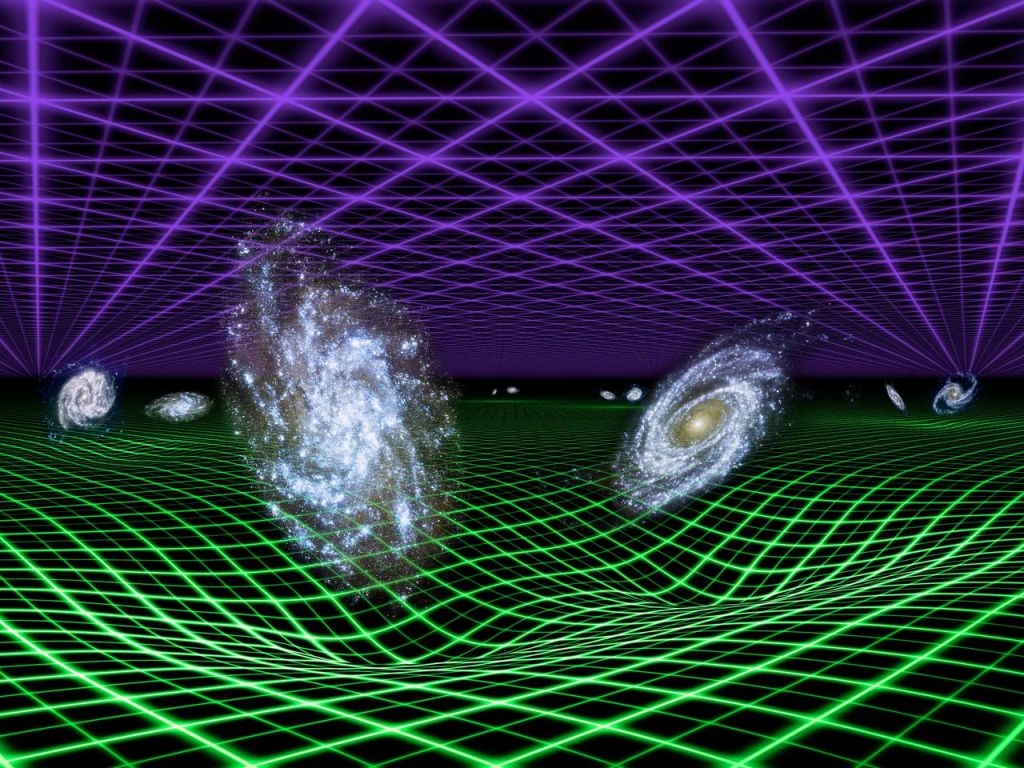
3. Loop Quantum Gravity: Geometry Without Background
Loop Quantum Gravity (LQG) represents one of the most direct attempts to formulate a quantum theory of gravity without relying on a background spacetime. Key physicists andarchitects of LQG are Carlo Rovelli and Lee Smolin.
Rather than treating space as a continuous arena in which events occur, LQG proposes that:
- space itself is quantized (not gravity itself)
- its structure is composed of discrete relational units
- these elements form networks (spin networks) describing relational geometry
In this framework:
- geometry is not given in advance
- it is constructed from the relations between nodes
- gravitational behavior arises from changes in this relational structure
- There is no background spacetime
- No gravitons are required, and
- Reality = events + relations
Whitehead's “actual occasions” ↔ nodes in a relational network."
Gravity, in the LQG sense, is not mediated by particles -
but is the dynamical evolution of geometric relations themselves.
*Note: In classical general relativity, “geometry” refers to the curvature of spacetime itself. In many contemporary approaches to quantum gravity, however, geometry is no longer taken as fundamental, but as something that emerges from deeper relational structures. In this context, “geometry” names not a pre-given arena, but the stabilized form of underlying relations.
Within a processual framework we get these several alignments:
- geometry = coherence made visible
- curvature = constraint of relation
- gravity = persistence of that constraint across scale
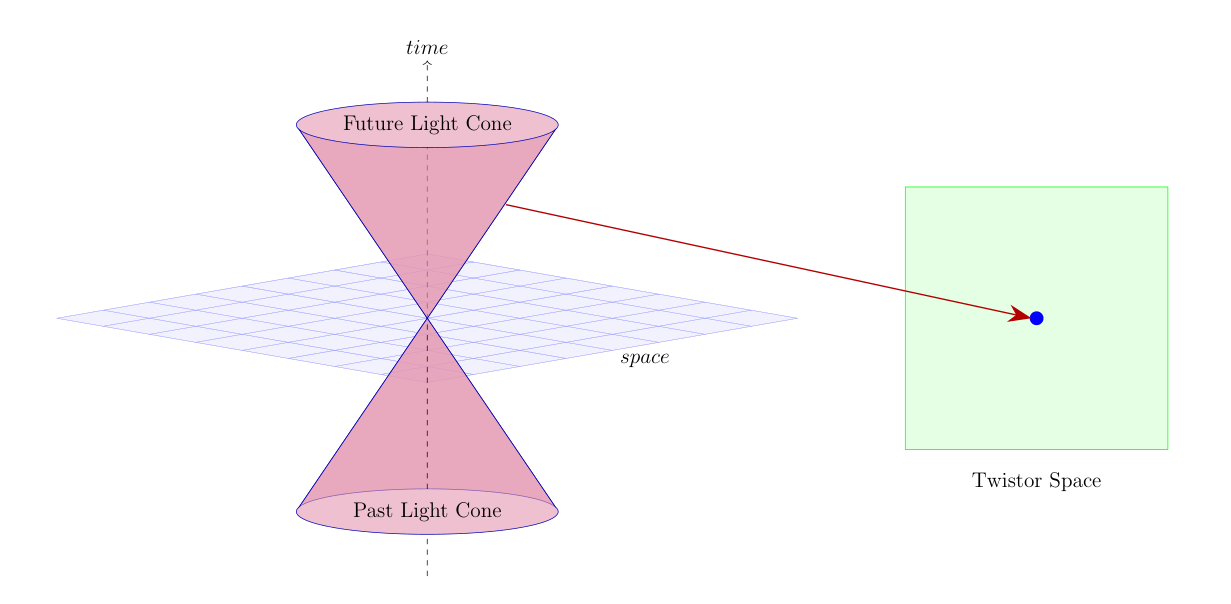

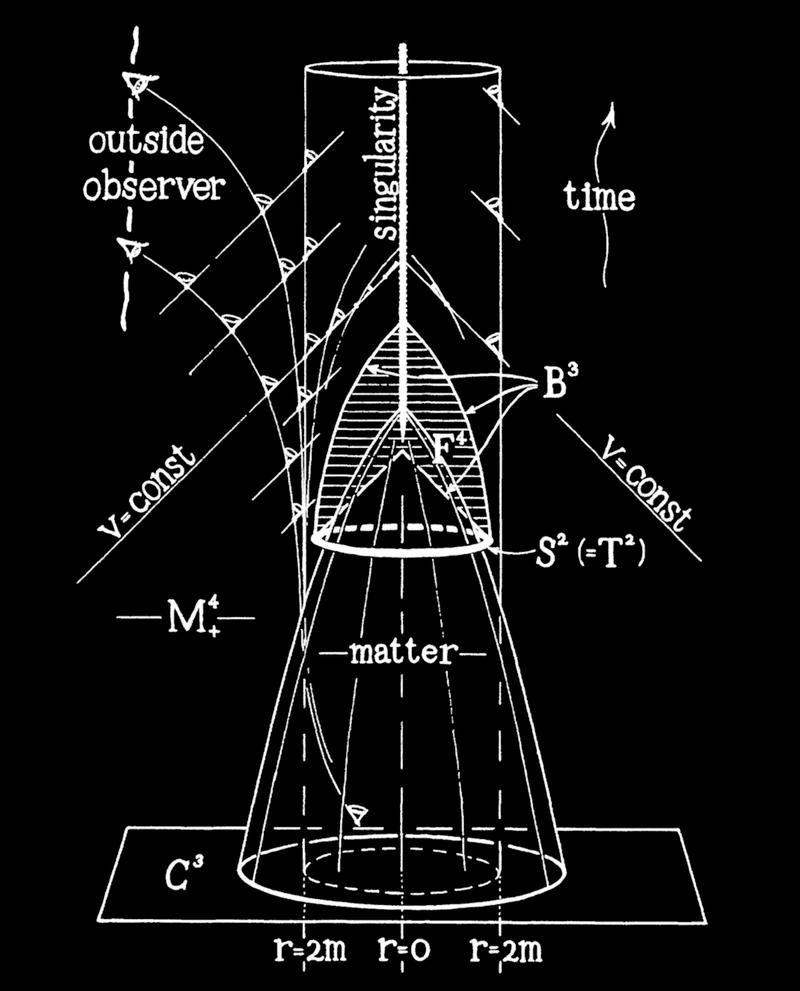
An even more radical proposal, developed by Roger Penrose, suggests that spacetime itself may not be the fundamental arena of reality. Instead, the basic structure of the universe may be encoded in a different kind of geometry—one defined not in spacetime, but in complex relational space known as twistor space.
In this framework:
- the fundamental elements are not particles or spacetime points
- but light-like relations encoded in complex geometry
- spacetime emerges as a derived construct
Gravity, in this view:
- does not arise from particle exchange
- but from nonlinear geometric structures within this deeper relational framework
Twistor theory thus represents:
- a shift from spacetime-based ontology
- to relation-based geometry
It suggests that:
what we perceive as spacetime—and its curvature—may be a secondary manifestation
of deeper relational structures encoded in a more fundamental mathematical domain
Causal Dynamical Triangulations (CDT) approaches the problem differently.
Instead of quantizing geometry directly, it:
- builds spacetime from discrete building blocks (simplexes)
- sums over possible configurations (path integrals)
- enforces causal structure as a constraint
Remarkably, when these configurations are aggregated, they produce:
- large-scale spacetime behavior
- structures resembling our observed universe
In CDT:
- spacetime is not assumed
- it is assembled from relational configurations
- macroscopic geometry emerges from microscopic combinatorics
6. Causal Set Theory: Order Without Geometry
Causal Set Theory takes relational thinking even further. It proposes that spacetime is fundamentally:
- a discrete set of events
- ordered by causal relations
There is:
- no continuous geometry at the base level
- no background spacetime
- only relations of “before” and “after”
From this minimal structure:
- spacetime geometry is expected to emerge
- distance and curvature become derived properties
Here, reality is not built from particles or fields, but from ordered relations themselves.
7. Asymptotic Safety: Structure Without Breakdown
Asymptotic Safety takes a different route. Asymptotic Safety, or "Structure Without Breakdown," refers to a quantum field theory approach to gravity where coupling constants do not diverge at high energies, but rather approach a non-Gaussian fixed point (NGFP). This creates a "safe" UV (high energy ultraviolet) completion of gravity without needing new, exotic ingredients.
Rather than abandoning field theory, it asks:
Can gravity remain a quantum field theory if treated non-perturbatively?
It proposes that:
- gravitational interactions approach a stable fixed point at high energies
- infinities can be controlled
- spacetime retains its dynamical character
While this approach still uses field-theoretic language, it shifts emphasis toward:
- global structural consistency
- scale-dependent behavior
- the stability of relational dynamics across energy regimes
It suggests that what matters most is not particle exchange, but the coherence of structure across scales.
- The Asymptotic Safety Paradigm for Gravity and Matter by Astrid Eichhorn: A comprehensive talk on how this paradigm goes beyond effective field theory.
- Asymptotically Safe Gravity! | with Aaron Held: Discusses why we need to quantize gravity and how asymptotic safety provides a potential solution.
- A fractal universe? Asymptotically safe quantum gravity: Explores the intriguing possibility that spacetime might have a fractal structure at tiny scales.
- The five most promising ways to quantize gravity by Sabine Hossenfelder: A broader overview that places Asymptotically Safe Gravity alongside String Theory and Loop Quantum Gravity.
- Is Quantum Gravity safe? | with Alessia Platania: An interview-style video discussing the safety of quantum gravity and its intersections with other theories
8. Convergence: Toward Relational Foundations
Gravity is not something acting on objects.
It is the way relations are stabilized across the universe.
Or more precisely:
Gravity is coherence expressed geometrically.
These approaches differ significantly in method and mathematics. They are not reducible to a single framework. Yet, they share several striking features:
- background independence (spacetime not assumed)
- relational construction (structure from relations)
- emergence (geometry arises, rather than precedes)
- de-emphasis of particle ontology
Taken together, they suggest that gravity may not originate in particles at all, but in the organization of relational structures across scale.
9. Interpretive Trajectory
At this point, a philosophical observation becomes increasingly difficult to ignore.
If:
- spacetime can emerge
- geometry can be constructed
- relations can precede objects
then the question is no longer simply how gravity works,
but:
what kind of ontology best accommodates such a universe?
Without forcing a conclusion, the direction is suggestive:
- not substance → interaction
- but relation → stabilization → structure
In this light, gravity may be understood not as something added to the universe, but as something arising from - the persistence and organization of relational coherence across scale
10. Transition
These theoretical pathways do not yet resolve quantum gravity. But they collectively indicate a shift:
- from particles to relations
- from background to emergence
- from force to structure
The next step is to examine the conceptual language through which this shift is being expressed:
- information
- entropy
- entanglement
- coherence
It is to these concepts - and their growing centrality in physics - that we now turn.
IV. Coda - Coherence and the Real
“What appears as spacetime curvature may be the macroscopic expression of deeper relational structures—patterns of coherence unfolding across the ontological fabric of the cosmos.”
Across contemporary physics, no single theory has yet resolved the problem of "quantum" gravity. The frameworks surveyed remain incomplete, provisional, and in many cases incompatible.
And yet, taken together, they exhibit a striking convergence. They suggest that:
- spacetime may not be fundamental
- geometry may be emergent
- systems may be defined by information and constraint
- relations may precede objects
- from particles to relations
- from background structures to emergent organization
- from interaction to constraint and coherence
In this light, the problem of gravity can be reconsidered. If gravity is not best understood as a particle-mediated force, then the question becomes:
what kind of underlying reality gives rise to gravitational behavior at all?
The answer suggested - though not yet formalized within a single theory - is that:
gravitational phenomena may arise from the large-scale organization and persistence of relational structures
That is:
- not from exchange
- but from coherence
that such a particle would itself participate in a broader relational structure whose persistence cannot be reduced to exchange alone
what is most fundamental is not the carrier, but the coherence within which any carrier could exist
From this perspective, a broader philosophical implication emerges. If contemporary physics increasingly describes reality in terms of:
- information
- entropy
- entanglement
- coherence
then realism itself must be reconsidered. Not abandoned - but reformulated.
We may state the emerging insight simply:
Reality is not fundamentally composed of independent entities, but of relational structures that persist through coherence across scale.
Within this framework:
- structure replaces substance as primary
- persistence replaces static existence
- relation replaces isolation
Thus, the movement traced in this essay marks not the conclusion of a theory, but the emergence of a possibility: of a realism grounded not in things, but in the enduring coherence of relations
If this is so, then the next task is not merely scientific, but ontological.
We must ask:
What would a realism look like if coherence - rather than substance - were taken as fundamental?
It is to this question that the next essay turns..
Quantum Gravity & Foundational Frameworks
Rovelli, Carlo. Quantum Gravity. Cambridge: Cambridge University Press, 2004.
Rovelli, Carlo. Reality Is Not What It Seems: The Journey to Quantum Gravity. New York: Riverhead Books, 2017.
Ambjørn, Jan, Jerzy Jurkiewicz, and Renate Loll. “The Universe from Scratch.” Contemporary Physics 47, no. 2 (2006): 103–117.
Loll, Renate. “Quantum Gravity from Causal Dynamical Triangulations: A Review.” Classical and Quantum Gravity 37, no. 1 (2020): 013002.
Bombelli, Luca, Joohan Lee, David Meyer, and Rafael Sorkin. “Space-Time as a Causal Set.” Physical Review Letters 59, no. 5 (1987): 521–524.
Sorkin, Rafael D. “Causal Sets: Discrete Gravity.” In Lectures on Quantum Gravity, edited by Andrés Gomberoff and Don Marolf, 305–327. New York: Springer, 2005.
Weinberg, Steven. “Ultraviolet Divergences in Quantum Theories of Gravitation.” In General Relativity: An Einstein Centenary Survey, edited by S. W. Hawking and W. Israel, 790–831. Cambridge: Cambridge University Press, 1979.
Reuter, Martin, and Frank Saueressig. Quantum Gravity and the Functional Renormalization Group: The Road Towards Asymptotic Safety. Cambridge: Cambridge University Press, 2019.
Bekenstein, Jacob D. “Black Holes and Entropy.” Physical Review D 7, no. 8 (1973): 2333–2346.
Hawking, Stephen W. “Particle Creation by Black Holes.” Communications in Mathematical Physics 43 (1975): 199–220.
’t Hooft, Gerard. “Dimensional Reduction in Quantum Gravity.” arXiv:gr-qc/9310026.
Susskind, Leonard. “The World as a Hologram.” Journal of Mathematical Physics 36, no. 11 (1995): 6377–6396.
Preskill, John. “Quantum Information and Physics: Some Future Directions.” Journal of Modern Optics 47, no. 2–3 (2000): 127–137.
Van Raamsdonk, Mark. “Building Up Spacetime with Quantum Entanglement.” General Relativity and Gravitation 42 (2010): 2323–2329.
Maldacena, Juan. “The Large N Limit of Superconformal Field Theories and Supergravity.” International Journal of Theoretical Physics 38 (1999): 1113–1133.
Swingle, Brian. “Entanglement Renormalization and Holography.” Physical Review D 86 (2012): 065007.
Ladyman, James, and Don Ross. Every Thing Must Go: Metaphysics Naturalized. Oxford: Oxford University Press, 2007.
French, Steven. The Structure of the World: Metaphysics and Representation. Oxford: Oxford University Press, 2014.
Kuhlmann, Meinard. “Quantum Field Theory.” In The Stanford Encyclopedia of Philosophy, edited by Edward N. Zalta.
Maudlin, Tim. Philosophy of Physics: Space and Time. Princeton: Princeton University Press, 2012.
Whitehead, Alfred North. Process and Reality. New York: Free Press, 1978.
Whitehead, Alfred North. Science and the Modern World. New York: Free Press, 1997.
Bergson, Henri. Creative Evolution. New York: Dover, 1998.
Rescher, Nicholas. Process Philosophy: A Survey of Basic Issues. Pittsburgh: University of Pittsburgh Press, 1996.
Seibt, Johanna. “Process Philosophy.” In The Stanford Encyclopedia of Philosophy, edited by Edward N. Zalta.
Prigogine, Ilya, and Isabelle Stengers. Order Out of Chaos. New York: Bantam Books, 1984.
Anderson, Philip W. “More Is Different.” Science 177, no. 4047 (1972): 393–396.
Wheeler, John Archibald. “Information, Physics, Quantum: The Search for Links.” In Complexity, Entropy, and the Physics of Information, edited by W. Zurek. Redwood City, CA: Addison-Wesley, 1990.
Zurek, Wojciech H. “Decoherence and the Transition from Quantum to Classical.” Physics Today 44, no. 10 (1991): 36–44.
- Materialism generally posits that matter is the fundamental substance of nature, and all things, including mind, arise from material interactions.
- Physicalism extends materialism to include forms of physicality beyond just "matter," such as energy, spacetime, physical laws, and forces, as described by physics.
- Processual Philosophy challenges both, arguing that reality is not made of "things" (substances) at all, but rather of processes, events, and continuous change (becoming).
- Fundamental Unit: Inert matter or substance.
- Core Belief: Everything that exists is either matter or dependent on matter for its existence.
- View of Mind: Consciousness is secondary, emerging from material interactions (often reducing mind to brain activity).
- Limitation: Historically, classical materialism struggled to explain non-solid phenomena like gravity or thoughts.
- Fundamental Unit: Entities and properties studied by physics (energy, forces, spacetime, fields).
- Core Belief: Everything "supervenes" on the physical—meaning no two possible worlds can be identical in their physical properties but differ in their mental or social properties.
- View of Mind: Mental states are identified with, or realized by, physical states.
- Difference from Materialism: While often used interchangeably, physicalism is considered more modern, embracing quantum mechanics and energy, whereas traditional materialism is tied to "solid" matter.
- Fundamental Unit: Processes, events, and relations rather than static substances.
- Core Belief: "Things" are artificial, static boundaries we impose on a dynamic, constantly changing world. Reality is a continuous unfolding ("becoming").
- Key Proponents: Alfred North Whitehead, Henri Bergson.
- Contrast with Others: Processual philosophy reinterprets the substantival assumptions of both materialism and physicalism by suggesting that what appears as stable “things” may be better understood as relatively enduring patterns within ongoing processes. As example, in process-relational ontology, entities (like a tree or forest) emerge from their relations.

- Neuroscience: The majority of neuroscientists operate under physicalist assumptions, treating the mind as a product of physical brain activity (neurons, chemical signals, and electrical impulses).
- Fundamental Physics: It easily accommodates quantum fields, dark matter, and spacetime curvature, which classical materialism struggled to explain.
- Key Concept: Supervenience. Scientists often assume that "higher-level" facts (like biological or psychological ones) "supervene" on physical facts - meaning you can't change the mind without changing the physical state of the brain.
- Theoretical Biology: In works like Everything Flows: Towards a Processual Philosophy of Biology, researchers argue that an organism is not a "thing" but a stable metabolic flow. This shift is helping scientists better understand cancer genetics, development, and evolution as dynamic systems rather than fixed blueprints.
- Quantum Theory: Some interpretations of physics (like Loop Quantum Gravity) suggest that the universe is made of events rather than "particles," making process philosophy a natural fit for describing the subatomic world.
- Environmental Ecosystems and Ecology: It provides a framework for viewing ecosystems as interconnected sequences of occurrences rather than a collection of separate species.
- Classical Engineering: When building bridges or engines, scientists still use a materialist framework because "matter in motion" remains an effective abstraction for 99.9% of macroscopic science.
- Methodological Materialism: Many scientists adopt materialism not as a final truth, but as a method. They look for material causes because they are empirically testable, even if they suspect the underlying reality might be more complex.

