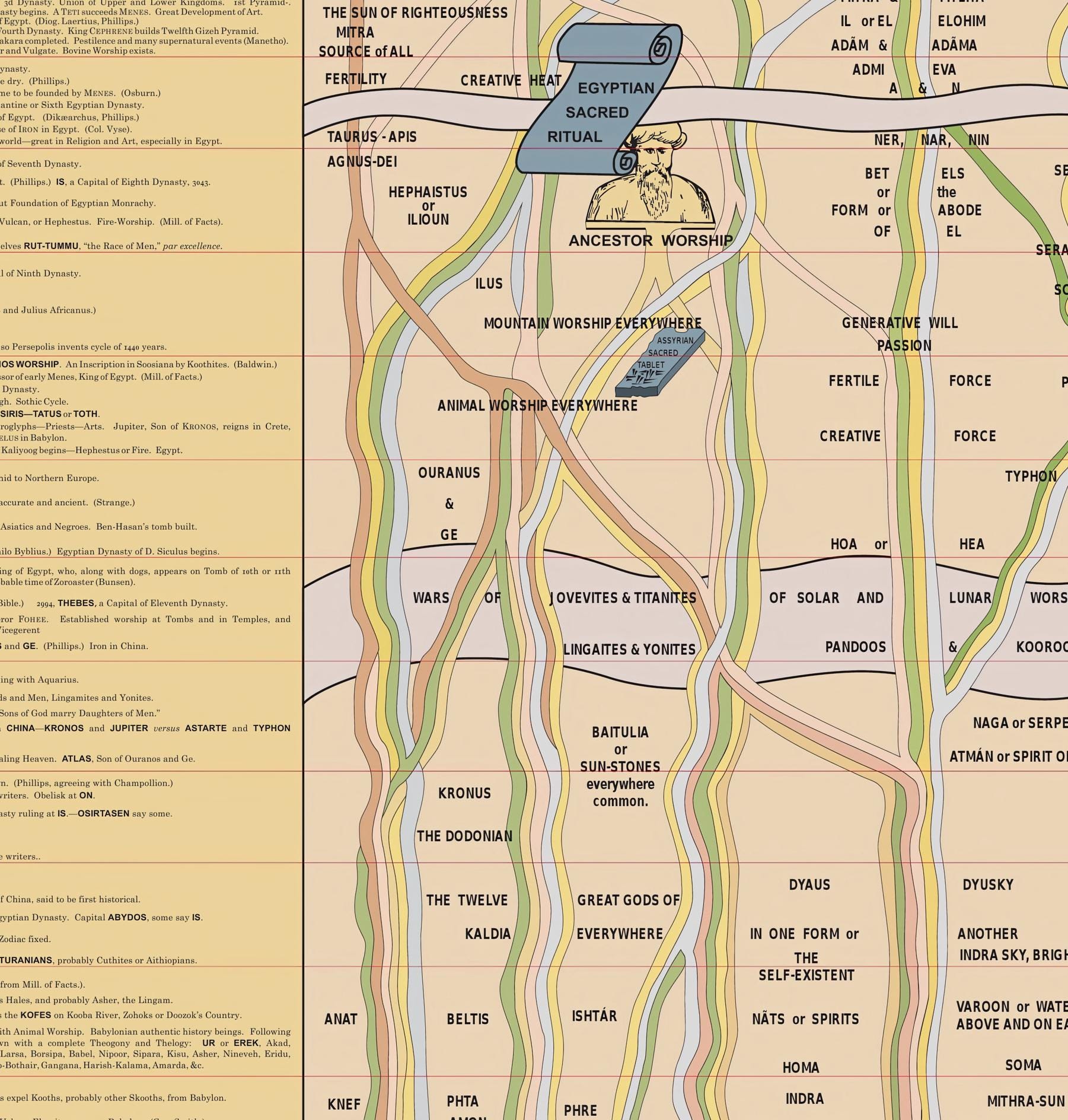
The Evolution of Worship & Religion traces humanity's long search for meaning, transcendence, identity, community, and the sacred.
Beginning in the early prehistories of mankind and moving through the great civilizations of Mesopotamia, Egypt, Israel, India, Greece, Christianity, modernity, and beyond, this series explores how religious ideas emerged, evolved, flourished, fragmented, and continue to transform.
The essays which follow are accompanied by supplementary studies, historical investigations, theological reflections, and processual reconstructions designed to help readers navigate the complex history of faith, culture, scripture, philosophy, and society.
Evolution of Worship & Religion
The Historical Journey of Religion from Prehistory to the Contemporary World
The Evolution of Worship & Religion traces humanity's long search for meaning, transcendence, identity, community, and the sacred. Beginning in prehistory and moving through the great civilizations of Mesopotamia, Egypt, Israel, India, Greece, Christianity, modernity, and beyond, the series explores how religious ideas emerged, evolved, flourished, fragmented, and continue to transform.
Part historical survey, part cultural history, and part philosophical reflection, these essays examine the development of worship, mythology, scripture, theology, and religious institutions across more than ten thousand years of human experience. Throughout, the series seeks to understand religion not as a static phenomenon, but as a dynamic and evolving response to humanity's encounter with reality, meaning, and the mystery of existence.
INTRODUCTION
- Prequel - The Evolution of Worship & Religion
- Introduction
- Maps, Tables & Data
- A Proposed Outline
- Resources
PART I - FOUNDATIONS: THE BIRTH OF THE SACRED
The earliest religious impulses emerged long before written history. This section explores humanity's first experiences of ritual, symbolism, kinship, animism, and sacred presence, tracing the foundations from which later religious traditions would arise.
- Prequel - Before History: Humanity in the Long Dawn of Becoming
- Essay 1 - Animism and the Living Cosmos
- Essay 2 - From Tribe to Totem
PART II - THE AGE OF GODS
As civilizations grew, so too did their pantheons. The sacred became increasingly organized through temples, priesthoods, myths, kingship, and divine hierarchies. These essays examine the great religious cultures of the ancient world and the emergence of the gods who shaped human imagination for millennia.
- Essay 3 - The Mesopotamian Fertile Crescent
- Essay 4 - Egypt, Indus, and Minoa Sacred Cultures
- Essay 5 - From Polytheism to Henotheism
PART III - AXIAL AWAKENINGS
Between roughly 800 and 200 BCE, many civilizations experienced profound intellectual, philosophical, and religious transformations. Ancient assumptions were challenged as new visions of morality, transcendence, reason, and human purpose emerged.
- Essay 6 - Ancient Israel, Persia, and Monotheism
- Essay 7 - India's Axial Age
- Essay 8 - Greece and the Birth of Reason
PART IV - THE SACRED MADE UNIVERSAL
The local gods of tribes and nations gradually gave way to religious traditions claiming universal significance. This section explores the emergence of world religions, the challenges of modernity, and the continuing transformation of faith in an increasingly interconnected world.
- Essay 9 - The Age of Universal Religions
- Essay 10 - Modernity and the Eclipse of the Sacred
- Essay 11 - The Rebirth of the Sacred
PART V - A PROCESSUAL SUMMATION
The final essays draw together the themes developed throughout the series and explore their implications for contemporary faith, theology, ethics, and spiritual formation.
- Essay 12 - A Processual Summation of Worship and Religion
- Essay 13 - The Way of Cruciformity: When God Refused Power
- Essay 14 - Messiah: From Anointed Saviour to Suffering Sacred
- Essay 15 - Becoming Aligned with the Sacred
PART VI - SUPPLEMENTARY STUDIES
The following companion studies expand upon key historical, linguistic, textual, theological, and comparative themes introduced throughout the series.
Ancient Near Eastern Studies
Israel and the Ancient Near East
SM 4 - How the Ancient Near East Gave Shape to Israel's God:
- Why the ANE is Essential for Israel's Received Theology (I-II)
- Affecting Cultic Syncretism Across the Ancient Near East (III-V)
- Cultural Identity Formation & the Rejection of Syncretism (VI-IX)
Biblical Formation and Transmission
SM 5 - The History & Compilation of the Hebrew Bible:
- From Oral Memory to Proto-Canon (I-II)
- Exile, Redaction, and the Birth of Scripture (III)
- Second Temple Scribalization to Canonization (IV-V)
Second Temple Scribalization and Canonization
Bible Versions, Variants, and Their Histories
Theological and Comparative Studies:
From Ancient Plurality to Modern Certainty:
The journey continues in the Companion Essays to The Evolution of Worship & Religion, where themes of myth, philosophy, scripture, theology, cosmology, and ethics are explored in greater depth through a process-relational lens.

Companion Essays to the
"Evolution of Worship & Religion"
These companion studies extend the themes explored in the Evolution of Worship & Religion. Together they trace a broad intellectual journey from the mythological worlds of antiquity to contemporary questions of faith, scripture, theology, cosmology, ethics, and human flourishing.
The movement follows a historical and philosophical progression:
Outline
Myth → Philosophy → Faith → Scripture → Church → Cosmos → Theology → Ethics
Ancient religion → Greek critique → Christian reconstruction → Biblical history →
Ecclesial critique → Process metaphysics → Process theology → Process ethics
FROM MYTH TO PHILOSOPHY
Beginning in the Late Bronze Age world of Mycenaean civilization (c. 1600–1200 BCE), this study traces the evolution of Greek religious imagination from the heroic myths and divine pantheons preserved in Homeric tradition, through their composition and collection during the Greek Archaic Age (c. 750–500 BCE), and ultimately to the rise of Greek philosophy in the works of Socrates, Plato, and Aristotle (c. 470–322 BCE).
Together, these essays explore one of history's great intellectual transformations: the movement from mythic explanations of reality toward philosophical inquiry, skepticism, and reasoned reflection on the nature of gods, humanity, and the cosmos.
Here, we trace the long journey from the sacred myths of gods and heroes to the emergence of philosophy, skepticism, and reasoned inquiry, as Greek thinkers increasingly questioned the divine stories that had once explained the world.
FROM CERTAINTY TO FAITH
If ancient philosophy challenged inherited mythologies, modernity and postmodernity challenged inherited certainties. Yet the collapse of certainty need not result in the collapse of faith.
These essays explore how religious belief might be reconstructed after modern skepticism, scientific naturalism, postmodern deconstruction, and contemporary doubt. Rather than returning to older forms of certainty, they seek new possibilities for faith within an open, relational, and evolving world.
- A Process Theology for a Metamodern Age (4)
- A Process Theology for a Metamodern Age (5)
- A Process Theology for a Metamodern Age (6)
- A Process Theology for a Metamodern Age (7)
SCRIPTURE, MESSIAH, AND MEMORY
Religious traditions are sustained not only through belief, but through memory, narrative, scripture, and interpretation. These studies examine the development of biblical traditions, messianic expectations, and early Christian understandings of Jesus using Isaiah 53.
- A Study of Isaiah 53 (1)
- A Study of Isaiah 53 (2)
- A Study of Isaiah 53 (3)
- The Beatitudes and Their Grammar of Love
- Between Tomb and Morning (an Easter Prayer)
- Mark's Message - "The Oddity of a Crucified Messiah"
THE BIBLE THROUGH HISTORY
The Bible did not emerge fully formed. Rather, it developed through centuries of oral tradition, scribal activity, textual transmission, translation, interpretation, and theological reflection.
These essays explore the historical formation of scripture and the diverse communities that shaped its preservation and meaning.
- An Introduction to Modern Scholarship
- The Formation of Sacred Texts
- Christianity's Many Voices
- The Church's Memory, Deconstruction, and Future of Its Faith
- Textual Criticism, Archaeology, and the Rediscovery of Ancient Beliefs
- Reconstructing Christianity Politically and/or Ethically
THE CHURCH, POWER, AND PUBLIC WITNESS
Religious institutions often struggle between faithfulness and power, conviction and coercion, witness and ideology.
These essays critically examine biblical authority, ecclesial identity, nationalism, war, and the challenges facing Christianity in the modern world.
- Closed Biblical Texts Produce Closed, Caustic Worlds (1)
- Diagnosing the Chicago Statement on Biblical Inerrancy (2)
- Divine Authority Reconsidered: What Is Meant by "Biblical Authority?" (3)
- When Christianity Forgets Christ & Witness Becomes Propaganda
- Five Reasons a "Just War Theology" Isn't Faithful to the Gospel
- Four Christians. Four Conversations. One Faith.
COSMOS, REALITY, AND DIVINE BECOMING
The story of religion eventually encounters larger questions concerning reality itself. What kind of universe do we inhabit? Is consciousness fundamental or emergent? Does reality possess value, direction, or meaning?
These essays explore cosmology, metaphysics, consciousness, and the nature of becoming within a process-relational universe.
- An Awakening Universe - Cosmology and Consciousness (42)
- A Cosmic Metaphysic - Of Origins and Futures (43)
- A Universe of Value (44)
- The Universe as Divine Process (45)
THE SACRED COSMOS
If reality is fundamentally relational, creative, and participatory, then theology must be reconsidered in light of that vision.
These studies explore a processual understanding of divinity emerging from the world itself rather than descending from beyond it.
SACRED ETHICS AND CULTURE
Ideas ultimately return to practice. How shall we live within an open, relational, evolving universe?
These essays explore ethics, culture, cooperation, sustainability, and human flourishing within a processual vision of reality.
- Ethics I – On Faith, Scripture, and the Refusal of Certainty
- Ethics II – Cohesion in a Fragmenting Age
- Ethics III – Toward Sustainable Futures
- Ethics IV – Living Within Processual Reality
The journey continues...

 |
| Re-illustrated Chronologically by ChatGPT |