 |
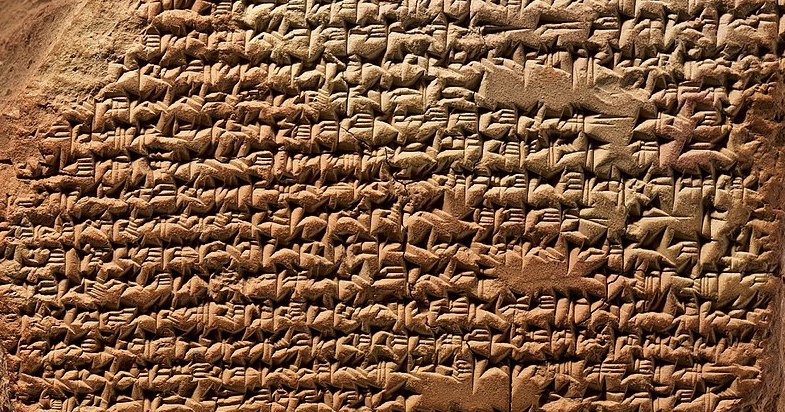
| Sumerian script on a cunneiform tablet |
Supplementary Materials
Part VI, SM 3
How the Ancient Sumerians Created
the World’s First Writing System
Bartle Bull on the Mesopotamian
Origins of Modern Civilization
by Bartle Bull
November 22, 2024
“In Uruk he built walls, a great rampart, and the temple of blessed Eanna for the god of the firmament Anu, and for Ishtar the goddess of love. Look at it still today: the outer wall where the cornice runs, it shines with the brilliance of copper; and the inner wall, it has no equal. Touch the threshold, it is ancient.”
–The Epic of Gilgamesh, ca. 1750 BC
In the middle of the fourth millennium before Christ, men and women could feed themselves and their families, much of the time, but almost nobody else. They did not yet have the wheel. They could fight, but they did not have the capacity to make war. They could not read or write, for there was no writing. Without writing, there was no history. There were stories but no literature. Art was something that people might produce on their pottery, but never for a living. There were customs but no laws. There were chiefs but no kings, tribes but no nations. The city was unknown.
And then, around that time, civilization was born: urban life, based on nutritional surplus and social organization, characterized by complexity and material culture, much of it made possible by writing. This happened in a very particular part of the world: the flood-prone, drought-wracked, frequently pestilential plain of southern Iraq, where the rivers Tigris and Euphrates meet the Persian Gulf. The plain could be fertile, very fertile, but only when people worked together to irrigate it and control the floods with channels and earthworks; this necessity, most likely, accounts for much of the early surge in social complexity that distinguished the area. Later civilizations would arise independently in two great river valleys not so far away, the Indus and the Nile, but the original organized, literate, urban culture was produced by a far crueler and more challenging environment than either of those.
The need for a single script to serve a geography using two such dissimilar languages almost interchangeably was a great spur to the development of early Mesopotamian writing.
This first civilization came to be known as Sumer. By about the year 3000 BC, a city called Uruk near the mouth of the Euphrates River, just inland of the head of the Persian Gulf, had eighty thousand residents. A thousand years later Iraq, the land along the Euphrates and its sister stream, the Tigris, would be named for this early metropolis of Uruk. Sharing the land of Sumer, about the size of Belgium, with a dozen other city-states, Uruk was not always the foremost among its rivals in the land. But for most of its existence, spanning the two millennia of the Sumerian world, Uruk was the greatest city on earth.
The Sumerians invented kingship, priesthood, diplomacy, law, and war. They gave the West its founding stories: the opposition of darkness and light at the Beginning; the Flood, with its ark and dove and surviving patriarch; the tower of Babel; the distant ancestors of Odysseus and Hercules. The Sumerians established the outlines of our political, legal, and temporal structures too, with the first kings and assemblies, the first written laws, the first legal contracts, and the sexagesimal system of counting that regulates the hours and seconds of our days.
The Sumerians wrote the first epics and constructed the first monumental buildings. They invented the wheel, the sailing boat, the dome, and the arch. They were the first people to cast, rivet, and solder metals. They were the first to develop mathematics, calculating the hypotenuse of a right triangle two thousand years before Pythagoras and enabling extraordinary achievements in civil engineering. Compiling methodical lists of plants and animals, the Sumerians were the first people to apply rational order to our knowledge of the natural world.
The Sumerians wrote down almost everything they knew, much of it on disposable clay tablets that have survived the millennia. Some thirty-nine centuries after the last of the Sumerians died, another inventive and curious people, the Victorians of the nineteenth century AD, initiated a remarkable period of foreign exploration in Iraq. Thanks to this colorful and dramatic intellectual adventure, which began in the 1840s, today we can follow the course of Sumerian lawsuits, track Sumerian inventories, and study the terms of Sumerian marriages, wills, and loans. We read the overtures of Sumer’s diplomats. We follow in detail the provisioning of Sumer’s armies and the triumphs or disasters of their expeditions. We know intimately the pleadings of Sumerian students for more money from their fathers, and the pleadings of their fathers for more diligence from their sons. We track the transactions of Sumerian merchants in copper or onions. We admire the complex and perfect calculations of Sumerian engineers.
Human life on the alluvial plain of the two rivers at the birth of civilization five thousand years ago was precarious. Again and again, through the ancient stories and archaeological records that illuminate the dawn of history, plagues and pestilence swept the hot, low country. Terrifying floods killed and destroyed everything within reach of the raging waters that came every spring when the snow melted in the mountains five hundred miles and more to the north, in what is now Armenia and southeast Turkey. At Ur in Sumer’s far south, the great archaeologist Sir Leonard Woolley, digging in 1929, discovered a layer of “perfectly clean clay” more than eight feet thick separating the remains—pottery and much more—of two distinct cultures from some time before 3000 BC. A single flood, in other words, had created a temporary lake that deposited this eight-foot-thick layer. The catastrophic scale of such a deluge is almost beyond the powers of imagination. Woolley naturally surmised that it was the great flood of Genesis. Other floods have left similar records in southern Iraq. Most were smaller than Woolley’s Ur deluge. One left eleven feet of new flood soil.
Meanwhile neighbors from the higher, rougher country to the east, north, and west were greedy for the wealth of the settled plain, then as now. The invasions of barbarians from the Persian hill country, the Kurdish and Turkish mountains, and the Arabian steppe sometimes paused, but never ended. Within Sumer, Uruk and its neighboring city-states fought against each other almost constantly during the twenty-odd centuries of Sumerian civilization.
The soil of southern Iraq is a dusty, flinty accumulation of silt from the two shifting rivers that originate far to the north. In the areas where Iraq’s alluvial soil is not dry, it is marshy, especially in the south; it was more so in ancient times, when the Tigris and Euphrates were bigger. The ground is home to no minerals or ores, although bitumen seeps from the earth in places. The land contains no stones for building. Almost no tree, aside from the date palm, grows on it successfully. Trade with the far-off source-lands of raw materials—for tin and copper to alloy into bronze for weapons, for gold and silver to please the rich and the divine, for hardwood timbers for the roof beams of palaces and temples—required the pooling of resources. Organization and leadership were required to conduct commerce at scale with places as far afield as Anatolia for tin, Lebanon for cedar timbers, “Oman for copper, south-west Iran for carved stone bowls, eastern Iran for lapis lazuli, the Indus for carnelian.”
*
The water of the two great rivers irrigated the rainless plain. It also raged as a violent killer, to be restrained with dykes and channels. This required cooperation on a much larger scale than the individual village or town could offer. Better irrigation led to increasing harvests. As the land of Sumer became crowded with more and more people, food was another reason for increasingly sophisticated social arrangements. Each of these catalysts—trade, water, sustenance—also led to humanity’s first organized conflicts. War was born. Every Sumerian city had its own principal deity, and the many gods also sent men into their earliest battles there on the hot plain.
*
Late in the fourth millennium BC, a couple of thousand years after the advent of agriculture with the Neolithic revolution, Sumer was one of several distinct cultures around the world. In none of these cultures had true urban life and, with it, civilization yet developed. Then the Sumerian genius produced its greatest innovation: writing.
The eighty thousand people living in Uruk by 3000 BC sheltered behind walls that were forty feet high and six miles long. Archaeologists estimate these to have cost over five million man-hours to build. The fourth-millennium city occupied about 1.7 square miles, a little bit less than imperial Rome at its peak (2.1 square miles) and larger than classical Athens.At the archaeological site of Uruk, the residential buildings, workshops, and barracks have not yet been excavated. Thus it is still the case that “very little about the actual conditions of life in the city is known.” Yet this is certain: Uruk was the world’s only major city of the fourth millennium BC, marked by public buildings that were “unprecedented and unrivaled at the time.” Most of the labor for such civic projects in Sumer came from free laborers requiring recompense for their work. Trade in livestock and agricultural produce fed them and the residents of nearby towns. The Sumerians needed a way to keep track of it all. This was the setting in which writing was born.
The earliest writing and the earliest direct precursors of writing, all from the second half of the fourth millennium, have been found at Uruk. Initially, clay tokens the size of a thimble would be formed to represent the sorts of things that a person might own and trade, such as sheep. For convenience, these tokens would then be put into a larger, hollow clay ball a little smaller than a grapefruit. These clay spheres, called “bullae,” served as something like sealed wallets or envelopes for the information within. On its exterior, the bulla would then be impressed with authenticating marks from cylindrical seals rolled upon the clay surface.
At Uruk some of these bullae have been found with additional marks impressed onto their surfaces. These marks indicated the number of tokens contained inside. It was an obvious step. The next step then suggested itself. With the contents marked on the exterior, there was no need for the little tokens rattling around inside. By 3300 BC, the information was instead simply scratched onto the surface of the spheres. The Sumerians had invented writing.
It is the only invention that has ever rivaled that of agriculture for its transformational effect upon human existence. Eventually flat clay tablets replaced the bullae.
At this stage writing was almost purely pictographic. Characters signified their objects through more or less recognizable images. Any given pictograph might mean several different things. “Mountain”—a right-side-up pyramid formed by three convex half circles—also meant “foreign lands,” for Sumer was completely flat. Consequently the same character also signified “conquest.” Shown together with the symbol for “woman,” a downward-pointing triangle with a notch at the bottom tip, the two symbols meant a woman captured from far away: “slave-woman.”
Pictographs were originally drawn on wet clay with a sharp-pointed object. Clay was an ideal medium for the Sumerians. It was cheap and abundant on the floodplain. Clay tablets were easy to make and prepare, although it is still not known how the larger ones were kept wet and impressionable. Sumerian scribes eventually wrote for the most part as we do, from left to right, top to bottom.
A typical tablet might be two to three inches high and half again as wide, with writing often going all the way to the margins. Incisions toward the bottom of archaic Iraq’s writing tablets tend to be visibly less deep and clear than those at the top of tablets, as the drying clay became harder to work. Once the inscribed clay had dried in southern Mesopotamia’s hot sun, it would endure for scores of centuries, and possibly forever, if left somewhere still and dry. Tablets made from such cheap and ubiquitous material were easily discarded once no longer needed. To the delight of archaeologists dozens of centuries later, they were thrown into heaps or used to fill the spaces beneath floors.
The original pictographs were for the most part recognizably indicative of something physical: a plow or a mountain, a head or a hand. But clay as a two-dimensional medium is ill-suited to both detail and curves. Around the year 2900, scribes discovered that impressing a sequence of lines with a straight-edged implement such as a cut reed was easier than tracing with a pointed implement. Reeds are flat, with a spine along one edge. Thus the mark made by each impression of the cut-off reed comprised a straight line with a wedge at its tip. By 2100, Sumerian scribes possessed a fast, well-developed script. Almost four thousand years later, in 1700 AD, cuneiform was named after the Latin word for wedge, cuneus, by the court interpreter of Eastern languages at the court of William III of England.
The rigid straight lines of the new technique pushed the characters away from the representational and toward the symbolic and the stylized. As centuries passed, the pictographs lost their illustrational quality. They were now “ideographs.” “Mountain,” for example, became three semicircles. By 2500 BC the recognizably representational had disappeared.
Here was the evolution from the ideographic to the phonetic. The impact was revolutionary. The boundaries of writing were now as infinite as those of speech.
A representational writing system has significant limitations. It is not practical to have a symbol for everything. The symbols must mean the same to all who use the writing. Users must memorize thousands of these symbols and must also be familiar with that which is being expressed. Tenses, cases, and voices are mostly impossible to depict. In the first centuries of writing, an image illustrating a foot meant “walk,” “stand up,” “ground,” “foundation,” and more besides simply “foot.” This made things difficult enough, but how would one say, “She will walk”? Or, worse, “Will she walk?” or “How will she have walked?” The ideographic method also had great limitations, as it connected writing not to words themselves, but rather to whatever it was that the words expressed. Ideographic writing bypassed spoken language, in other words. Restricted to known events and objects, unconnected to the spoken word, such a system can never cover all that language covers.
The next great innovation in the development of writing derived from puns. Early in the third millennium before Christ, Sumerian scribes perceived that homophones allowed them greatly to expand the verbal territory covered by the symbols they had mastered. For example, the Sumerians originally lacked a pictograph for their word sum, “to give.” To signify “give” in writing they used the pictograph for another word (“garlic”) that also was pronounced “sum.” In English such a visual pun is called a rebus. We might remember these from school. The picture of an eye next to that of a reed is one such, challenging us to remember dimly, the Sumerians with the sentence “I read.”
With this development, writing was now attached to sounds, to the “signifier” and not the “signified.” By the time of what is known as the Old Babylonian period, about 1500 BC, the Sumerian discovery of the power of paronomasia had helped the Uruk period’s written lexicon of two thousand characters halve in number, even as it covered more meaning. Writing was more accessible. During the Old Babylonian period even a king might be able to read, where hitherto that skill had been largely the province of scribes.
*
Shortly after the earliest development of writing, an ominous cloud appeared on Sumer’s northern horizon: a people called the Akkadians. In contrast to the native Sumerians, the Akkadians were Semitic pastoralists living in what came to be known as the Arabian Desert, the huge, dry steppe to the south and west of the Mesopotamian floodplain. By about 3000 BC, the Akkadians had moved eastward out of the desert. They settled north of Sumer in the part of Iraq that later came to be known as Babylonia.
The Sumerians and Akkadians lived next to each other for a thousand years. The two peoples mixed and fought constantly. There was a great degree of bilingualism, and all manner of sharing between the two languages over time. But the Sumerian and Akkadian tongues are entirely different. How, in such a setting, might a Sumerian scribe record the name of an Akkadian merchant? The need for a single script to serve a geography using two such dissimilar languages almost interchangeably was a great spur to the development of early Mesopotamian writing. Eventually the increasingly cosmopolitan quality of life on the Mesopotamian floodplain would force the script to make itself usable by people of different tongues.
The demands of the emerging southern Mesopotamian sprachbund required that the script deliver more and more of the nuances of speech. With writing no longer able to ignore spoken language, a crucial change happened. Most of writing’s symbols came to represent not meaning—an object, activity, or idea, for example—but rather sound. Here was the evolution from the ideographic to the phonetic. The impact was revolutionary. The boundaries of writing were now as infinite as those of speech. Once the Sumerian script became phonetic, the civilization that cuneiform defined would spread until it reached from Iran to the Mediterranean and from the Persian Gulf to Anatolia.
*Excerpted from Land Between the Rivers: A 5,000-Year History of Iraq by Bartle Bull. Copyright © 2024 by Bartle Bull. Reprinted with the permission of the publisher, Atlantic Monthly Press, an imprint of Grove Atlantic, Inc. All rights reserved.
__________________________________
 |
| amazon link |
The epic, five millennia history of the region between the Tigris and Euphrates Rivers that was the birthplace of civilization and remains today the essential crossroads between East and WestAt the start of the fourth millennium BC, at the edge of historical time, civilization first arrived with the advent of cities and the invention of writing that began to replace legend with history. This occurred on the floodplains of southern Iraq where the great rivers Tigris and Euphrates meet the Persian Gulf. By 3000 BC, a city called Uruk (from which “Iraq” is derived) had 80,000 residents. Indeed, as Bartle Bull reveals in his magisterial history, “if one divides the 5,000 years of human civilization into ten periods of five centuries each, during the first nine of these the world’s leading city was in one of the three regions of current day Iraq”—or to use its Greek name, Mesopotamia.Inspired by extensive reporting from the region to spend a decade delving deep into its history, Bull chronicles the story of Iraq from the exploits of Gilgamesh (almost certainly an historical figure) to the fall of the Iraqi monarchy in 1958 that ushered in its familiar modern era. The land between the rivers has been the melting pot and battleground of countless outsiders, from the Akkadians of Hammurabi and the Greeks of Alexander to the Ottomans of Suleiman the Magnificent. Here, by the waters of Babylon, Judaism was born and the Sunni-Shia schism took its bloody shape.Central themes play out over the millennia: humanity’s need for freedom versus the co-eternal urge of tyranny; the ever-present conflict and cross-fertilization of East and West with Iraq so often the hinge. We tend to view today’s tensions in the Middle East through the prism of the last hundred years since the Treaty of Versailles imposed a controversial realignment of its borders. Bartle Bull’s remarkable, sweeping achievement reminds us that the region defined by the land between the rivers has for five millennia played a uniquely central role on the global stage.

Bartle Bull has written from the Middle East for the New York Times, Washington Post, Wall Street Journal, Financial Times, Daily Telegraph, Foreign Policy, Die Welt, and other publications. He is the only western journalist to have been embedded with the Mahdi Army in Iraq. He sits on the Visiting Committee of the Department of Ancient Near Eastern Art at the Metropolitan Museum in New York City. His 2017 Showtime documentary film Cradle of Champions, following three young athletes competing in the world’s oldest amateur boxing tournament, received numerous awards and rave reviews.


No comments:
Post a Comment