Quotes & Sayings


We, and creation itself, actualize the possibilities of the God who sustains the world, towards becoming in the world in a fuller, more deeper way. - R.E. Slater

There is urgency in coming to see the world as a web of interrelated processes of which we are integral parts, so that all of our choices and actions have [consequential effects upon] the world around us. - Process Metaphysician Alfred North Whitehead

Kurt Gödel's Incompleteness Theorem says (i) all closed systems are unprovable within themselves and, that (ii) all open systems are rightly understood as incomplete. - R.E. Slater

The most true thing about you is what God has said to you in Christ, "You are My Beloved." - Tripp Fuller

The God among us is the God who refuses to be God without us, so great is God's Love. - Tripp Fuller

According to some Christian outlooks we were made for another world. Perhaps, rather, we were made for this world to recreate, reclaim, redeem, and renew unto God's future aspiration by the power of His Spirit. - R.E. Slater

Our eschatological ethos is to love. To stand with those who are oppressed. To stand against those who are oppressing. It is that simple. Love is our only calling and Christian Hope. - R.E. Slater

Secularization theory has been massively falsified. We don't live in an age of secularity. We live in an age of explosive, pervasive religiosity... an age of religious pluralism. - Peter L. Berger

Exploring the edge of life and faith in a post-everything world. - Todd Littleton

I don't need another reason to believe, your love is all around for me to see. – Anon

Thou art our need; and in giving us more of thyself thou givest us all. - Khalil Gibran, Prayer XXIII

Be careful what you pretend to be. You become what you pretend to be. - Kurt Vonnegut

Religious beliefs, far from being primary, are often shaped and adjusted by our social goals. - Jim Forest

We become who we are by what we believe and can justify. - R.E. Slater

People, even more than things, need to be restored, renewed, revived, reclaimed, and redeemed; never throw out anyone. – Anon

Certainly, God's love has made fools of us all. - R.E. Slater

An apocalyptic Christian faith doesn't wait for Jesus to come, but for Jesus to become in our midst. - R.E. Slater

Christian belief in God begins with the cross and resurrection of Jesus, not with rational apologetics. - Eberhard Jüngel, Jürgen Moltmann

Our knowledge of God is through the 'I-Thou' encounter, not in finding God at the end of a syllogism or argument. There is a grave danger in any Christian treatment of God as an object. The God of Jesus Christ and Scripture is irreducibly subject and never made as an object, a force, a power, or a principle that can be manipulated. - Emil Brunner

“Ehyeh Asher Ehyeh” means "I will be that who I have yet to become." - God (Ex 3.14) or, conversely, “I AM who I AM Becoming.”

Our job is to love others without stopping to inquire whether or not they are worthy. - Thomas Merton

The church is God's world-changing social experiment of bringing unlikes and differents to the Eucharist/Communion table to share life with one another as a new kind of family. When this happens, we show to the world what love, justice, peace, reconciliation, and life together is designed by God to be. The church is God's show-and-tell for the world to see how God wants us to live as a blended, global, polypluralistic family united with one will, by one Lord, and baptized by one Spirit. – Anon

The cross that is planted at the heart of the history of the world cannot be uprooted. - Jacques Ellul

The Unity in whose loving presence the universe unfolds is inside each person as a call to welcome the stranger, protect animals and the earth, respect the dignity of each person, think new thoughts, and help bring about ecological civilizations. - John Cobb & Farhan A. Shah

If you board the wrong train it is of no use running along the corridors of the train in the other direction. - Dietrich Bonhoeffer

God's justice is restorative rather than punitive; His discipline is merciful rather than punishing; His power is made perfect in weakness; and His grace is sufficient for all. – Anon

Our little [biblical] systems have their day; they have their day and cease to be. They are but broken lights of Thee, and Thou, O God art more than they. - Alfred Lord Tennyson

We can’t control God; God is uncontrollable. God can’t control us; God’s love is uncontrolling! - Thomas Jay Oord

Life in perspective but always in process... as we are relational beings in process to one another, so life events are in process in relation to each event... as God is to Self, is to world, is to us... like Father, like sons and daughters, like events... life in process yet always in perspective. - R.E. Slater

To promote societal transition to sustainable ways of living and a global society founded on a shared ethical framework which includes respect and care for the community of life, ecological integrity, universal human rights, respect for diversity, economic justice, democracy, and a culture of peace. - The Earth Charter Mission Statement

Christian humanism is the belief that human freedom, individual conscience, and unencumbered rational inquiry are compatible with the practice of Christianity or even intrinsic in its doctrine. It represents a philosophical union of Christian faith and classical humanist principles. - Scott Postma

It is never wise to have a self-appointed religious institution determine a nation's moral code. The opportunities for moral compromise and failure are high; the moral codes and creeds assuredly racist, discriminatory, or subjectively and religiously defined; and the pronouncement of inhumanitarian political objectives quite predictable. - R.E. Slater

God's love must both center and define the Christian faith and all religious or human faiths seeking human and ecological balance in worlds of subtraction, harm, tragedy, and evil. - R.E. Slater

In Whitehead’s process ontology, we can think of the experiential ground of reality as an eternal pulse whereby what is objectively public in one moment becomes subjectively prehended in the next, and whereby the subject that emerges from its feelings then perishes into public expression as an object (or “superject”) aiming for novelty. There is a rhythm of Being between object and subject, not an ontological division. This rhythm powers the creative growth of the universe from one occasion of experience to the next. This is the Whiteheadian mantra: “The many become one and are increased by one.” - Matthew Segall

Without Love there is no Truth. And True Truth is always Loving. There is no dichotomy between these terms but only seamless integration. This is the premier centering focus of a Processual Theology of Love. - R.E. Slater

-----

Note: Generally I do not respond to commentary. I may read the comments but wish to reserve my time to write (or write from the comments I read). Instead, I'd like to see our community help one another and in the helping encourage and exhort each of us towards Christian love in Christ Jesus our Lord and Savior. - re slater

Monday, March 2, 2026

The Evolution of Worship & Religion - Prequel to Essay I


The Evolution of Worship & Religion

Prequel to Essay I

Before History:
Humanity in the Long Dawn of Becoming

by R.E. Slater & ChatGPT

The story of humanity was written long before ink -
in stone, in fire, in bone,
and in the slow remembering of the earth itself.


Preface

This essay inaugurates the series “Evolution of Worship & Religion” by situating religion not as a sudden invention, but as an emergent dimension of human becoming. Before doctrine, before priesthood, before sacred texts, there existed a long developmental arc in which early humans encountered the world as both material and meaningful.

Prehistory, therefore, is not merely a background to religion - it is its generative ground. The gestures that would later become ritual, the markings that would become symbol, and the communal bonds that would become liturgy all arise within this deep, pre-literate past.

To understand religion, one must first understand the conditions under which human consciousness itself unfolded. This essay traces those conditions across the prehistoric ages, interpreting them not as static periods but as dynamic phases within a continuous process of relational becoming.


Introduction - Prehistory as the Ground of Religious Emergence

https://images.openai.com/static-rsc-3/95yG2nus4rEJ_G9KhGwy7aaDx4mhoNXv6yJD6DvTLGvjtV7eF1QhrPho7F22JJ4T93EtPAesOt7zMCmUQXyoVRHL4yjjmAsFwkUgroXAaug?purpose=fullsize&v=1

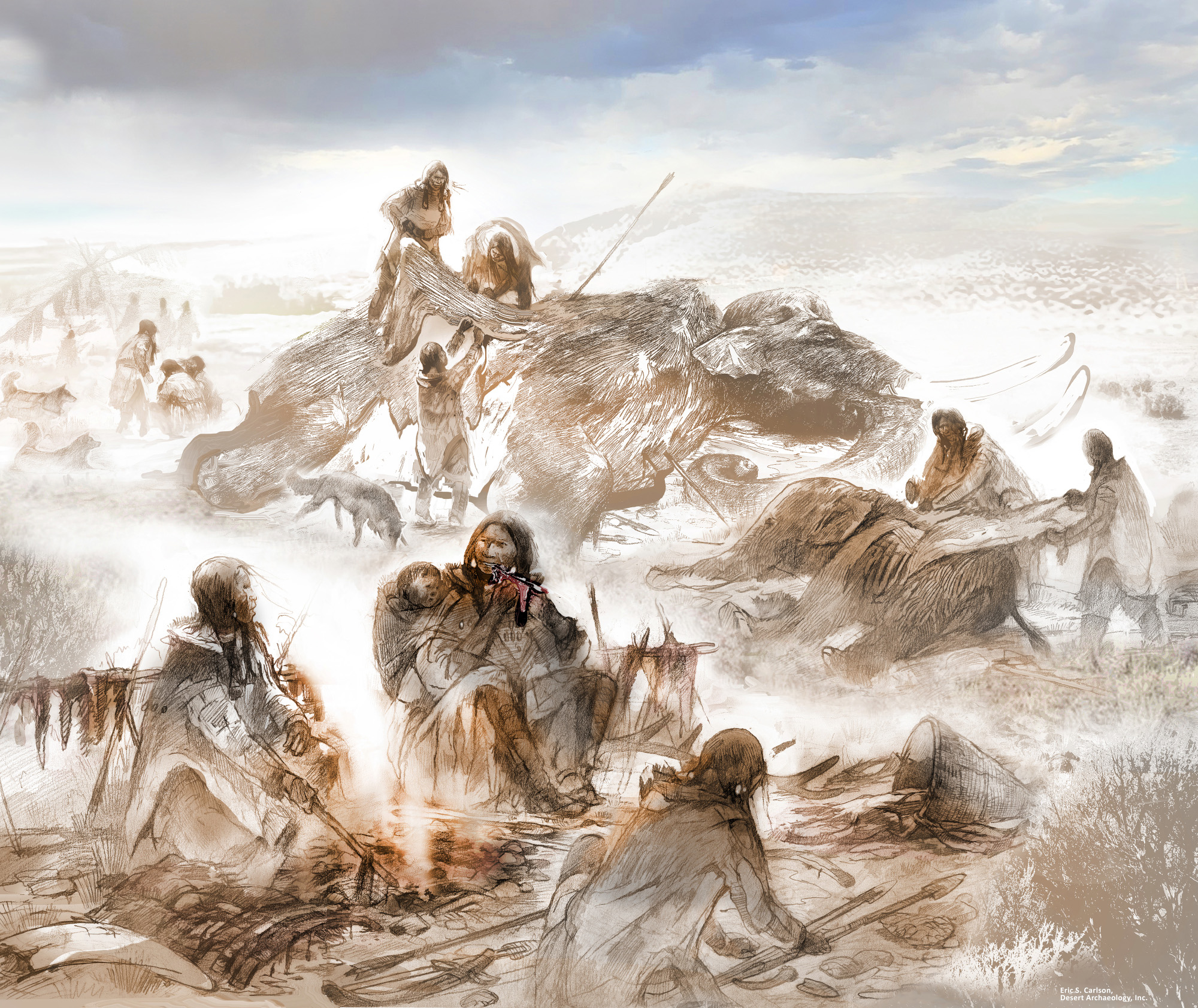
https://scitechdaily.com/images/Artists-Reconstruction-of-Clovis-Life.jpg


18 mya - Pliopithecus
3.5 mya - Australopithecus
2.0 mya - Homo habilis
0.5 mya - Homo erectus
70,000 BP - Homo neaderthalensis
35,000 BP - Homo sapiens sapiens

Human existence precedes written history by hundreds of thousands of years. While written records emerge only within the last five millennia, anatomically modern humans have existed for approximately 300,000 years, and earlier hominin forms extend the lineage back over 2.5 million years.

This immense span - commonly termed prehistory - is accessible not through texts but through material traces: tools, bones, pigments, settlements, and environmental modifications. These traces reveal not only survival strategies but also the gradual emergence of symbolic and relational awareness.

From a processual perspective, prehistory is best understood not as a void but as a field of becoming - a continuous unfolding in which biological, cognitive, social, and proto-religious dimensions co-evolve. Religion, in this sense, is not introduced into human life from without; it arises from within the evolving structure of human experience itself.


I. The Paleolithic Age - Survival, Symbol, and the First Sacred Gestures


2.5 mya - Lower Paleolithic
300,000 BP - Middle Paleolithic
30,000 BP - Upper Paleolithic (before last major ice age)
14,000 BP - Mesolithic (after the last major ice age)
11,700 BP - Neolithic
3,300 BCE - Ancient India

The Paleolithic Age - spanning from approximately 2.5 million years ago to around 10,000 BCE - represents the longest and most formative phase of human existence. During this period, human communities lived primarily as nomadic hunter-gatherers, adapting to a wide range of ecological conditions.

Technologically, Paleolithic humans developed increasingly sophisticated stone tools, including hand axes, blades, and scrapers. The controlled use of fire marked a decisive threshold, enabling cooking, protection, and social gathering. These developments reflect not only practical ingenuity but also the emergence of cooperative social structures.

Yet the Paleolithic record reveals more than subsistence. The appearance of cave paintings, carvings, and burial practices suggests an early symbolic consciousness. Sites such as Lascaux and Chauvet indicate intentional representation of animals, movement, and possibly cosmological patterns. Burial sites, often accompanied by grave goods or red ochre, imply a recognition of death that transcends mere biological cessation.

These elements may be interpreted as proto-religious expressions - not formalized systems of belief, but embodied responses to mystery, mortality, and environment. Early humans appear to have engaged the world not only as a resource but as a presence - something to be encountered, interpreted, and perhaps revered.

From a process perspective, the Paleolithic age represents the emergence of symbolic mediation - the capacity to hold experience in forms that extend beyond immediate perception. This capacity becomes the seedbed for later myth, ritual, and theology.


II. The Mesolithic Age - Transition, Environment, and Relational Adaptation


The Mesolithic Age - roughly 14,000 to 8,000 BCE - emerges in the wake of the last (inter-glacial) Ice Age. As glaciers receded and climates stabilized, human populations adapted to increasingly diverse and localized environments.

Technological innovation during this period includes the development of microliths - small, refined stone tools often combined with wood or bone to form composite implements such as arrows and spears. Fishing technologies expanded, and many communities established seasonal or semi-permanent settlements near rivers, lakes, and coastlines.

Archaeological evidence such as shell middens reveals patterns of sustained habitation and resource management. These developments indicate a shift toward ecological attunement - a deepening relationship between human communities and specific landscapes.

Religiously or symbolically, this period likely witnessed a continuation and diversification of earlier practices. While direct evidence is limited, the increasing stability of settlement patterns suggests the possibility of localized ritual activity tied to place.

From a processual standpoint, the Mesolithic represents a phase of relational refinement. Human beings are no longer merely surviving within environments; they are learning to inhabit them with increasing sensitivity and continuity.


III. The Neolithic Age - Agriculture, Settlement, and the Structuring of Meaning


Stone Age - 3.3 mya to 3300 BCE
Bronze Age - 3300 - 1200 BCE
Iron Age - 1200 - 500 BCE

The Neolithic Age - approximately 8,000 to 3,000 BCE - marks one of the most transformative transitions in human history: the shift from foraging to agriculture.

The domestication of plants and animals enabled the development of permanent settlements, leading to the formation of villages and proto-urban communities. This shift brought profound changes in social organization, including division of labor, population growth, and the accumulation of material culture.

Technological advancements include polished stone tools, pottery, weaving, and architectural construction. These developments reflect not only increased efficiency but also the emergence of aesthetic and symbolic elaboration.

Importantly, the Neolithic period provides clearer evidence of structured religious activity. Sites such as Göbekli Tepe and Çatalhöyük suggest communal ritual spaces, symbolic architecture, and possibly organized ceremonial practices. These developments indicate that religion is becoming institutionalized within communal life.

From a process perspective, the Neolithic transition represents a movement from fluid existence to structured continuity. Human beings begin to orient themselves not only in space but in time - cultivating land, storing resources, and transmitting traditions. Religion, in this context, becomes a means of stabilizing and interpreting this new temporal depth.


IV. The Bronze Age - Civilization, Order, and the Codification of the Sacred

Wikipedia - Overview map of the world at the end of the 2nd millennium BC, color-coded by cultural stage:
  Palaeolithic or Mesolithic hunter-gatherers
  nomadic pastoralists
  simple farming societies
  complex farming societies (Old World Bronze AgeAndes)
  state societies (Fertile CrescentChina)

The Bronze Age - roughly 3,300 to 1,200 BCE - is characterized by the emergence of complex societies, facilitated by advances in metallurgy. The alloying of copper and tin to produce bronze enabled stronger tools and weapons, supporting agricultural expansion, trade networks, and urban development.

This period witnesses the rise of early civilizations, including those of Mesopotamia (Sumeria, Akkadia, Assyria, Babylonia, Hittites, Shoenicia & Sea Peoples) and Egypt (refer to timeline). With increasing social complexity come systems of governance, codified law, and stratified social hierarchies.

Crucially, the Bronze Age marks the advent of writing systems, such as cuneiform and hieroglyphics. These systems allow for the recording of economic transactions, political decrees, and religious narratives.

Religion in this period becomes increasingly formalized. Temples, priesthoods, and mythological systems emerge as central components of societal organization. The sacred is no longer only experienced in immediate relation to environment or life-cycle events; it is now mediated through institutions and texts.

From a processual lens, the Bronze Age represents the codification of meaning - the translation of lived experience into enduring symbolic systems.


V. The Iron Age - Expansion, Identity, and the Emergence of Historical Consciousness


The Iron Age - beginning around 1,200 BCE - introduces more accessible and durable metal technologies. Iron tools and weapons contribute to agricultural productivity, territorial expansion, and intensified social interaction.

Urbanization accelerates, and societies develop increasingly complex infrastructures, including roads, water systems, and fortified settlements. Writing systems evolve into alphabets, enabling broader literacy and the preservation of cultural memory.

Religiously, this period sees the further development of ethical, narrative, and theological traditions. Texts begin to reflect not only ritual practice but also moral reflection and historical interpretation.

This marks the transition from prehistory to history proper - a shift in which human communities begin to narrate their own existence within time.

From a process perspective, the Iron Age represents the emergence of self-conscious identity - the capacity of societies to understand themselves as participants within an unfolding historical narrative.


Conclusion - The Deep Roots of Religion in Human Becoming

Prehistory is not a primitive prelude to civilization; it is the matrix within which human consciousness, culture, and religion emerge.

Across the Paleolithic, Mesolithic, Neolithic, Bronze, and Iron Ages, we observe not isolated developments but a continuous process of transformation:

  • from survival to symbolism

  • from mobility to settlement

  • from immediacy to memory

  • from experience to interpretation

Religion, in this light, is not an external addition to human life. It is an emergent dimension of humanity’s ongoing effort to situate itself within a world that is at once material and meaningful.

Thus, the evolution of worship is inseparable from the evolution of humanity itself. Both arise within the same process - a process of relational becoming that continues into the present.


For Additional Referral:

The Prehistoric Ages: How Humans Lived Before Written Records, by Lesley Kennedy


Poetic Coda

Before the word, there was the mark,
before the temple - the open sky.

Hands of earth in firelight dark
asked not what - but why.

And still we walk that ancient thread,
through field and flame and frame -

A living past beneath our tread,
becoming without name.

- R.E. Slater


~ Continue to Part I, Essay 1 ~


Evolution of Worship & Religion


Bibliography

  • Childe, V. Gordon. Man Makes Himself. London - Watts & Co., 1936.

  • Cunliffe, Barry. Europe Between the Oceans. New Haven - Yale University Press, 2008.

  • Diamond, Jared. Guns, Germs, and Steel - The Fates of Human Societies. New York - W. W. Norton, 1997.

  • Harari, Yuval Noah. Sapiens - A Brief History of Humankind. New York - Harper, 2015.

  • Hodder, Ian. Çatalhöyük - The Leopard’s Tale. London - Thames & Hudson, 2006.

  • Mithen, Steven. The Prehistory of the Mind. London - Thames & Hudson, 1996.

  • Renfrew, Colin. Prehistory - The Making of the Human Mind. New York - Modern Library, 2007.

  • Stringer, Chris. The Origin of Our Species. London - Allen Lane, 2011.

  • Tattersall, Ian. Masters of the Planet. New York - Palgrave Macmillan, 2012.

  • Whitehead, Alfred North. Process and Reality. New York - Free Press, 1978.


Friday, February 20, 2026

On vacation, Feb 2026

An eco-tour (transitional, tropical) hike on bad ground.

Hi.

My wife and I are away for a few weeks. When returning I intend to finish "What is reality" series and "How is cosmogical reality processual?" along with about about 30 other essays and commentaries.

These forthcoming essays will all be layered, organized, and outlined with one another... they just are not written yet. They are also related all the way back to all the published essays ftom last July forwards. If you wish to catch up, start with the Frege articles, July 2025, and read the next 150 essays chronologically.

Also, check out the many hundreds and hundreds of articles using the topic listing on the right. To assist topical readings, the listed Indexes in the topics-listing summarize previously written series as a group. When I set out to deconstruct - and - reconstruct Christianity I have done this completely without loss of faith. Just the opposite. I wish to strengthen the faith of millions. In affect, I have properly updated and contemporized today's faith.

There are also poetry articles here at Relevancy22 and a completely separate poetry site on google. To find it, just type "r.e. slater + poetry." Its my alter-ego site when I need a break.

Otherwise, be patient. I need the rest, and I need to be unplugged and decompress. My first three days I simply slept and slept. Apparently I had become exhausted.

Blessings!


R.E. Slater
Feb 20, 2026
Central and South America

   
Camels are not stinky, but riding is uncomfortable.

Racing in the Baja on UTX's.


Sunday, February 8, 2026

Truth as Horizon - Responding to Truth Cultures (38)


ESSAY 38
ETHICS & CULTURE IN A LIVED REALITY

Truth as Horizon - Responding to Truth Cultures

Ethics I - On Faith, Scripture, and the Refusal of Certainty

A Public Creed for a Searching People in a Fragile Democracy

by R.E. Slater & ChatGPT

Truth is not a possession to be guarded,
but a horizon best approached together.
- R.E. Slater

Public Creed

We believe truth is approached, not owned.
That faith must remain open to correction.
That any belief justifying cruelty and oppression has failed.
That love and human dignity come before doctrine.

Preamble
These statements do not claim authority, finality, or exclusive insight. It arises from the recognition that truth cannot be possessed without distortion, and that faith and democracy alike fail when certainty is used to excuse harm. In a time when religious and ideological language is increasingly invoked to justify brutal cruelty, exclusion, dehumanization, and unaccountable power, we offer these thoughts as a public posture or set of guidelines rather than as a doctrine - one that honors searching over certainty, responsibility over obedience, and shared becoming over fortified belief.

Truth is not what we hold.
It is how we walk together.
- R.E. Slater


A Public Statement

  • We affirm that truth is approached, not owned.
  • That no institution, ideology, or tradition is exempt from correction or accountability.
  • That certainty invoked to justify cruelty has forfeited moral authority.
  • That human dignity precedes any civic or religious doctrine, policy, and power.
  • That democracy depends on humility, plural voices, and the willingness to be wrong.
  • That faith, when it is worthy of trust, remains open, revisable, and accountable to love.
  • That shared responsibility matters more than enforced conformity.
  • That dialogue, restraint, and compassion are civic and spiritual strengths, not weaknesses.
  • That no claim to truth is legitimate if it requires dehumanizing the other.


Faith is Not a Possession

One says they hold truth,
as one might hold a deed,
a barrier fence line,
at times barbed and long.

One might say they are biblical,
as though ink could finish breath,
as though God consented,
to be archived and laminated.

But truth was never a property.
It came as weather.
As fire that burned.
As a voice refusing permanence.

Moses carried it in stone that broke.
The prophets spoke of it in grief.
The psalmists and poets wrote of mercy.
The Jesus gospels spoke in parables
that God might be heard in no one way.

Truth was never so simply "handed over."
It was to be entered into experientially -
as  the burning bush and consciences alike.
To be walked on roads that came-and-went.
Whose borders were permeable and crossed.

Those claiming to own "biblical truth"
built walls around the poor and unwanted,
calling imposed cruelty obedience,
mistaking a loving faith for absolutism.

But such an abominable faith was
never the answer in God's economy.
It was to be a posture of listening.
The courage to say, "I do not know,"
and to walk together in pursuit.

We do not come to belief to arrive.
We come to search, to be corrected,
to be interrupted, to learn and listen,
to be widened by other perspectives.

To conclude this is heresy is to repeat
the heresy of Abraham leaving Ur,
of Jacob limping away from divine encounter,
of Mary consenting without clarity,
of Jesus rightly refusing lurid kingdoms.

Truth does not live in locked fortresses.
It breathes where questions are allowed,
where power is held accountable,
where love risks uncertainty.

If divinity speaks at all,
it speaks in the verbs of life -
calling, undoing, welcoming,
becoming, learning, loving.

And if democracy is to live again,
it will not be through sacred certainty,
or declared human "truths"
by human dogmas and doctrines.

But through shared searching -
together, in many voices,
in unfinished sentences,
by peoples re-learning how to listen,
without owning flat, finished answers.

Those who claim truth's possession
have learned to keep their locked doors.
But those who hold truth loosely
have unlocked their doors
to walk outside their mindscapes.


R.E. Slater
 February 8, 2026
@copyright R.E. Slater Publications
all rights reserved


Seeking, Not Possessing

We do not claim to hold truth.
We commit ourselves to seeking it.

We reject the belief that Scripture is a finished subject,
or that "objectivized faiths" grant ownership of certainty.

We receive Scripture as witness, not weapon;
as provocation, not possession;
as a living field of struggle, failure, revision, and growth.

We deny any theology that confuses certainty with faith
or obedience with moral abdication of human rights and equality.

We refuse the use of “biblical truth” as a shield against responsibility,
or as a tool of discipline,
or as a justification for imposed, immoral, cruelty.

We reject fortress faiths -
faiths that make enemies of friends,
demands purity,
sacralizes power,
or renders love optional.

We affirm that faith is not assent but orientation;
not arrival but becoming;
not certainty but responsibility.

We stand with the deeper biblical postures -
of (rabbinic) argument, lament, parable, humility, and unfinished vision.

We believe any faith worthy of the name
must remain open to correction,
be accountable to the vulnerable,
and answerable to love's remiss.

We hold that faith and democracy rise or fall together -
each requiring humility, plural voices, revisability,
and the courage to be wrong and acknowledge it.

We confess that when belief harms another,
it has already betrayed its living source.

We do not guard truth -
We walk towards it, together.


R.E. Slater
 February 8, 2026
@copyright R.E. Slater Publications
all rights reserved


Preamble

This creed does not claim authority, finality, or exclusive insight. It arises from a long recognition that truth cannot be possessed without becoming distorted, and that faith collapses when certainty is used to excuse harm. In an age when religious language is increasingly invoked to justify cruelty, exclusion, and authoritarian power, we offer this as a statement of posture rather than doctrine - one that honors searching over certainty, responsibility over obedience, and shared becoming over fortified belief.

Such a creed does not an end.
It is a refusal to close.


A Civic Statement

  • We affirm that truth is approached, not owned.
  • That no institution, ideology, or tradition is exempt from revision or accountability.
  • That certainty used to justify harm has forfeited moral authority.
  • That democracy depends on humility, plural voices, and the willingness to be wrong.
  • That human dignity precedes policy, power, and ideology.
  • That shared responsibility matters more than enforced conformity.
  • That dialogue, compassion, and restraint are civic strengths, not weaknesses.
  • That no claim to truth is legitimate if it requires dehumanizing the other.
  • That the future depends not on final answers, but on our capacity to listen, revise, and act together.


An Anti-Creed Statement (What We Refuse)

  • We refuse the claim that truth can be owned, guarded, or weaponized.
  • We refuse the use of sacred language to excuse cruelty or indifference.
  • We refuse obedience that dissolves moral responsibility.
  • We refuse faith that builds fortresses instead of communities.
  • We refuse certainty that silences dissent or punishes doubt.
  • We refuse nationalism baptized as righteousness.
  • We refuse purity tests that require enemies to survive.
  • We refuse authority that answers only to itself.
  • We refuse beliefs that demand suffering as proof of loyalty.
  • We refuse any vision of order that renders love optional.
  • We refuse the lie that arrival matters more than becoming.


Truth as Horizon, Not Property

On Faith, Scripture, and the Refusal of Certainty

1. Holding Truth vs Seeking Truth

The difference between holding truth and seeking truth is not semantic. It is postural. It determines how Scripture is read, how faith is practiced, and how power is exercised.

To claim possession of “biblical truth” is to treat Scripture as a static deposit - as something finished, to be secured, and guarded. It becomes a boundary-marker distinguishing insiders from outsiders, and a credentialed authority that legitimizes teaching, discipline, and exclusion for others to follow. Truth, in this posture, is something one arrives at, then defends, and oppresses others for not assimilating towards their perceptions.

However, to seek truth through Scripture is to enter an altogether different relationship with the Divine, the sacred, the Loving Other - where holiness and justice conform to love and not love to holiness and justice.

Scripture must become a witness rather than a weapon, a provocation rather than a possession; to be encountered as a field of struggle, failure, revision, and growth... an unfolding conversation rather than a closed system of boundary truths. Here, faith is not about guarding (religious or faith) conclusions but about remaining open to interruption.

The church’s repeated insistence that it holds “biblical truth” must be framed in humility, but too often it is more accurately a descriptor for untenable, mythic certainties masquerading as real faith. And mythic certainties do not remain benign. They harden. Calcify. And eventually become inhumanly coercive as exampled by trans-abuse, immigrant-abuse, abuse of women, and children... all in the mighty name of faith.

One never should enter Christianity in order to "arrive". But to enter within to journey, wrestle, and be undone by the divine sacred of love and love's becoming. That holy posture - of seeking rather than possessing - places it's faithful closer to the Abrahamic-Davidic-Prophetic-Jesus tradition than those who claim to guard it.


2. The Myth of “Biblical Truth” as a Finished Object

In contemporary church discourse, “biblical truth” functions less as a theological claim and more as a mechanism of control within its power centers. It serves as a rhetorical shield against critique, a disciplinary tool for enforcing conformity, and a permission structure for cruelty. Too frequently the children and women of bible-churches experience abuse and oppression in the name of "biblical truth."

It allows religious institutions such as churches, synods, denominations, and schools, to say, "We are not choosing oppression - we are merely obeying God."

But the Bible itself never behaves as a single, settled truth-system. It is argumentative rather than uniform. It revises itself across generations. It contains internal resistance and unresolved tensions. Its ethical vision advances in fits and starts. It is morally uneven and theologically self-correcting. It is a very real picture of people and societies in motion, seeking thrival and discovering brutal roadblocks to love and energy.

To claim the Bible as a "finalized truth" is to deny the Bible’s own mode of existence. Scripture does not present itself as a "closed answer" but as a living record of human struggle with God, neighbor, power, and responsibility where truth is always approached and never quite apprehended. At its height, Israel failed and crucified the living God... how much more does the church do the same thing with Jesus' love and faithfulness through high-and-holy rules and obedience sentences??

In this sense, “biblical truth,” as it is often deployed today, rests more on a mythic foundation than it does a truth foundation - not because Scripture is meaningless, but because it is too dynamically alive to be reduced to mere "era-specific or culture-oriented" certainty. The problem is not that Scripture is unstable, but that certainty demands a stillness Scripture refuses to provide, and to which "certainty faiths" always demand of themselves.


3. MAGA Christianity and Fortress Faith

MAGA Christianity represents a particularly stark example of what happens when truth is treated as property. It fuses absolutist theology with nationalist identity and fear-driven boundary enforcement. The result is not faith, but oppresive fortress-building all in the name of "purity" and "White Christian culture".

Fortress faiths always require enemies. It depends on purity tests. It thrives on spectacle. It legitimizes punishment. It needs scapegoats to sustain itself.
This is why cruelty can coexist so easily with “biblical truth” language without producing cognitive dissonance. Once truth is owned, love becomes optional. Compassion becomes negotiable. Suffering becomes collateral.

Outsiders are not wrong to connect this magafaith-posture to ICE raids, dehumanizing policy rhetoric, indifference to suffering, and the sacralization of state power. These are not accidental failures of that theology. They are its logical outcomes.

When certainty is baptized, coercion soon follows.


4. The Older, Deeper Biblical Posture

What must be articulated aligns not with today's modernized, albeit secular, faith absolutism, but with the deeper, "truer,"  biblical posture itself:

The Hebrew prophets argued with God rather than quoting Him. The wisdom tradition refused certainty and prized discernment. Jesus taught in parables precisely to prevent closure and resist final answers. Paul confessed that we see “through a glass, darkly,” acknowledging the limits of knowledge even within faith.

Across these traditions runs a consistent thread: faith is not assent - but reorientation. Not possession - but re-attunement. Not certainty - but re-acquired responsibility.

This posture cannot coexist with absolutism. One dissolves the other. The moment faith becomes fixed, it ceases to be faithful. The moment faith learns faithfulness it ceases to be fixed.


5. Re-Birthing Faith and Democracy

To link this faith critique to democracy is exactly right. Democracy MUST depend on epistemic humility, a plurality of voices, critique and revisability, and the willingness to be wrong.

It requires shared participation rather than enforced conformity. These are not weaknesses. They are the conditions of collective life.

Similarly with any faith - whether Christian, Jewish, Muslim, etc. When churches and faith groups claim to own truth, they train people to accept authoritarian certainty, moral exemption, and (often enforced) hierarchical obedience. When churches model God's love, they then place themselves in the posture of seeking truth rather than owning truth; cultivating dialogue rather than demand obedience; and willingly seek to be accountable, compassionate, shared responsibility, and grow in civic maturity with cultural and religious difference.

In summary, challenging the rhetorics of “biblical truth” is not an act of anti-faith or lost-faith; it is a very pro-God, pro-democratic, pro-human, and profoundly biblical in its deepest sense.

When true truth seeks seek loving, critiquing approaches to flat statements of "biblical truth" they are not dismantling their faith. They are removing false floors that lead to abuse and oppression. They are allowing perceived truth to breathe again as Abraham had learned with his experiences in Ur and later, with God. Seekers of true-truth are but naming the difference between faith as arrival and faith as becoming. We wish always to become the latter.


A Manifesto Against Possessed Truth

On Faith, Scripture, and Democratic Life


  1. Truth is not a possession.
    Any claim to hold truth as settled, guarded, or owned has already begun to distort it.

  2. Scripture is not a finished object.
    It is a living record of struggle, argument, revision, and moral growth.
    To freeze it is to betray it.

  3. “Biblical truth” has become a mythic device.
    It now functions less as theological insight and more as a shield against responsibility,
    a tool of discipline,
    and a permission structure for cruelty.

  4. Certainty masquerading as faith is not humility.
    It is mythic certainty—and mythic certainty always hardens into coercion.

  5. We reject obedience that dissolves moral agency.
    “We are merely obeying” is not faith.
    It is abdication.

  6. Fortress faith is not faith.
    Any belief system that requires enemies, purity tests, spectacle, punishment, or scapegoats
    has already abandoned love.

  7. Cruelty justified by sacred language is not a failure of theology.
    It is its logical outcome when truth is treated as property.

  8. The deeper biblical posture is unfinished by design.
    Prophets argued.
    Wisdom refused certainty.
    Jesus spoke in parables to prevent closure.
    Paul confessed partial sight.

  9. Faith is not assent.
    It is orientation.
    Not arrival, but becoming.
    Not certainty, but responsibility.

  10. Absolutism and faith cannot coexist.
    One dissolves the other.

  11. Democracy and faith share the same ethical soil.
    Both require humility, plural voices, revisability, and the courage to be wrong.

  12. When churches claim to own truth, they train people for authoritarianism.
    When they seek truth, they form people capable of dialogue, accountability, and care.

  13. Challenging “biblical truth” rhetoric is not anti-faith.
    It is pro-human, pro-democratic, and faithful to Scripture’s living character.

  14. We did not enter belief to arrive.
    We entered to walk, to wrestle, and to be undone.

  15. The future belongs to becoming, not certainty.
    Faith that cannot be questioned will not survive.
    Faith that refuses possession may yet endure.