Quotes & Sayings


We, and creation itself, actualize the possibilities of the God who sustains the world, towards becoming in the world in a fuller, more deeper way. - R.E. Slater

There is urgency in coming to see the world as a web of interrelated processes of which we are integral parts, so that all of our choices and actions have [consequential effects upon] the world around us. - Process Metaphysician Alfred North Whitehead

Kurt Gödel's Incompleteness Theorem says (i) all closed systems are unprovable within themselves and, that (ii) all open systems are rightly understood as incomplete. - R.E. Slater

The most true thing about you is what God has said to you in Christ, "You are My Beloved." - Tripp Fuller

The God among us is the God who refuses to be God without us, so great is God's Love. - Tripp Fuller

According to some Christian outlooks we were made for another world. Perhaps, rather, we were made for this world to recreate, reclaim, redeem, and renew unto God's future aspiration by the power of His Spirit. - R.E. Slater

Our eschatological ethos is to love. To stand with those who are oppressed. To stand against those who are oppressing. It is that simple. Love is our only calling and Christian Hope. - R.E. Slater

Secularization theory has been massively falsified. We don't live in an age of secularity. We live in an age of explosive, pervasive religiosity... an age of religious pluralism. - Peter L. Berger

Exploring the edge of life and faith in a post-everything world. - Todd Littleton

I don't need another reason to believe, your love is all around for me to see. – Anon

Thou art our need; and in giving us more of thyself thou givest us all. - Khalil Gibran, Prayer XXIII

Be careful what you pretend to be. You become what you pretend to be. - Kurt Vonnegut

Religious beliefs, far from being primary, are often shaped and adjusted by our social goals. - Jim Forest

We become who we are by what we believe and can justify. - R.E. Slater

People, even more than things, need to be restored, renewed, revived, reclaimed, and redeemed; never throw out anyone. – Anon

Certainly, God's love has made fools of us all. - R.E. Slater

An apocalyptic Christian faith doesn't wait for Jesus to come, but for Jesus to become in our midst. - R.E. Slater

Christian belief in God begins with the cross and resurrection of Jesus, not with rational apologetics. - Eberhard Jüngel, Jürgen Moltmann

Our knowledge of God is through the 'I-Thou' encounter, not in finding God at the end of a syllogism or argument. There is a grave danger in any Christian treatment of God as an object. The God of Jesus Christ and Scripture is irreducibly subject and never made as an object, a force, a power, or a principle that can be manipulated. - Emil Brunner

“Ehyeh Asher Ehyeh” means "I will be that who I have yet to become." - God (Ex 3.14) or, conversely, “I AM who I AM Becoming.”

Our job is to love others without stopping to inquire whether or not they are worthy. - Thomas Merton

The church is God's world-changing social experiment of bringing unlikes and differents to the Eucharist/Communion table to share life with one another as a new kind of family. When this happens, we show to the world what love, justice, peace, reconciliation, and life together is designed by God to be. The church is God's show-and-tell for the world to see how God wants us to live as a blended, global, polypluralistic family united with one will, by one Lord, and baptized by one Spirit. – Anon

The cross that is planted at the heart of the history of the world cannot be uprooted. - Jacques Ellul

The Unity in whose loving presence the universe unfolds is inside each person as a call to welcome the stranger, protect animals and the earth, respect the dignity of each person, think new thoughts, and help bring about ecological civilizations. - John Cobb & Farhan A. Shah

If you board the wrong train it is of no use running along the corridors of the train in the other direction. - Dietrich Bonhoeffer

God's justice is restorative rather than punitive; His discipline is merciful rather than punishing; His power is made perfect in weakness; and His grace is sufficient for all. – Anon

Our little [biblical] systems have their day; they have their day and cease to be. They are but broken lights of Thee, and Thou, O God art more than they. - Alfred Lord Tennyson

We can’t control God; God is uncontrollable. God can’t control us; God’s love is uncontrolling! - Thomas Jay Oord

Life in perspective but always in process... as we are relational beings in process to one another, so life events are in process in relation to each event... as God is to Self, is to world, is to us... like Father, like sons and daughters, like events... life in process yet always in perspective. - R.E. Slater

To promote societal transition to sustainable ways of living and a global society founded on a shared ethical framework which includes respect and care for the community of life, ecological integrity, universal human rights, respect for diversity, economic justice, democracy, and a culture of peace. - The Earth Charter Mission Statement

Christian humanism is the belief that human freedom, individual conscience, and unencumbered rational inquiry are compatible with the practice of Christianity or even intrinsic in its doctrine. It represents a philosophical union of Christian faith and classical humanist principles. - Scott Postma

It is never wise to have a self-appointed religious institution determine a nation's moral code. The opportunities for moral compromise and failure are high; the moral codes and creeds assuredly racist, discriminatory, or subjectively and religiously defined; and the pronouncement of inhumanitarian political objectives quite predictable. - R.E. Slater

God's love must both center and define the Christian faith and all religious or human faiths seeking human and ecological balance in worlds of subtraction, harm, tragedy, and evil. - R.E. Slater

In Whitehead’s process ontology, we can think of the experiential ground of reality as an eternal pulse whereby what is objectively public in one moment becomes subjectively prehended in the next, and whereby the subject that emerges from its feelings then perishes into public expression as an object (or “superject”) aiming for novelty. There is a rhythm of Being between object and subject, not an ontological division. This rhythm powers the creative growth of the universe from one occasion of experience to the next. This is the Whiteheadian mantra: “The many become one and are increased by one.” - Matthew Segall

Without Love there is no Truth. And True Truth is always Loving. There is no dichotomy between these terms but only seamless integration. This is the premier centering focus of a Processual Theology of Love. - R.E. Slater

-----

Note: Generally I do not respond to commentary. I may read the comments but wish to reserve my time to write (or write from the comments I read). Instead, I'd like to see our community help one another and in the helping encourage and exhort each of us towards Christian love in Christ Jesus our Lord and Savior. - re slater

Thursday, December 4, 2025

The History & Compilation of the Hebrew Bible (SM 5A)

Samaritan high priest with and Old Pentateuch, 1905

Supplementary Materials
Part VI, SM 5A

THE HISTORY & COMPILATION
OF THE HEBREW BIBLE (I-II)

From Oral Memory to Proto-Canon:
A Literary-Historical Journey
(1200 BCE - 200 CE)

by R.E. Slater & ChatGPT-5


References

Wikipedia - The Hebrew Bible
Britannica - The Hebrew Bible
Blogger Source - Old & New Testaments


Sectional Outline

Section I - The Hebrew Bible Before Writing
Orality, memory, storytelling, ancestral traditions, tribal archives, cultic recitations, early poetry.

Section II - The First Written Traditions (Iron Age I & II)
Earliest inscriptions, scribal culture, royal archives, temple writings, early prophetic material.

Section III - Exile, Redaction, and the Birth of Scripture
Deuteronomistic history, Priestly school, exilic reinterpretation, Genesis 1, canon consciousness.

Section IV - Second Temple Consolidation and Scribalization
Ezra, the rise of Torah centrality, the shift from oral to textual authority, Dead Sea Scrolls, competing textual traditions.

Section V - The Closing of the Canon and Early Reception
Proto-Masoretic text, Septuagint, Samaritan Pentateuch, canon debates, early Jewish interpretation.

Each sub-essay can be standalone yet interlinked, giving your readers a clear map from oral tradition to canon.


Section 1 - Before the Bible: Orality, Memory, and the Earliest Forms of Sacred Tradition

The Hebrew Bible, as a collection of written books, is the final stage of a much longer process of cultural remembering. Before a single verse was written, Israel’s earliest traditions lived in the breath of storytellers, the rhythms of song and poetry, the liturgies of shrines, and the memories of tribes. The world in which the Bible began was not a literary world. It was primarily oral - dynamic, fluid, flexible, and communal.

Israel’s earliest ancestors lived in a culture where history, identity, and theology were preserved not on scrolls but in ritual performance and spoken narrative. What would later become Scripture began as:

  • ancestral stories told around hearths and campfires

  • tribal genealogies recited to maintain kinship and land claims

  • cultic liturgies sung at local shrines

  • victory hymns celebrating battles

  • legal customs and taboos preserved through repetition

  • poetic blessings and curses marking life’s transitions

In this early period at the end of the late Bronze Age Collapse and beginning of the Iron Age (c. 1200–1000 BCE) - also known as Israel's Golden Age as it had reached its largest geographical size -  writing existed, but its use was limited. Literacy was confined mostly to scribes employed by palaces, temples, and administrative centers. The populations that would later become “Israel” lived in the highlands during a time of social decentralization; they preserved their religious identity through memory rather than manuscripts.

Poetry is often the oldest layer of this tradition. Biblical scholars frequently note that the Song of Deborah (Judges 5), the Blessing of Jacob (Genesis 49), and the Song of the Sea (Exodus 15) bear hallmarks of archaic Hebrew. Their language is rougher, their imagery more primal, their syntax more ancient. These compositions likely predate the formation of Israelite prose narrative and represent the earliest crystallization of Israel’s sacred memory.

In oral cultures, traditions do not remain static. They are adapted, expanded, abbreviated, and reinterpreted as they pass from generation to generation. The stories of Abraham, Isaac, and Jacob, the Exodus, and Sinai - before being written - were living traditions, shaped by their tellers and by the needs of the communities who cherished them. Orality allows for variation, and this variation is not a flaw but a sign of vitality. Ancient Israelites did not seek “verbatim accuracy”; they sought meaning, identity, and the presence of God in their collective memory.

Thus, the Hebrew Bible begins its life not as scripture but as storytelling, song, ritual, and cultural memory. It emerges from the same oral world that shaped the epics of Mesopotamia, the myths of Ugarit, and the liturgies of Egypt. In this earliest phase, Israel’s sacred tradition stands shoulder to shoulder with its neighbors, participating in the wider ANE oral matrix while gradually developing a distinctive voice.

The movement from orality to writing would begin only with the rise of monarchy and the establishment of centralized institutions dependent upon cultural memory - but even then, the written word would serve to stabilize, not replace, the living voice of the tradition.

This is the threshold where the Bible’s written history begins.


II. The First Written Traditions: Inscriptions, Scribes, and the Early Formation of Text (1000-722 BCE)

The transition from orality to writing in ancient Israel was gradual, uneven, and deeply tied to the rise of political institutions. Before the monarchy, writing played a limited role in Israelite society. But with the establishment of royal courts under David and Solomon, and the growth of administrative complexity through the 10th-8th centuries BCE, writing began to serve new functions: taxation, diplomacy, legal codification, historical memory, and eventually theological reflection.

Writing did not replace oral tradition; it stabilized, organized, and selected elements from a vast living reservoir of stories and laws. What we call “biblical literature” emerges through this interplay: oral tradition gave the content, written tradition gave the shape, and later editors supplied the theological coherence.

This period is crucial - not because we already have the “Bible,” but because the conditions that would one day produce the Bible first took root.


II.A. The Archaeological Footprint: Early Hebrew Inscriptions

The earliest evidence for Hebrew writing appears not in biblical manuscripts but in short inscriptions carved on pottery, walls, and arrowheads. These inscriptions, though fragmentary, show that writing was known and used in daily life.

Some of the most important examples include:

  • The Gezer Calendar (10th century BCE) - a simple agricultural schedule, possibly a school exercise, written in early Hebrew script.

  • The Tel Zayit Abecedary (10th century BCE) - showing that scribal training existed in small highland towns.

  • The Khirbet Qeiyafa Ostracon (early 10th century BCE) - a proto-Israelite inscription with moral and legal language that anticipates later biblical themes.

  • The Kuntillet ‘Ajrud and Khirbet el-Qom inscriptions (8th century BCE) - blessing formulas mentioning “Yahweh and his Asherah,” demonstrating diversity in early Israelite religion.

  • Samaria Ostraca (8th century BCE) - administrative receipts that indicate a functioning bureaucratic scribal apparatus.

These inscriptions reveal a society where writing was becoming increasingly important, but still limited in scope. It was used more for administration and cultic formulae than for extended narrative.

Long literary texts would come much later, preserved not in stone or pottery, but in perishable scrolls held in royal, temple, or prophetic archives.


II.B. The Rise of Scribes: Literacy as Specialized Craft

In Iron Age Israel, literacy was not widespread. Scribes formed a professional class, trained in the arts of writing, calculation, legal formulation, and archival preservation. Their skill was parallel to, though less extensive than, the scribal elites of Egypt and Mesopotamia.

The biblical references to scribes (soferim) in royal courts suggest that by the 9th century BCE, Israel had developed:

  • a system of scribal education
  • access to writing materials (ink, papyrus, parchment)
  • royal archives containing records, treaties, genealogies, and annals
  • temple scribes responsible for ritual and legal texts

Writing in this period did not aim to create “Scripture.” It aimed to produce royal history, administrative records, legal precedents, and prophetic collections. Only later, during and after the Babylonia exile, 500-400 years later, would these writings become the foundation of sacred canon.

But the early scribes of the monarchic period are the first to turn Israel’s oral tradition into durable textual tradition.


II.C. Early Narrative Traditions: Court Histories and Tribal Memories

Many biblical books contain embedded literary units that likely originated as court documents, royal inscriptions, or tribal histories.

Examples include:

  • The Court History of David (in 2 Samuel), a remarkably candid narrative that seems to reflect early royal archives.

  • The Annals of the Kings of Israel and Judah, repeatedly referenced in Kings but now lost.

  • The Song of the Sea (Exodus 15) and Song of Deborah (Judges 5), which early scribes likely copied down as prized cultural memory.

  • Early cycle stories around Jacob, Joseph, and the Judges, preserved orally but first shaped into prose during the monarchic era.

These early texts are not yet part of a unified “Bible.” They exist as independent scrolls, copied and maintained in different locations --> Jerusalem for the southern kingdom, --> Samaria for the northern kingdom, and --> various local shrines.

The diversity of the Bible’s voices - its multiple styles, dialects, and theological perspectives - reflects this multiplicity of origins.


II.D. Deuteronomy and the First Wave of Literary Theologization

The 7th century BCE marks a watershed moment. Under King Josiah, a “book of the law” is discovered during temple renovations (2 Kings 22–23). Most scholars identify this text with an early version of Deuteronomy.

Why is this significant?

Because Deuteronomy represents the first attempt to interpret Israel’s entire history theologically through writing. It introduces themes that will dominate later biblical literature:

  • exclusive worship of Yahweh (either henotheism or early monotheism)
  • covenant fidelity (ditto)
  • centralization of cult in Jerusalem
  • historical interpretation of the covenantal blessings and curses
  • concern for social ethics
For the first time, writing becomes a tool not merely to record events, but to shape religious identity. Deuteronomy is literary, rhetorical, and deeply theological - a bridge between older oral traditions and the later, more structured biblical worldview.

Its composition marks the beginning of what scholars call the Deuteronomistic History (Deuteronomy → Joshua → Judges → Samuel → Kings), a sweeping narrative that presents Israel’s past as a drama of covenant faithfulness and failure.


II.E. Prophetic Scrolls and the Beginnings of Scriptural Consciousness

From the 8th century onward, prophets such as Amos, Hosea, Micah, and Isaiah began to write or dictate scrolls of their speeches. These writings differ from administrative or court documents - they speak with the authority of divine message. Their preservation indicates a growing recognition that certain words, phrases, ideas or concepts, were not merely historical but sacred, carrying a significance beyond their moment.

Although the prophets themselves did not think they were writing “Bible,” the communities that preserved these scrolls already sensed that they held enduring (sacred) truth.

These prophetic texts would later become early core components of the Hebrew Bible - but only after centuries of compilation, editing, and reinterpretation.


II.F. The Northern Kingdom’s Fall and the Acceleration of Literary Preservation (722 BCE)

The Assyrian destruction of the northern kingdom in 722 BCE created a massive crisis of identity. Refugees fled to Judah, bringing with them:

  • northern oral traditions
  • early written narratives
  • prophetic memories
  • covenant traditions
  • tribal genealogies
  • liturgical practices

This influx likely stimulated a surge in literary activity in Judah, as scribes sought to preserve traditions now at risk of disappearing forever.

The blending of northern and southern traditions during this period would eventually give rise to:

  • combined patriarchal narratives
  • composite Exodus story
  • harmonized covenant traditions
  • preserved prophetic schools

In short, the fall of the northern kingdom catalyzed the first major phase of the Hebrew Bible’s compilation - long before the exile, long before canonization.


~ Continue to Part VI, SM 5B ~


Evolution of Worship & Religion


Wednesday, December 3, 2025

How the ANE Gave Shape to Israel's God (SM 4C)


Supplementary Materials
Part VI, SM 4C

HOW THE ANCIENT NEAR EAST
GAVE SHAPE TO ISRAEL’S GOD (VI-IX)

Syncretism, Cultural Exchange, and the ANE Roots
of Israelite Religion (2000-200 BCE)

by R.E. Slater & ChatGPT-5


Childhood shapes our sense of the sacred;
it whispers the first names we give to wonder.
Religion, too, grows in this way -
from cradle-formed imaginings
through to the long work of maturity.

So it was for Israel.
The stories of her youth,
inherited from neighbors and forgotten ancestors,
became the soil from which her God would grow.

As with all of us:
what begins in early innocence
follows us through life,
ripening, wrestling, deepening -
until, at last, we return
to the Mystery from which we came.


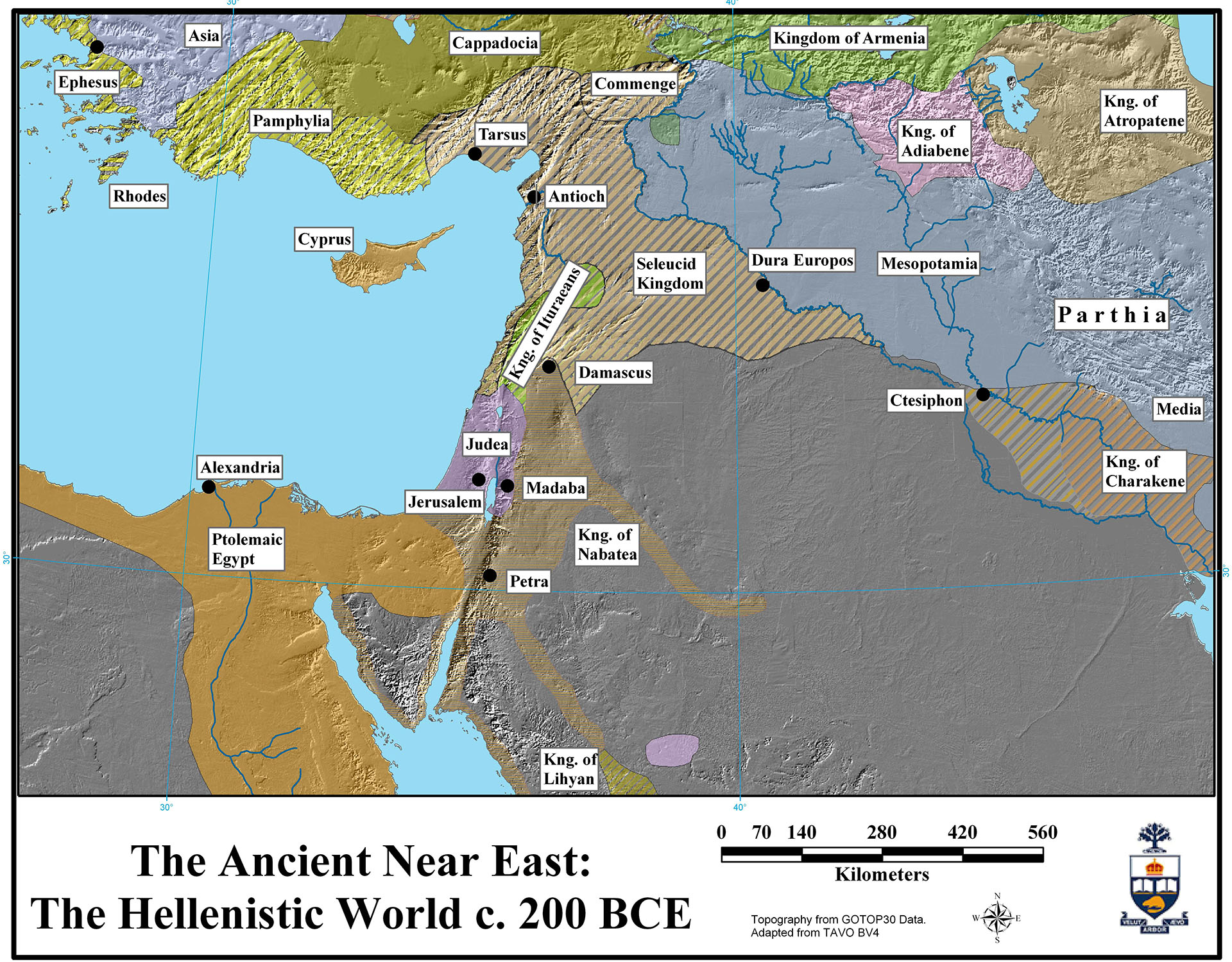
https://www.asor.org/wp-content/uploads/2020/11/pid000505_Map_2005_01_Hellenistic-World-Egypt-Levant-and-Mesopotamia.jpg

VI. Language as the Conveyance of Myth (2000–200 BCE)

Language is more than a means of communication; it is a vessel that carries memory, identity, and the inherited stories of a people. In the Ancient Near East, where literacy was limited to scribal classes and oral tradition dominated communal life, the shape of a word could preserve the shape of a worldview. Israel’s language—Early Northwest Semitic gradually taking the recognizable form of Biblical Hebrew—bears within it the deep sediments of older civilizations.

Hebrew did not emerge in isolation. It grew out of linguistic strata that link it to Akkadian, Ugaritic, Amorite, Phoenician, Aramaic, and other West Semitic dialects. Many of these linguistic connections carry with them theological resonances. For example, the Hebrew word tehom (“the deep”) echoes the older Tiamat, the Mesopotamian goddess of primordial chaos. Although the biblical authors radically reinterpreted this term—stripping it of its divinity and reshaping it into an impersonal deep—the linguistic memory preserves a window into a shared mythic past.

Likewise, the word eden resembles the Akkadian edin, meaning “plain” or “steppe,” which appears in Mesopotamian texts long before Genesis. The divine epithet El Shaddai may carry Amorite origins, suggesting ancestral forms of worship predating the emergence of Israel. Even the word Torah has analogues in earlier Akkadian terms for instruction and decree, highlighting the continuity of legal and wisdom traditions across regions.

These inherited words did not dictate Israel’s theology, but they shaped its imaginative possibilities. When biblical authors told creation stories, they used vocabulary already weighted with older meanings—sometimes affirming them, sometimes contesting them, often transforming them. Language thus functioned as an archive of myth, a repository of cultural memory from which Israel crafted its own distinctive religious vision.


Through linguistic inheritance, Israel participated in a millennia-long conversation. The result is a Bible whose words are both deeply local—rooted in the speech of hill-country villagers—and cosmopolitan—shaped by the vast intellectual world of Mesopotamia, Egypt, and beyond. Language preserved continuity even as theology evolved.


VII. Comparative Syncretism Across the Ancient World

Syncretism was not unique to Israel or Canaan; it was the default mode of religious life throughout the Mediterranean and Near Eastern world. Seeing how other cultures blended their gods and ideas helps illuminate the broader patterns within which Israel’s story unfolds.

In Egypt, for example, the rise of Amun-Ra—a fusion of Thebes’ local god Amun with the solar deity Ra—illustrates how political unification could produce religious unification. In Greece, Zeus-Ammon emerged when Greek mercenaries encountered the Libyan oracle of Amun, recognizing a familiar divine pattern in a foreign setting. In Asia Minor, the Hittites and later Luwians incorporated Mesopotamian storm gods into their own pantheons, creating composite deities whose identities spanned linguistic and cultural boundaries.

The Greco-Egyptian city of Alexandria provides some of the most dramatic examples of syncretism. The god Serapis was deliberately crafted during the Ptolemaic period to unify Greek and Egyptian religious sensibilities. Serapis combined aspects of Osiris, Apis, and Greek healing traditions into a single deity whose iconography intentionally blended cultural forms.

Such examples illustrate that syncretism served multiple purposes: political integration, cultural diplomacy, theological enrichment, and social cohesion. To the ancient mind, the divine was not a set of mutually exclusive propositions but a multitude of complementary manifestations of sacred power.

Israel’s resistance to syncretism must therefore be seen as an exception, not the rule. Most cultures embraced syncretism as a natural expression of the interconnectedness of the world. Israel, in contrast, eventually forged a religious identity through the renunciation of this universal cultural logic—a dramatic and unprecedented move.

By placing Israel within this comparative frame, we come to appreciate the radical nature of its later monotheistic commitments. Israel’s theological trajectory did not follow the dominant pattern of the ANE; it forged a new path, one that would profoundly influence the religious history of the world.


VIII. Cultural Identity Formation & the Rejection of Syncretism

Israel’s eventual rejection of syncretism cannot be understood apart from the pressures of political vulnerability, imperial domination, and existential crisis. What had been religiously normal in earlier centuries became untenable as Israel sought to preserve its identity under foreign rule.

The Assyrian destruction of the northern kingdom in 722 BCE, followed by the Babylonian conquest in 586 BCE, shattered the old frameworks of community life. These catastrophic events forced Israel to confront a fundamental question: What does it mean to be the people of God when the land is lost, the temple destroyed, and the monarchy extinguished?

The prophetic literature answers this question by re-centering identity on exclusive loyalty to Yahweh. Syncretism, once tolerated or even celebrated, now represented a threat to Israel’s very existence. The prophets interpreted Israel’s political disasters as consequences of religious infidelity: worship of Baal, veneration of Asherah, and participation in Canaanite rituals were seen as betrayals of the covenant.

The Deuteronomistic historians crafted a sweeping theological narrative in which national survival depended on absolute devotion to Yahweh alone. The exile crystallized this vision. With the temple gone, Israel turned to Scripture, prayer, and communal practices of remembrance. Identity was no longer tied to land or cultic practice but to text, tradition, and monotheistic allegiance.

This reformulation of identity marks one of the most dramatic transformations in ancient religious history. Israel became a people defined not by the gods it shared with its neighbors but by the God it refused to share. This commitment to exclusivity—unique among the religions of the ANE—would shape the future of Judaism, Christianity, and Islam.

In this transition, Israel moved from participation in a shared cultural grammar to the creation of an entirely new theological world—a world in which religious identity was defined by covenantal fidelity, ethical monotheism, and historical memory.


IX. Process-Theological Coda: Religious Evolution as Creative Transformation

From a process-theological perspective, the story traced in this supplementary essay is not merely a historical sequence but a pattern of creative advance. Cultures evolve as they encounter novelty, and novelty is taken up, integrated, or transformed according to the needs and possibilities of the moment.

Israel’s religion emerges as a prime example of such creative evolution. It begins with inherited materials—myths, linguistic structures, divine archetypes—and reshapes them through lived experience, ethical reflection, and communal struggle. The movement from polytheism to henotheism to monotheism is not simply a doctrinal progression but a profound increase in relational depth, moral vision, and conceptual coherence.

Process thought sees this not as a move away from the sacred diversity of the ancient world but as a new synthesis, in which the divine becomes understood as the One who holds relational multiplicity within a coherent unity. Increment by increment, Israel shaped and was shaped by its historical context, creatively transforming inherited religious forms into a singular vision of divine presence that continues to influence the world’s great monotheistic traditions.

In this reading, Israel’s journey mirrors the journey of human consciousness itself: moving from childhood images of the sacred, through adolescent conflict and experimentation, toward a more mature and integrated understanding of divine reality. The God of the Bible, seen through a process lens, evolves with the people—growing in conceptual richness, ethical force, and relational intimacy.


ADDENDUM


Linguistic Inheritance and Mythic Memory: Hebrew v Akkadian Language Differences

  • Origin: The modern Hebrew script (known as "Ashurit" or "Assyrian script") is derived from the Aramaic alphabet, which itself came from the Phoenician alphabet, ultimately evolving from Egyptian hieroglyphs. The Akkadian cuneiform script developed independently from a different pictorial system in Mesopotamia.
  • Writing System: Hebrew uses an alphabetic script (specifically an abjad, a consonant-only alphabet) consisting of 22 characters, each representing a single consonant sound. Akkadian, by contrast, used a logo-syllabic cuneiform script, which employed hundreds of complex, wedge-shaped signs representing either entire words, syllables, or phonetic values.
  • Appearance and Shape: Hebrew characters have a distinct, relatively uniform "square" or block shape in their printed form, as seen on the left side of your image. Akkadian cuneiform signs, seen on the right, are composed of multiple wedge-shaped impressions made by a reed stylus into wet clay, giving them an angular, abstract appearance.
  • Writing Material: Hebrew was typically written with ink on perishable media like papyrus or leather scrolls. Akkadian was primarily written by pressing a stylus into durable clay tablets.

Comparative Syncretism Across Civilizations


~ Continue to Part VI, SM 5A ~


Evolution of Worship & Religion


BIBLIOGRAPHY


Primary Texts & Translations

  • Epic of Gilgamesh, trans. Andrew George

  • Enuma Elish (Babylonian Creation Epic)

  • Ugaritic Texts, trans. Simon Parker

  • Hebrew Bible, NRSV or JPS Tanakh

Ancient Near Eastern Religion & Myth

  • Mark Smith, The Early History of God: Yahweh and the Other Deities in Ancient Israel

  • Mark Smith, The Origins of Biblical Monotheism

  • John Day, Yahweh and the Gods and Goddesses of Canaan

  • Thorkild Jacobsen, Treasures of Darkness

  • Tikva Frymer-Kensky, In the Wake of the Goddesses

Language, Culture, and Literature

  • K. Lawson Younger et al., A History of Ancient Near Eastern Literature

  • Edward Greenstein, Essays on Hebrew Poetics

  • Jo Ann Hackett, “Phoenician and Hebrew in the Iron Age”

Israelite Religion & Historical Context

  • William Dever, Did God Have a Wife?

  • Israel Finkelstein & Neil Asher Silberman, The Bible Unearthed

  • Walter Brueggemann, Theology of the Old Testament

  • Jon Levenson, Creation and the Persistence of Evil

Process-Theological Context

  • Alfred North Whitehead, Process and Reality

  • Catherine Keller, Face of the Deep

  • John B. Cobb Jr., A Christian Natural Theology

  • Marjorie Suchocki, God, Christ, Church


How the ANE Gave Shape to Israel's God (SM 4B)


Supplementary Materials
Part VI, SM 4B

HOW THE ANCIENT NEAR EAST
GAVE SHAPE TO ISRAEL’S GOD (III-V)

Syncretism, Cultural Exchange, and the ANE Roots
of Israelite Religion (2000-200 BCE)

by R.E. Slater & ChatGPT-5


Childhood shapes our sense of the sacred;
it whispers the first names we give to wonder.
Religion, too, grows in this way -
from cradle-formed imaginings
through to the long work of maturity.

So it was for Israel.
The stories of her youth,
inherited from neighbors and forgotten ancestors,
became the soil from which her God would grow.

As with all of us:
what begins in early innocence
follows us through life,
ripening, wrestling, deepening -
until, at last, we return
to the Mystery from which we came.


https://www.asor.org/wp-content/uploads/2020/11/pid000505_Map_2005_01_Hellenistic-World-Egypt-Levant-and-Mesopotamia.jpg

III. Affecting Cultic Syncretism Across the Ancient Near East

To modern readers, the merging of gods and religious symbols can appear chaotic or contradictory. But in the Ancient Near East, syncretism was not only normal—it was expected. The religious world of antiquity was a world without rigid boundaries. Deities moved across regions with traders, soldiers, intermarriages, and diplomatic rituals. A foreign god was rarely rejected outright; more often, a community asked, “Who is this god most like among our own?” and allowed the newcomer to settle into an already familiar slot within the divine landscape.

This interpretive attitude—sometimes called interpretatio, the practice of identifying foreign gods with local ones—was not a philosophical reflection but a cultural instinct. The divine world was experienced as vast and interconnected. If the cosmos was populated by many deities, there was little difficulty imagining that your neighbor’s storm-god might be another face of your own, or that a healing goddess from abroad might be yet another manifestation of powers already present in the land.

What held this world together was the sense that the sacred was relational. Gods had families, alliances, domains, and cosmic roles that aligned across regions. Thus, when cultures met, their gods commonly met as well. The Egyptians recognized the Canaanite Baal in certain forms of Seth; the Greeks later saw aspects of Amun in Zeus; the Hittites incorporated Mesopotamian deities into their own pantheon. This adaptability preserved social cohesion, facilitated diplomacy, and affirmed that the cosmos was a shared space where the divine could be approached through many names.

Seen from the inside, syncretism was less about blending mythologies indiscriminately and more about finding resonance—locating analogies between divine functions, aligning ritual practices, and harmonizing myths into a broader, more coherent picture of the sacred world. In this way, syncretism functioned as a cultural grammar: it provided the tools by which people understood their neighbors, expanded their sense of the divine, and navigated political life. A unified cosmos invited unified divine interpretation.

Israel’s early religious experience was shaped within this world. Before Israel developed strong commitments to religious distinction, it shared in this common cultural logic. Yahweh, El, Baal, and Asherah were not immediately experienced as mutually exclusive. Rather, they were religious figures inhabiting a shared West Semitic conceptual field. Israel’s earliest forms of devotion, attested both in the biblical text and in archaeology, reflect this reality. The impulse toward strict monotheism or exclusive worship did not arise at the beginning of Israel’s story; it came as a later, dramatic reform.

To appreciate the significance of these later reforms, we first need to understand the world Israel grew out of. And for that, we turn now to Israel’s own religious evolution.


IV. Israel’s Syncretic Religious Evolution (1200–586 BCE)
 
IVA. The Early Yahwistic Period (1200–1000 BCE): A Syncretic Beginning

Israel first appears historically as a small hill-country society in Canaan at the end of the Late Bronze Age. The distinctive features of this early community were economic and social rather than religious; their religious ideas were essentially indistinguishable from surrounding Canaanite patterns. They worshiped a high god associated with the ancestral figure El, honored Baal-like storm imagery, and participated in household cults that mirrored those of other West Semitic peoples.

Into this world enters Yahweh, initially known in the southern territories of Edom, Midian, and Sinai. How Yahweh came to be adopted by these early Canaanite-speaking groups remains debated, but the earliest biblical traditions speak of Yahweh as a divine warrior who came from the south. This image aligns with broader ANE patterns of storm and warrior deities, making Yahweh conceptually familiar to the Israelites who adopted him.

In this early stage, Yahweh was not yet understood as the only god, but as a god of particular importance—perhaps the patron deity of the emerging Israelite federation. The merging of Yahweh with El, the old high god of the Canaanite pantheon, appears to occur gradually. The biblical patriarchs speak not of Yahweh but of El Shaddai, El Elyon, and related epithets. By the time we reach the earliest poetic fragments of the Hebrew Bible, El and Yahweh have become nearly indistinguishable.

This is the first major example of syncretism within Israel’s own history: the god of Midian or Edom becomes identified with the older patriarchal god El, resulting in the Yahweh-El fusion that underlies Israel’s later theology.


IVB. State Formation and the Struggle for Religious Identity (1000–722 BCE)

With the rise of the monarchy under Saul, David, and Solomon, Israel experienced unprecedented political centralization. Jerusalem became the religious and administrative center of the kingdom, and with it came a new phase of religious development. Yahweh’s identity expanded dramatically: he was now not merely a tribal protector but a national deity, associated with kingship, law, and cosmic order.

The monarchy’s theological agenda is preserved in texts such as Psalms, Samuel, and Kings. Yahweh is depicted as enthroned on Zion, ruling over nations, and presiding over cosmic forces. These images are not unique to Israel; they reflect the common royal theologies of the ANE, where the king’s authority was legitimized through divine patronage.

But beneath this emerging royal theology lay deep tension. The common people continued to practice forms of household religion inherited from their Canaanite past. Archaeology reveals small altars, figurines of Asherah, and signs of Baal worship across Israelite towns. The reforms of kings like Hezekiah and Josiah only make sense against this background: Israel’s worship was diverse, local, and deeply syncretistic.

The biblical prophets—Amos, Hosea, Isaiah, Jeremiah—arise precisely because they perceive this diversity as a threat to the covenantal vision of Israel’s God. But their critique is evidence of the religious reality they confronted. Israel was not yet monotheistic; it lived between worlds, pulled by inherited patterns on one hand and emerging theological commitments on the other.


IVC. Collapse, Crisis, and the Emergence of Monolatry (722–586 BCE)

The destruction of the northern kingdom by Assyria in 722 BCE marks a turning point in Israel’s religious consciousness. Suddenly, the promises of divine protection seemed hollow. Why had Yahweh allowed his own people to fall? In this crisis, prophetic reflection grew sharper. Israel’s calamity was interpreted not as Yahweh’s weakness but as Israel’s unfaithfulness. The problem was syncretism; the solution was purity.

Thus begins the era of monolatry—the exclusive worship of one god without yet denying the existence of others. This shift is visible in texts like Deuteronomy, where Yahweh demands undivided allegiance: “You shall have no other gods before me.” The command presupposes that other gods are real but forbidden.

This period is characterized by a theological hardening: the divine identity becomes more singular, the covenant becomes more binding, and the ethical demands become more stringent. Yahweh emerges not as one deity among many but as the sole legitimate object of Israel’s loyalty.

But monolatry was not yet monotheism. That final step would come only after the greatest trauma of all: the destruction of Jerusalem and the Babylonian exile.


V. The Birth of Israel's Monotheism (586–450 BCE)

The destruction of Jerusalem in 586 BCE and the subsequent exile to Babylon mark one of the most profound theological turning points in the history of religion. What had begun as a tribal devotion to a regional deity, and matured into monolatrous faith in a national God, now underwent a transformation of unprecedented scale. Israel lost homeland, temple, monarchy, priesthood, and the institutions that had anchored its covenantal life. In that loss, Yahweh himself had to be reimagined.

No event forced deeper reflection on the nature of God. If Yahweh was the God of Israel, how could Israel fall? If Yahweh dwelt in the temple, what did his presence mean after the temple was destroyed? If Yahweh guaranteed the Davidic dynasty, what would happen now that no king remained? Every pillar of Israel’s earlier theology—land, temple, king, and cult—collapsed in a single generation. The result was not the end of Israel’s religion but its rebirth.


VA. Crisis as Catalyst: The Death of Syncretism in Israel

The trauma of exile severed Israel from the rituals and landscapes that had sustained traditional worship. Household shrines were replaced by gatherings around Scripture; sacrifices were replaced by prayer; and the temple’s destruction removed any possibility of returning to the older syncretistic practices that had characterized Israel’s pre-exilic life.

The prophets of the exile—Jeremiah, Ezekiel, Second Isaiah—interpreted the catastrophe as divine judgment upon Israel’s long flirtation with foreign gods. In their telling, the history of Israel had been one of persistent infidelity. The exile was not evidence of Yahweh’s weakness but of his moral seriousness. This interpretation reframed the nation’s story and forged a new theological path: the God of Israel was not merely stronger than other gods; he alone determined the fate of nations.

In this environment, syncretism ceased to be a cultural norm and became a theological impossibility. Israel could only survive by consolidating its religious identity around a singular and exclusive focus on Yahweh.


VB. Israel's Theological Innovation: Yahweh as the God of All Nations

The most revolutionary theological development of this period was the expansion of Yahweh from national deity to universal sovereign. In Babylon, surrounded by the imperial gods Marduk and Ishtar, Israel came to articulate a bold claim: Yahweh was not defeated by the Babylonian gods; he had sent his people into exile by his own sovereign will. And more: the gods of the nations were, in fact, no gods at all.

This conviction appears with greatest force in Second Isaiah (Isaiah 40–55), where Yahweh declares himself the creator of heavens and earth, the maker of light and darkness, the author of history, and the only God who truly exists. The rhetorical intensity of these passages bears witness to a people undergoing profound transformation. The ancient category of “gods” is either redefined or denied. The divine council recedes; the cosmic rivalry ceases. What emerges is a theological vision unparalleled in the ancient world: radical monotheism.

This is not merely the belief in one God; it is the assertion that only one being can properly be called God, and that this God is not bound to land, temple, or nation but is the sovereign ground of all reality.


VC. Persian Influence and the Re-imagining of the Cosmic Order Once Again

When Cyrus of Persia conquered Babylon in 539 BCE and allowed the exiled peoples to return home, Israel entered yet another phase of religious development. The Persian empire brought its own cosmology, anchored in Zoroastrian concepts of cosmic dualism, moral struggle, angelic intermediaries, and final judgment. While Israel remained fiercely committed to monotheism, it nonetheless absorbed Persian imagery into its worldview.

The rise of angels and demons in post-exilic Judaism, the clearer distinction between good and evil, the development of eschatological expectation, and the hope for resurrection all reflect the subtle but significant influence of Persian religious ideas. Israel now envisioned the cosmos as a morally charged arena shaped by divine justice and cosmic purpose.

Yet the greatest transformation remained internal: Yahweh was now the singular source of both history and morality, transcendent and universal, yet intimately concerned with the fate of a particular people. The old patterns of polytheistic and henotheistic thought could no longer contain Israel’s emerging theological vision.


VD. Scripture as Identity & The Birth of Judaism

Out of exile comes not simply monotheism but Judaism—a scripturally defined, text-shaped, covenantally ordered religion. The loss of temple worship forced Israel to reinterpret its identity through story, law, memory, and theological reflection. The Torah took shape in its final form during this period; the prophetic corpus was arranged and edited; psalms and wisdom traditions were collected and reinterpreted.

Religion became portable. It no longer required a place; it required a people shaped by text, ritual, and ethical commitment. This transformation ensured Israel’s survival in diaspora and enabled the later flourishing of Jewish, Christian, and Islamic traditions.


VE. Israel Transformed

By the end of the Persian period, Israel had undergone nothing less than a religious metamorphosis. The tribal god of early Israel had become the singular God of heaven and earth. The local cults had been replaced by devotion centered on Scripture, prayer, and ethical monotheism. The divine council had given way to a cosmology governed by a single sovereign will. Syncretism had been decisively rejected, not by political decree alone but by a theological worldview reshaped through trauma, reflection, and hope.

This transformation sets the stage for everything that follows in the history of religion: the rise of Judaism, the emergence of Christianity, and the eventual development of Islam. The seeds of these later traditions are sown here, in the ashes of exile and the birth of monotheism.


~ Continue to Part VI, SM 4C ~


Evolution of Worship & Religion