Quotes & Sayings


We, and creation itself, actualize the possibilities of the God who sustains the world, towards becoming in the world in a fuller, more deeper way. - R.E. Slater

There is urgency in coming to see the world as a web of interrelated processes of which we are integral parts, so that all of our choices and actions have [consequential effects upon] the world around us. - Process Metaphysician Alfred North Whitehead

Kurt Gödel's Incompleteness Theorem says (i) all closed systems are unprovable within themselves and, that (ii) all open systems are rightly understood as incomplete. - R.E. Slater

The most true thing about you is what God has said to you in Christ, "You are My Beloved." - Tripp Fuller

The God among us is the God who refuses to be God without us, so great is God's Love. - Tripp Fuller

According to some Christian outlooks we were made for another world. Perhaps, rather, we were made for this world to recreate, reclaim, redeem, and renew unto God's future aspiration by the power of His Spirit. - R.E. Slater

Our eschatological ethos is to love. To stand with those who are oppressed. To stand against those who are oppressing. It is that simple. Love is our only calling and Christian Hope. - R.E. Slater

Secularization theory has been massively falsified. We don't live in an age of secularity. We live in an age of explosive, pervasive religiosity... an age of religious pluralism. - Peter L. Berger

Exploring the edge of life and faith in a post-everything world. - Todd Littleton

I don't need another reason to believe, your love is all around for me to see. – Anon

Thou art our need; and in giving us more of thyself thou givest us all. - Khalil Gibran, Prayer XXIII

Be careful what you pretend to be. You become what you pretend to be. - Kurt Vonnegut

Religious beliefs, far from being primary, are often shaped and adjusted by our social goals. - Jim Forest

We become who we are by what we believe and can justify. - R.E. Slater

People, even more than things, need to be restored, renewed, revived, reclaimed, and redeemed; never throw out anyone. – Anon

Certainly, God's love has made fools of us all. - R.E. Slater

An apocalyptic Christian faith doesn't wait for Jesus to come, but for Jesus to become in our midst. - R.E. Slater

Christian belief in God begins with the cross and resurrection of Jesus, not with rational apologetics. - Eberhard Jüngel, Jürgen Moltmann

Our knowledge of God is through the 'I-Thou' encounter, not in finding God at the end of a syllogism or argument. There is a grave danger in any Christian treatment of God as an object. The God of Jesus Christ and Scripture is irreducibly subject and never made as an object, a force, a power, or a principle that can be manipulated. - Emil Brunner

“Ehyeh Asher Ehyeh” means "I will be that who I have yet to become." - God (Ex 3.14) or, conversely, “I AM who I AM Becoming.”

Our job is to love others without stopping to inquire whether or not they are worthy. - Thomas Merton

The church is God's world-changing social experiment of bringing unlikes and differents to the Eucharist/Communion table to share life with one another as a new kind of family. When this happens, we show to the world what love, justice, peace, reconciliation, and life together is designed by God to be. The church is God's show-and-tell for the world to see how God wants us to live as a blended, global, polypluralistic family united with one will, by one Lord, and baptized by one Spirit. – Anon

The cross that is planted at the heart of the history of the world cannot be uprooted. - Jacques Ellul

The Unity in whose loving presence the universe unfolds is inside each person as a call to welcome the stranger, protect animals and the earth, respect the dignity of each person, think new thoughts, and help bring about ecological civilizations. - John Cobb & Farhan A. Shah

If you board the wrong train it is of no use running along the corridors of the train in the other direction. - Dietrich Bonhoeffer

God's justice is restorative rather than punitive; His discipline is merciful rather than punishing; His power is made perfect in weakness; and His grace is sufficient for all. – Anon

Our little [biblical] systems have their day; they have their day and cease to be. They are but broken lights of Thee, and Thou, O God art more than they. - Alfred Lord Tennyson

We can’t control God; God is uncontrollable. God can’t control us; God’s love is uncontrolling! - Thomas Jay Oord

Life in perspective but always in process... as we are relational beings in process to one another, so life events are in process in relation to each event... as God is to Self, is to world, is to us... like Father, like sons and daughters, like events... life in process yet always in perspective. - R.E. Slater

To promote societal transition to sustainable ways of living and a global society founded on a shared ethical framework which includes respect and care for the community of life, ecological integrity, universal human rights, respect for diversity, economic justice, democracy, and a culture of peace. - The Earth Charter Mission Statement

Christian humanism is the belief that human freedom, individual conscience, and unencumbered rational inquiry are compatible with the practice of Christianity or even intrinsic in its doctrine. It represents a philosophical union of Christian faith and classical humanist principles. - Scott Postma

It is never wise to have a self-appointed religious institution determine a nation's moral code. The opportunities for moral compromise and failure are high; the moral codes and creeds assuredly racist, discriminatory, or subjectively and religiously defined; and the pronouncement of inhumanitarian political objectives quite predictable. - R.E. Slater

God's love must both center and define the Christian faith and all religious or human faiths seeking human and ecological balance in worlds of subtraction, harm, tragedy, and evil. - R.E. Slater

In Whitehead’s process ontology, we can think of the experiential ground of reality as an eternal pulse whereby what is objectively public in one moment becomes subjectively prehended in the next, and whereby the subject that emerges from its feelings then perishes into public expression as an object (or “superject”) aiming for novelty. There is a rhythm of Being between object and subject, not an ontological division. This rhythm powers the creative growth of the universe from one occasion of experience to the next. This is the Whiteheadian mantra: “The many become one and are increased by one.” - Matthew Segall

Without Love there is no Truth. And True Truth is always Loving. There is no dichotomy between these terms but only seamless integration. This is the premier centering focus of a Processual Theology of Love. - R.E. Slater

-----

Note: Generally I do not respond to commentary. I may read the comments but wish to reserve my time to write (or write from the comments I read). Instead, I'd like to see our community help one another and in the helping encourage and exhort each of us towards Christian love in Christ Jesus our Lord and Savior. - re slater

Wednesday, March 4, 2026

A Study of Isaiah 53 In Its Evolving Historical Contexts (1)


ESSAY ONE

A Study of Isaiah 53

The Interpretation and Evolving Meaning
of the Suffering Servant of God

by R.E. Slater & ChatGPT

Please note
I will provide a process-theological reflection after each of six sections. I have also listed in the Appendix five English versions of Isaiah 53 using BibleHub.com for comparative, side-by-side reading and study. I have also included the Hebrew Interlinear bible and Greek Septuagint (LXX) versions.

“The biblical text does not live in the past alone,
but in the continuing life of evolving communities
that receive and pursue it's loving message.
- R.E. Slater


Additional Suggested Readings

The Suffering Servant


Preface

Among the prophetic writings of the Hebrew Bible, Isaiah 53 stands as one of the most influential and contested passages in religious history. Jews and Christians alike have wrestled with its meaning for centuries. The poem speaks of a mysterious “servant” who suffers unjustly, bears the burdens of others, and ultimately receives vindication.

Yet the identity of this servant has never been singular or fixed. Across time the passage has been interpreted as referring to:

  • Israel as a people
  • a righteous individual such as an anointed figure
  • a future messianic figure (also anointed)
  • or, in Christian interpretation, Jesus of Nazareth

These differing readings do not merely reflect theological disagreement. They also reveal how sacred texts function within communities: they are continually re-read, reinterpreted, and re-appropriated as history unfolds.

Isaiah 53 therefore offers an illuminating case study in the dynamic life of scripture. To understand it properly (that is, in its several sociological/religious contexts), we must examine the passage through several layers of context: historical, literary, communal, and theological.


Introduction

The Mystery of the Suffering Servant

Isaiah 53 forms the climax of a poetic section often called the Fourth Servant Song (Isaiah 52:13–53:12). The poem describes a figure who:

  • grows up in obscurity
  • is despised and rejected
  • bears the suffering of others
  • and ultimately receives vindication from God.

The language is striking and evocative:

  • “He was despised and rejected.”
  • “He has borne our infirmities.”
  • “Like a lamb that is led to the slaughter.”
  • “By his wounds we are healed.”

Because of this imagery, the passage has become central to many theological debates. But its meaning cannot be grasped in isolation. Instead it emerges through several overlapping contexts that shaped both its original composition and its later interpretations.

I

Among the prophetic writings of the Hebrew Bible, few passages have exerted as enduring and far-reaching an influence as Isaiah 53. The chapter stands at the center of the final and most dramatic of the so-called Servant Songs (Isaiah 52:13–53:12), a poetic sequence embedded within the latter portion of the Book of Isaiah (properly, Deutero-Isaiah, or "Second Isaiah")

  • Isaiah 1–39 → Proto-Isaiah (First Isaiah) 
  • Isaiah 40–55 → Deutero-Isaiah (Second Isaiah)
  • Isaiah 56–66 → Trito-Isaiah (Third Isaiah)
  • So Isaiah 53 sits within the Deutero-Isaiah section (40–55).
Proto-Isaiah (Isaiah 1–39)
  • Historical setting: 8th century BCE, Jerusalem during the Assyrian crisis, and associated with the historical prophet Isaiah of Jerusalem
  • Themes: Warning of judgment, Covenant failure, Political trust in God vs alliances
Deutero-Isaiah (Isaiah 40–55)
  • Historical setting: The Babylonian exile (6th century BCE); Jerusalem is already destroyed; Israel is living in captivity.
  • Themes: Comfort and restoration; the coming end of exile; God's sovereignty over nations; the Servant of the Lord is introduced; includes the famous opening line that sets the tone: “Comfort, comfort my people.” (Isaiah 40:1)
  • Servant Motif Emphasized: Here, Isaiah 53 appears in this section as the fourth and climactic Servant Song: Isaiah 42:1–9, Isaiah 49:1–6, Isaiah 50:4–11, Isaiah 52:13–53:12
Trito-Isaiah (Isaiah 56–66)
  • Historical setting:
    • 539 BCE - Persia conquers Babylon under Cyrus the Great placing exiled Judeans under Persian rule who issues an edict freeing all foreign captives (Ezra 1.1-4)
    • 538-520 BCE - The first return of the post-exilic Judah community from Babylon by Persian King Cyrus' decree; the exiles are led by Zerubbabel. The altar is rebuilt and rebuilding of the temple begun. Political opposition and local conflict delay its build for nearly two decades (Ezra 1-3)
    • 516 BCE - (Second) Temple reconstruction resumes under the prophetic encouragement of Haggai and Zechariah. It is completed under Darius I's reign, seventy years after its destruction echoing the prophetic "70 years of exile (Ezra 5-6)
    • 458 BCE - Ezra's Reformation ministry commences re-teaching the Torah, establishing updated religious practices, and reinforcing Judah's covenant identity with YHWH. This period reflects a shift from political restoration to religious and legal cultural consolidation (Ezra 7-10).
    • 445-432 BCE - Nehemiah (Neh. 1-13) institutes further reforms, rebuilds Jerusalem's fallen walls for protection, and marks the consolidation of Judah's community restoration.
    • Throughout this time Persia governed Judah as a small province called "Yehud" with the larger administrative region of Eber-Nari ("Across the River"). They were generally tolerant of local religions provided taxes were paid and political stability was maintained.
  • Themes: Judah rebuilds its society; Justice is examined as well as Zion's future hope.

Summary - Why This Matters for Isaiah 53

Understanding the post-exilic period helps illuminate how the Servant Song(s) were later interpreted. After the return from exile, the Judean community was asking:
  • Why did Israel suffer so greatly?
  • What role did that suffering play in God’s purposes?
Isaiah 53 offered a powerful theological framework in which suffering could be understood not merely as punishment but as part of a larger redemptive story.

II

In this passage, the reader encounters a striking and enigmatic figure described as the “servant of the Lord,” whose life is marked not by triumph or royal splendor but by rejection, suffering, and humiliation. Paradoxically, however, the poem concludes with the servant’s vindication and exaltation, suggesting that the servant’s suffering participates in a larger divine purpose.

The language of Isaiah 53 is both evocative and theologically dense. The servant is portrayed as one who grows up in obscurity, lacking the outward appearance that might command admiration or authority. He is despised and rejected, acquainted intimately with suffering, and treated as one afflicted by divine judgment...

...And yet the poem simultaneously declares that the servant bears the infirmities and transgressions of others, and that through his wounds healing becomes possible. This dramatic reversal - wherein apparent defeat becomes the vehicle for restoration - has invited centuries of reflection on the nature of suffering, justice, and divine purpose.

III

Part of the enduring fascination with Isaiah 53 lies in the ambiguity surrounding the servant’s identity. The text itself never explicitly identifies the servant, leaving future readers to discern whether the figure represents an individual, a collective community, or a symbolic embodiment of Israel’s vocation.

This ambiguity has generated a rich and complex interpretive tradition across both Jewish and Christian history. Jewish interpreters have frequently understood the servant as a representation of Israel or the faithful remnant within Israel, whose historical suffering bears witness to God among the nations. Christian interpreters, by contrast, have often read the passage as a prophetic foreshadowing of the life and death of Jesus Christ, seeing in the servant’s suffering a prefiguration of the crucifixion and its redemptive significance.

Modern biblical scholarship has further complicated the picture by situating Isaiah 53 within its historical and literary contexts. Many scholars argue that the passage practically emerged during the period of Judah's Babylonian exile, when the destruction of Jerusalem , it's Temple, and the forced displacement of its people caused Israel to reconsider the meaning of suffering and covenant faithfulness. Within this context, the Servant Songs can be read as poetic reflections on Israel’s vocation amid catastrophe and displacement. Yet the power of the text lies precisely in the fact that its imagery transcends its immediate historical moment, allowing successive generations to interpret and reapply its themes in light of new experiences and theological concerns.

IV

This present essay approaches Isaiah 53 through several complementary lenses:

  • First, it examines the historical context in which the text likely emerged, particularly the crisis of exile that shaped Israel’s theological reflection.
  • Second, it explores the literary context of the Servant Songs within the broader structure of Isaiah 40-55.
  • Third, it considers how the servant figure has been understood within Jewish interpretation, especially in relation to Israel’s collective identity.
  • Fourth, it traces the development of Christian interpretations that identify the servant with Jesus.
  • Fifth, the essay reflects upon how modern scholarship recognizes the text’s layered and evolving meanings.
  • Finally, we will offer a processual reflection on how Isaiah 53 continues to generate meaning across time, inviting each (cultural) generation to reinterpret the text within its own historical, theological, and experiential horizon.

By examining Isaiah 53 within these multiple contexts, it is hoped deeper appreciation will be gained - not only of the passage itself, but also of the dynamic nature of scriptural interpretation as it persists through the centuries after the initializing events.

Isaiah 53 does not merely preserve a single historical message; rather, it functions as a theological and poetic locus where questions of suffering, redemption, and divine purpose continue to unfold across time. In this sense, Isaiah 53 stands as a remarkable example of how sacred texts remain alive within the communities that receive, interpret, and transmit them.


Map of Assyria illustrating the biblical Patriarchal Age

I. Historical Context

Isaiah’s World and the Crisis of Judah

The historical prophet commonly known as Isaiah of Jerusalem lived during the late eighth century BCE. His ministry unfolded during the rise of the powerful Assyrian Empire, which threatened the political survival of the (full, undivided) kingdom of Judah.

The period was marked by profound instability:

  • looming military invasion
  • shifting political alliances
  • intense theological reflection on national disaster.

Wicked Ahaz (c. 742-727 BCE), the 12th King of Judah, and his righteous son Hezekiah (c. 715-686 BCE), the 13th King of Judah, faced difficult choices whether to rely upon political alliances or trust in the protection of Yahweh. Ahaz introduced idolatry and faced threats from the Northern Kingdom of Israel (its ten northern tribes) while Hezekiah initiated significant religious reforms throughout Israel and resisted Assyrian expansion.

Model of ancient Jerusalem with the City of David in the foreground

The list of Israelite kings below follows the biblical narrative and generally accepted chronology, starting from the United Monarchy, through it's division into separate kingdoms, to their respective exiles (Assyrian for the North, Babylonian for the South):

1. United Monarchy (c. 1050–930 BCE)

  • Saul (c. 1050–1010 BCE)
  • David (c. 1010–970 BCE)
  • Solomon (c. 970–930 BCE)
2. Divided Monarchy: Kings of Israel and Judah (c. 930–586 BCE)

Following the death of Solomon, the kingdom divided into the Northern Kingdom (Israel) and Southern Kingdom (Judah). The following table correlates their reigns:
Approx. DateNorthern Kingdom (Israel)Southern Kingdom (Judah)
c. 930 BCEJeroboam I (Division)Rehoboam (Division)
c. 910 BCENadabRehoboam / Abijam (Abijah)
c. 909 BCEBaashaAsa
c. 886 BCEElahAsa
c. 885 BCEZimri / OmriAsa
c. 874 BCEAhabAsa / Jehoshaphat
c. 853 BCEAhaziahJehoshaphat
c. 852 BCEJoram (Jehoram)Jehoshaphat / Jehoram
c. 841 BCEJehu (Coups kill both kings)Ahaziah / Athaliah (Queen)
c. 835 BCEJehu / JehoahazJoash (Jehoash)
c. 798 BCEJehoash (Joash)Amaziah
c. 782 BCEJeroboam IIUzziah (Azariah)
c. 753 BCEZechariah / Shallum / MenahemUzziah / Jotham
c. 742 BCEPekahiahJotham
c. 732 BCEPekah / HosheaAhaz
722 BCEEXILE (Fall of Samaria)Hezekiah
c. 698 BCE(Exiled)Manasseh
c. 642 BCE(Exiled)Amon / Josiah
c. 609 BCE(Exiled)Jehoahaz / Jehoiakim
c. 597 BCE(Exiled)Jehoiachin
597-586 BCE(Exiled)Zedekiah
586 BCE(Exiled)EXILE (Fall of Jerusalem)


London Museum. 19th Century Assyrian slab of Divine Rule

II

Returning to Isaiah 53, most modern scholars agree that the Deutero-Isaiah section containing Isaiah 53 belongs to a later stage in the book’s development. Hence, chapters 40–55 are widely associated with an anonymous prophetic voice writing during the Babylonian exile in the sixth century BCE whose voice is later woven into the Jewish Canon (Scriptures) after the restoration of Israel's (second) Temple (sic, "the Second Temple period").

Despite this later composition, the deutero-text draws upon earlier themes already present in the Proto-Isaiah tradition.(chapters 1-39):

  • Israel’s missional/ministration vocation as a witness to the nations
  • The teaching of divine discipline as part of covenantal history (cycles of judgment and restoration) known as periods of blessing and cursing.

The early prophetic framework of the prophet Isaiah therefore provided the later theological foundation through which post-Isaiah writers would interpret Israel’s forsakenness, judgment, and catastrophic exile.

III

In detail, the prophetic tradition associated with Isaiah of Jerusalem emerged during one of the most turbulent periods in the history of the southern kingdom of Judah. The latter half of the eighth century BCE witnessed the rapid expansion of the Neo-Assyrian Empire, whose military campaigns reshaped the political landscape of the ancient Near East. Small Levantine states such as Judah existed under constant pressure from this imperial power, and survival often depended upon a delicate balance of diplomacy, tribute, and shifting alliances.

The geopolitical situation produced a climate of profound instability within Judah. Military invasion remained a persistent threat as Assyrian armies advanced westward across the Fertile Crescent. Neighboring kingdoms were conquered or reduced to vassal status, and the specter of similar devastation loomed over Jerusalem. In response, Judah’s rulers faced a difficult political dilemma: whether to enter defensive alliances with other regional powers - such as Egypt - or to pursue a policy of reliance upon divine protection.

These tensions are vividly reflected in the reigns of Ahaz and Hezekiah, both of whom confronted the strategic and theological implications of Assyrian dominance. For the prophet Isaiah, the fundamental issue was not merely political but theological. He insisted that Judah’s ultimate security lay not in military alliances but in fidelity to Yahweh and trust in Yahweh's divine sovereignty over history. In Isaiah's view, political maneuvering that ignored this theological reality reflected a deeper crisis of faith within the covenant community.

IV

Although these events belong to the historical context of the eighth century BCE, most modern scholars agree that Isaiah 53 itself was composed considerably later, during the period of the Babylonian exile in the sixth century BCE. The portion of the book in which the passage appears - Isaiah 40-55 - is widely attributed to an anonymous prophetic voice often referred to as “Second Isaiah” or Deutero-Isaiah. Writing in the aftermath of Jerusalem’s destruction in 586 BCE, this later prophet addressed a community struggling to interpret the meaning of exile and national catastrophe.

Yet the theological vision of Deutero-Isaiah did not arise in isolation. The earlier prophetic traditions associated with Isaiah of Jerusalem provided the conceptual and theological framework through which the later author interpreted Israel’s suffering. Several themes link the two contexts (CC 1-39 and CC 40-55). The prophetic tradition consistently portrays Israel as possessing a distinctive vocation among the nations, called to bear witness to the reality and to Yahweh's righteous justice. Further, national calamity is frequently understood not simply as divine abandonment but as part of the covenantal dynamics of discipline and restoration. Judgment, within this framework, is never the final word; it remains oriented toward the possibility of renewal.

In this way the earlier Isaiah tradition furnished the theological grammar through which later generations could interpret the catastrophic events of the Babylonian exile. The (national) suffering described in Isaiah 53 therefore resonates not only with the historical experience of surviving Jewish exiles but also with the broader prophetic conviction that divine purposes may unfold through moments of crisis and apparent defeat.


Process-Theological Reflection

From a process-oriented perspective, the historical setting of Isaiah’s prophetic tradition illustrates how religious meaning emerges within concrete historical circumstances. The theological insights preserved in Isaiah were not abstract doctrines detached from lived experience; rather, they were responses to the evolving realities of political upheaval, imperial domination, and communal survival. As history unfolded - from the Assyrian threat of the eighth century to the Babylonian exile of the sixth - Israel’s understanding of divine purpose continued to develop. The prophetic tradition therefore reflects an ongoing interpretive process in which communities discern the presence and activity of God within the changing conditions of historical life.

Within such a framework, what the biblical writers frequently describe as cycles of divine judgment may be understood less as acts of punitive intervention by God and more as the unfolding consequences of human decisions within a morally structured universe. Warfare, injustice, exploitation, and political hubris generate destructive outcomes that reverberate through societies and generations. Ancient prophets interpreted these events through the theological language available to them, often attributing catastrophe directly to divine judgment. From a process perspective it suggests that such disasters arise primarily from human actions themselves, while God’s role remains one of persistent invitation toward repentance, healing, and restoration. In this sense the prophetic narrative can be read not as evidence of a wrathful deity inflicting punishment, but as testimony to a divine presence continually seeking to transform the tragic consequences of human failure into opportunities for renewal.

A related dimension emerges when one considers the covenantal framework of blessings and curses that permeates much of the Hebrew Bible. This pattern did not arise uniquely within Israel but reflects a broader ancient Near Eastern cultural inheritance, particularly from treaty traditions in which loyalty to a sovereign was accompanied by promises of reward and warnings of penalty. A famous example of this NE cultural inheritance is the Hittite suzerainty treaties (c.1400-1200 BCE). Israel’s religious imagination adopted and reshaped these conventions to express its covenantal relationship with God. From a process perspective, such language can be interpreted as an early attempt to articulate the deep intuition that human behavior and communal well-being are interconnected. Faithfulness to justice, compassion, and covenantal responsibility tends toward flourishing, while injustice and violence generate instability and suffering. The blessings-and-curses motif thus represents an early theological effort to describe the moral fabric of relational existence.

Taken together, these reflections reveal the dynamic character of Israel’s theological development. The prophetic tradition did not emerge fully formed but evolved through successive generations as communities struggled to interpret their historical experiences in relation to God. In a process framework, this evolution reflects the ongoing interaction between divine persuasion and human interpretation. God continuously offers possibilities for life, justice, and restoration, while human communities interpret those possibilities through the symbolic languages and cultural frameworks available to them. Isaiah’s prophetic witness - and the later reinterpretation of that witness during exile - therefore exemplifies the living, unfolding character of theological understanding within ancient history's belief of God. 

Consequently, process theology suggests that, as theological understanding matures, religious communities may come to articulate more clearly what earlier traditions were struggling to express. In this view, God is consistently understood as loving rather than punitive, persuasive rather than coercive. Divine reality is not characterized by the human traits of wrath, vengeance, or violent judgment that ancient cultures often projected upon their deities. Rather, such descriptions reflect humanity’s attempt to interpret divine activity through the limitations of its own historical imagination. When these projections harden into rigid doctrines, they can foster distorted images of God and harmful attitudes toward others. Process theology therefore seeks to recover a vision of the divine grounded in relational love, creative transformation, and the continual invitation toward healing within the unfolding life of the world.

- R.E. Slater


BIBLIOGRAPHY


Blenkinsopp, Joseph. Isaiah 40–55. New York: Doubleday, 2002.

Brueggemann, Walter. Isaiah 40–66. Louisville: Westminster John Knox Press, 1998.

Childs, Brevard S. Isaiah. Louisville: Westminster John Knox Press, 2001.

Collins, John J. Introduction to the Hebrew Bible. Minneapolis: Fortress Press, 2018.

Goldingay, John. The Message of Isaiah 40–55. London: T&T Clark, 2005.

Sweeney, Marvin A. Isaiah 40–66. Grand Rapids: Eerdmans, 2016.


APPENDIX


Isaiah 53 in the King James Version (KJV), New American Standard Bible (NASB), English Standard Version (ESV), and New Revised Standard Version (NRSV) presents the "Suffering Servant" prophecy with distinct linguistic flavors, ranging from archaic, poetic language to modern, literal phrasing.

Here is a sample breakdown of linguistic/semantic differences:

1. Sample Verse Comparison (Isaiah 53:5)
  • KJV: Uses "wounded" and "bruised" with the famous phrase "with his stripes we are healed".
  • NASB (1995/2020): Uses "pierced through" and "crushed" for a more intense image.
  • ESV: Similar to NASB with "pierced" and "crushed," but renders the end as "with his wounds we are healed".
  • NRSV: Uses "wounded" and "crushed," focusing on "punishment that made us whole".
2. Translation Approach & Tone
  • KJV (1611): Known for its poetic, archaic language (e.g., "hath") and traditional phrasing.
  • NASB (1995/2020): A highly literal, "word-for-word" translation prioritizing precision in modern English.
  • ESV (English Standard Version): Balances literal accuracy with improved readability compared to the KJV.
  • NRSV (New Revised Standard Version): A "formal equivalence" translation using modern, inclusive language.
3. Parallel Bible Study Comparison
  • NASB is generally considered the most precise.
  • For Tradition/BeautyKJV is the standard for poetic, traditional English.
  • For Readability/Accuracy BalanceESV offers a solid balance of the two.
  • For Modern Semantic UpdatesNRSV provides updated, often more inclusive, phrasing.
4. New Testament References

The Suffering Servant
A Grave Assigned


NEW AMERICAN STD 1995ENGLISH STANDARD VERSION
1Who has believed our message? And to whom has the arm of the LORD been revealed?1Who has believed what he has heard from us? And to whom has the arm of the LORD been revealed?
2For He grew up before Him like a tender shoot, And like a root out of parched ground; He has no stately form or majesty That we should look upon Him, Nor appearance that we should be attracted to Him.2For he grew up before him like a young plant, and like a root out of dry ground; he had no form or majesty that we should look at him, and no beauty that we should desire him.
3He was despised and forsaken of men, A man of sorrows and acquainted with grief; And like one from whom men hide their face He was despised, and we did not esteem Him.3He was despised and rejected by men, a man of sorrows and acquainted with grief; and as one from whom men hide their faces he was despised, and we esteemed him not.
4Surely our griefs He Himself bore, And our sorrows He carried; Yet we ourselves esteemed Him stricken, Smitten of God, and afflicted.4Surely he has borne our griefs and carried our sorrows; yet we esteemed him stricken, smitten by God, and afflicted.
5But He was pierced through for our transgressions, He was crushed for our iniquities; The chastening for our well-being fell upon Him, And by His scourging we are healed.5But he was pierced for our transgressions; he was crushed for our iniquities; upon him was the chastisement that brought us peace, and with his wounds we are healed.
6All of us like sheep have gone astray, Each of us has turned to his own way; But the LORD has caused the iniquity of us all To fall on Him.6All we like sheep have gone astray; we have turned—every one—to his own way; and the LORD has laid on him the iniquity of us all.
7He was oppressed and He was afflicted, Yet He did not open His mouth; Like a lamb that is led to slaughter, And like a sheep that is silent before its shearers, So He did not open His mouth.7He was oppressed, and he was afflicted, yet he opened not his mouth; like a lamb that is led to the slaughter, and like a sheep that before its shearers is silent, so he opened not his mouth.
8By oppression and judgment He was taken away; And as for His generation, who considered That He was cut off out of the land of the living For the transgression of my people, to whom the stroke was due?8By oppression and judgment he was taken away; and as for his generation, who considered that he was cut off out of the land of the living, stricken for the transgression of my people?
9His grave was assigned with wicked men, Yet He was with a rich man in His death, Because He had done no violence, Nor was there any deceit in His mouth.9And they made his grave with the wicked and with a rich man in his death, although he had done no violence, and there was no deceit in his mouth.
10But the LORD was pleased To crush Him, putting Him to grief; If He would render Himself as a guilt offering, He will see His offspring, He will prolong His days, And the good pleasure of the LORD will prosper in His hand.10Yet it was the will of the LORD to crush him; he has put him to grief; when his soul makes an offering for guilt, he shall see his offspring; he shall prolong his days; the will of the LORD shall prosper in his hand.
11As a result of the anguish of His soul, He will see it and be satisfied; By His knowledge the Righteous One, My Servant, will justify the many, As He will bear their iniquities.11Out of the anguish of his soul he shall see and be satisfied; by his knowledge shall the righteous one, my servant, make many to be accounted righteous, and he shall bear their iniquities.
12Therefore, I will allot Him a portion with the great, And He will divide the booty with the strong; Because He poured out Himself to death, And was numbered with the transgressors; Yet He Himself bore the sin of many, And interceded for the transgressors.12Therefore I will divide him a portion with the many, and he shall divide the spoil with the strong, because he poured out his soul to death and was numbered with the transgressors; yet he bore the sin of many, and makes intercession for the transgressors.
New American Standard Bible Copyright © 1960, 1962, 1963, 1968, 1971, 1972, 1973, 1975, 1977, 1995 by The Lockman Foundation, La Habra, Calif. All rights reserved. For Permission to Quote Information visit //www.lockman.orgESV Text Edition: 2016. The ESV® Bible (The Holy Bible, English Standard Version®) copyright © 2001 by Crossway Bibles, a publishing ministry of Good News Publishers. The ESV® text has been reproduced in cooperation with and by permission of Good News Publishers. Unauthorized reproduction of this publication is prohibited. All rights reserved.

NEW KING JAMES VERSIONKING JAMES BIBLE
1Who has believed our report? And to whom has the arm of the LORD been revealed?1Who hath believed our report? and to whom is the arm of the LORD revealed?
2For He shall grow up before Him as a tender plant, And as a root out of dry ground. He has no form or comeliness; And when we see Him, There is no beauty that we should desire Him.2For he shall grow up before him as a tender plant, and as a root out of a dry ground: he hath no form nor comeliness; and when we shall see him, there is no beauty that we should desire him.
3He is despised and rejected by men, A Man of sorrows and acquainted with grief. And we hid, as it were, our faces from Him; He was despised, and we did not esteem Him.3He is despised and rejected of men; a man of sorrows, and acquainted with grief: and we hid as it were our faces from him; he was despised, and we esteemed him not.
4Surely He has borne our griefs And carried our sorrows; Yet we esteemed Him stricken, Smitten by God, and afflicted.4Surely he hath borne our griefs, and carried our sorrows: yet we did esteem him stricken, smitten of God, and afflicted.
5But He was wounded for our transgressions, He was bruised for our iniquities; The chastisement for our peace was upon Him, And by His stripes we are healed.5But he was wounded for our transgressions, he was bruised for our iniquities: the chastisement of our peace was upon him; and with his stripes we are healed.
6All we like sheep have gone astray; We have turned, every one, to his own way; And the LORD has laid on Him the iniquity of us all.6All we like sheep have gone astray; we have turned every one to his own way; and the LORD hath laid on him the iniquity of us all.
7He was oppressed and He was afflicted, Yet He opened not His mouth; He was led as a lamb to the slaughter, And as a sheep before its shearers is silent, So He opened not His mouth.7He was oppressed, and he was afflicted, yet he opened not his mouth: he is brought as a lamb to the slaughter, and as a sheep before her shearers is dumb, so he openeth not his mouth.
8He was taken from prison and from judgment, And who will declare His generation? For He was cut off from the land of the living; For the transgressions of My people He was stricken.8He was taken from prison and from judgment: and who shall declare his generation? for he was cut off out of the land of the living: for the transgression of my people was he stricken.
9And they made His grave with the wicked— But with the rich at His death, Because He had done no violence, Nor was any deceit in His mouth.9And he made his grave with the wicked, and with the rich in his death; because he had done no violence, neither was any deceit in his mouth.
10Yet it pleased the LORD to bruise Him; He has put Him to grief. When You make His soul an offering for sin, He shall see His seed, He shall prolong His days, And the pleasure of the LORD shall prosper in His hand.10Yet it pleased the LORD to bruise him; he hath put him to grief: when thou shalt make his soul an offering for sin, he shall see his seed, he shall prolong his days, and the pleasure of the LORD shall prosper in his hand.
11He shall see the labor of His soul, and be satisfied. By His knowledge My righteous Servant shall justify many, For He shall bear their iniquities.11He shall see of the travail of his soul, and shall be satisfied: by his knowledge shall my righteous servant justify many; for he shall bear their iniquities.
12Therefore I will divide Him a portion with the great, And He shall divide the spoil with the strong, Because He poured out His soul unto death, And He was numbered with the transgressors, And He bore the sin of many, And made intercession for the transgressors.12Therefore will I divide him a portion with the great, and he shall divide the spoil with the strong; because he hath poured out his soul unto death: and he was numbered with the transgressors; and he bare the sin of many, and made intercession for the transgressors.
The Holy Bible, New King James Version, Copyright © 1982 Thomas Nelson. All rights reserved.King James Bible, text courtesy of BibleProtector.com.


NEW REVISED STANDARD CATHOLIC EDITION

1Who has believed what we have heard?
And to whom has the arm of the Lord been revealed?
2For he grew up before him like a young plant,
and like a root out of dry ground;
he had no form or majesty that we should look at him,
nothing in his appearance that we should desire him.
3He was despised and rejected by others;
a man of suffering[a] and acquainted with infirmity;
and as one from whom others hide their faces[b]
he was despised, and we held him of no account.


4Surely he has borne our infirmities
and carried our diseases;
yet we accounted him stricken,
struck down by God, and afflicted.
5But he was wounded for our transgressions,
crushed for our iniquities;
upon him was the punishment that made us whole,
and by his bruises we are healed.
6All we like sheep have gone astray;
we have all turned to our own way,
and the Lord has laid on him
the iniquity of us all.


7He was oppressed, and he was afflicted,
yet he did not open his mouth;
like a lamb that is led to the slaughter,
and like a sheep that before its shearers is silent,
so he did not open his mouth.
8By a perversion of justice he was taken away.
Who could have imagined his future?
For he was cut off from the land of the living,
stricken for the transgression of my people.
9They made his grave with the wicked
and his tomb[c] with the rich,[d]
although he had done no violence,
and there was no deceit in his mouth.


10Yet it was the will of the Lord to crush him with pain.[e]
When you make his life an offering for sin,[f]
he shall see his offspring, and shall prolong his days;
through him the will of the Lord shall prosper.
11 Out of his anguish he shall see light;[g]
he shall find satisfaction through his knowledge.
The righteous one,[h] my servant, shall make many righteous,
and he shall bear their iniquities.
12Therefore I will allot him a portion with the great,
and he shall divide the spoil with the strong;
because he poured out himself to death,
and was numbered with the transgressors;
yet he bore the sin of many,
and made intercession for the transgressors.


Scripture quotations are from the New Revised Standard Version Bible: Catholic Edition, copyright © 1989, 1993 National Council of the Churches of Christ in the United States of America. Used by permission. All rights reserved worldwide.


THE LXX VERSION (SWETE'S SEPTUAGINT)

The Suffering Servant

1 Κύριε, τίς ἐπίστευσεν τῇ ἀκοῇ ἡμῶν; καὶ ὁ βραχίων Κυρίου τίνι ἀπεκαλύφθη;

2 ἀνηγγείλαμεν ὡς παιδίον ἐναντίον αὐτοῦ, ὡς ῥίζα ἐν γῇ διψώσῃ· οὐκ ἔστιν εἶδος αὐτῷ οὐδὲ δόξα. καὶ εἴδομεν αὐτόν, καὶ οὐκ εἶχεν εἶδος οὐδὲ κάλλος,

3 ἀλλὰ τὸ εἶδος αὐτοῦ ἄτιμον καὶ ἐκλιπὸν παρὰ τοὺς υἱοὺς τῶν ἀνθρώπων· ἄνθρωπος ἐν πληγῇ ὢν καὶ εἰδὼς φέρειν μαλακίαν, ὅτι ἀπέστραπται τὸ πρόσωπον αὐτοῦ, ⸆ ἠτιμάσθη καὶ οὐκ ἐλογίσθη.

4 οὗτος τὰς ἁμαρτίας ἡμῶν φέρει καὶ περὶ ἡμῶν ὀδυνᾶται, καὶ ἡμεῖς ἐλογισάμεθα αὐτὸν εἶναι ἐν πόνῳ καὶ ἐν πληγῇ καὶ ἐν κακώσει.

5 αὐτὸς δὲ ἐτραυματίσθη διὰ τὰς ἁμαρτίας ἡμῶν, καὶ μεμαλάκισται διὰ τὰς ἀνομίας ἡμῶν· παιδία εἰρήνης ἡμῶν ἐπ᾽ αὐτόν, τῷ μώλωπι αὐτοῦ ἡμεῖς ἰάθημεν.

6 πάντες ὡς πρόβατα ἐπλανήθημεν, ἄνθρωπος τῇ ὁδῷ αὐτοῦ ἐπλανήθη· καὶ Κύριος παρέδωκεν αὐτὸν ταῖς ἁμαρτίαις ἡμῶν.

7 καὶ αὐτὸς διὰ τὸ κεκακῶσθαι οὐκ ἀνοίγει τὸ στόμα· ὡς πρόβατον ἐπὶ σφαγὴν ἤχθη, καὶ ὡς ἀμνὸς ἐναντίον τοῦ κείροντος ἄφωνος, οὕτως οὐκ ἀνοίγει τὸ στόμα αὐτοῦ.

8 ἐν τῇ ταπεινώσει ἡ κρίσις αὐτοῦ ἤρθη· τὴν γενεὰν αὐτοῦ τίς διηγήσεται; ὅτι αἴρεται ἀπὸ τῆς γῆς ἡ ζωὴ αὐτοῦ, ἀπὸ τῶν ἀνομιῶν τοῦ λαοῦ μου ἤχθη εἰς θάνατον.

A Grave Assigned

9 καὶ δώσω τοὺς πονηροὺς ἀντὶ τῆς ταφῆς αὐτοῦ, καὶ τοὺς πλουσίους ἀντὶ τοῦ θανάτου· ὅτι ἀνομίαν οὐκ ἐποίησεν, οὐδὲ δόλον ἐν τῷ στόματι αὐτοῦ.

10 καὶ Κύριος βούλεται καθαρίσαι αὐτὸν τῆς πληγῆς· ἐὰν δῶτε περὶ ἁμαρτίας, ἡ ψυχὴ ἡμῶν ὄψεται σπέρμα μακρόβιον· καὶ βούλεται Κύριος ἀφελεῖν ἀπὸ τοῦ πόνου τῆς ψυχῆς αὐτοῦ,

11 δεῖξαι αὐτῷ φῶς καὶ πλάσαι τῇ συνέσει, δικαιῶσαι δίκαιον εὖ δουλεύοντα πολλοῖς, καὶ τὰς ἁμαρτίας αὐτῶν αὐτὸς ἀνοίσει.

12 διὰ τοῦτο αὐτὸς κληρονομήσει πολλούς, καὶ τῶν ἰσχυρῶν μεριεῖ σκῦλα· ἀνθ᾽ ὧν παρεδόθη εἰς θάνατον ἡ ψυχὴ αὐτοῦ, καὶ ἐν τοῖς ἀνόμοις ἐλογίσθη, καὶ αὐτὸς ἁμαρτίας πολλῶν ἀνήνεγκεν, καὶ διὰ τὰς ἀνομίας αὐτῶν παρεδόθη.


THE OLD TESTAMENT IN GREEK ACCORDING TO THE SEPTUAGINT edited by HENRY BARCLAY SWETE D.D. VOL. I - GENESIS–IV KINGS - Fourth Edition, 1909 - Reprinted 1925 VOL. II - I CRONICLES–TOBIT - Third Edition, 1907 VOL. III - HOSEA–IV MACCABEES - Fourth Edition, 1912 - Reprinted 1930 CAMBRIDGE AT THE UNIVERSITY PRESS

Versification has been modified to correspond with modern English texts. Section Headings Courtesy Bible Hub.


THE HEBREW INTERLINEAR BIBLE
The Suffering Servant
4310 [e]   1
   1
מִ֥י   1
Who   1
Interrog   1
539 [e]
he·’ĕ·mîn
הֶאֱמִ֖ין
has believed
V‑Hifil‑Perf‑3ms
  
 
؟
 
 
 8052 [e]
liš·mu·‘ā·ṯê·nū;
לִשְׁמֻעָתֵ֑נוּ
our report
Prep‑l | N‑fsc | 1cp
2220 [e]
ū·zə·rō·w·a‘
וּזְר֥וֹעַ
and the arm
Conj‑w | N‑fsc
3068 [e]
Yah·weh
יְהוָ֖ה
of Yahweh
N‑proper‑ms
5921 [e]
‘al-
עַל־
to
Prep
4310 [e]

מִ֥י
whom
Interrog
  
 
؟
 
 
 1540 [e]
niḡ·lā·ṯāh.
נִגְלָֽתָה׃
has been revealed
V‑Nifal‑Perf‑3fs
5927 [e]   2
way·ya·‘al   2
וַיַּ֨עַל   2
for He shall grow up   2
Conj‑w | V‑Qal‑ConsecImperf‑3ms   2


 3126 [e]
kay·yō·w·nêq
כַּיּוֹנֵ֜ק
as a tender plant
Prep‑k, Art | N‑ms
6440 [e]
lə·p̄ā·nāw,
לְפָנָ֗יו
before Him
Prep‑l | N‑cpc | 3ms
8328 [e]
wə·ḵaš·šō·reš
וְכַשֹּׁ֙רֶשׁ֙
and as a root
Conj‑w, Prep‑k, Art | N‑ms


 776 [e]
mê·’e·reṣ
מֵאֶ֣רֶץ
out of ground
Prep‑m | N‑fsc
6723 [e]
ṣî·yāh,
צִיָּ֔ה
dry
Adj‑fs
3808 [e]
lō-
לֹא־
no
Adv‑NegPrt
8389 [e]
ṯō·’ar
תֹ֥אַר
form
N‑ms
 
lōw
ל֖וֹ
He has
Prep | 3ms
3808 [e]
wə·lō
וְלֹ֣א
or
Conj‑w | Adv‑NegPrt


 1926 [e]
hā·ḏār;
הָדָ֑ר
comeliness
N‑ms
7200 [e]
wə·nir·’ê·hū
וְנִרְאֵ֥הוּ
and when we see Him
Conj‑w | V‑Qal‑ConjImperf.h‑1cp | 3ms
3808 [e]
wə·lō-
וְלֹֽא־
and [There is] no
Conj‑w | Adv‑NegPrt
4758 [e]
mar·’eh
מַרְאֶ֖ה
beauty
N‑ms
  
 
.
 
 
 2530 [e]
wə·neḥ·mə·ḏê·hū.
וְנֶחְמְדֵֽהוּ׃
that we should desire Him
Conj‑w | V‑Qal‑ConjImperf.h‑1cp | 3ms
959 [e]   3
niḇ·zeh   3
נִבְזֶה֙   3
He is despised   3
V‑Nifal‑Prtcpl‑ms   3
2310 [e]
wa·ḥă·ḏal
וַחֲדַ֣ל
and rejected by
Conj‑w | Adj‑msc


 376 [e]
’î·šîm,
אִישִׁ֔ים
men
N‑mp
376 [e]
’îš
אִ֥ישׁ
a Man
N‑msc


 4341 [e]
maḵ·’ō·ḇō·wṯ
מַכְאֹב֖וֹת
of sorrows
N‑mp
3045 [e]
wî·ḏū·a‘
וִיד֣וּעַ
and acquainted
Conj‑w | V‑Qal‑QalPassPrtcpl‑msc


 2483 [e]
ḥō·lî;
חֹ֑לִי
with grief
N‑ms
4564 [e]
ū·ḵə·mas·têr
וּכְמַסְתֵּ֤ר
and as it were we hid
Conj‑w, Prep‑k | N‑msc
6440 [e]
pā·nîm
פָּנִים֙
[our] faces
N‑mp
4480 [e]
mim·men·nū,
מִמֶּ֔נּוּ
from Him
Prep | 3ms


 959 [e]
niḇ·zeh
נִבְזֶ֖ה
He was despised
V‑Nifal‑Prtcpl‑ms
3808 [e]
wə·lō
וְלֹ֥א
and not
Conj‑w | Adv‑NegPrt
  
 
.
 
 
 2803 [e]
ḥă·šaḇ·nu·hū.
חֲשַׁבְנֻֽהוּ׃
we did esteem Him
V‑Qal‑Perf‑1cp | 3ms
403 [e]   4
’ā·ḵên   4
אָכֵ֤ן   4
Surely   4
Adv   4


 2483 [e]
ḥo·lā·yê·nū
חֳלָיֵ֙נוּ֙
our griefs
N‑mpc | 1cp
1931 [e]

ה֣וּא
He
Pro‑3ms
5375 [e]
nā·śā,
נָשָׂ֔א
has borne
V‑Qal‑Perf‑3ms


 4341 [e]
ū·maḵ·’ō·ḇê·nū
וּמַכְאֹבֵ֖ינוּ
and our sorrows
Conj‑w | N‑mpc | 1cp
5445 [e]
sə·ḇā·lām;
סְבָלָ֑ם
carried
V‑Qal‑Perf‑3ms | 3mp
587 [e]
wa·’ă·naḥ·nū
וַאֲנַ֣חְנוּ
and yet we
Conj‑w | Pro‑1cp
2803 [e]
ḥă·šaḇ·nu·hū,
חֲשַׁבְנֻ֔הוּ
esteemed Him
V‑Qal‑Perf‑1cp | 3ms


 5060 [e]
nā·ḡū·a‘
נָג֛וּעַ
stricken
V‑Qal‑QalPassPrtcpl‑ms
5221 [e]
muk·kêh
מֻכֵּ֥ה
Smitten by
V‑Hofal‑Prtcpl‑msc


 430 [e]
’ĕ·lō·hîm
אֱלֹהִ֖ים
God
N‑mp
  
 
.
 
 
 6031 [e]
ū·mə·‘un·neh.
וּמְעֻנֶּֽה׃
and afflicted
Conj‑w | V‑Pual‑Prtcpl‑ms
1931 [e]   5
wə·hū   5
וְהוּא֙   5
But He   5
Conj‑w | Pro‑3ms   5
2490 [e]
mə·ḥō·lāl
מְחֹלָ֣ל
[was] wounded
V‑Pual‑Prtcpl‑ms


 6588 [e]
mip·pə·šā·‘ê·nū,
מִפְּשָׁעֵ֔נוּ
for our transgressions
Prep‑m | N‑mpc | 1cp
1792 [e]
mə·ḏuk·kā
מְדֻכָּ֖א
[He was] bruised
V‑Pual‑Prtcpl‑ms


 5771 [e]
mê·‘ă·wō·nō·ṯê·nū;
מֵעֲוֺנֹתֵ֑ינוּ
for our iniquities
Prep‑m | N‑cpc | 1cp
4148 [e]
mū·sar
מוּסַ֤ר
the chastisement for
N‑msc
7965 [e]
šə·lō·w·mê·nū
שְׁלוֹמֵ֙נוּ֙
our peace
N‑msc | 1cp
5921 [e]
‘ā·lāw,
עָלָ֔יו
[was] upon Him
Prep | 3ms
2250 [e]
ū·ḇa·ḥă·ḇu·rā·ṯōw
וּבַחֲבֻרָת֖וֹ
and by His stripes
Conj‑w, Prep‑b | N‑fsc | 3ms
7495 [e]
nir·pā-
נִרְפָּא־
are healed
V‑Nifal‑Perf‑3ms
  
 
.


lā·nū.
לָֽנוּ׃
we
Prep | 1cp
3605 [e]   6
kul·lā·nū   6
כֻּלָּ֙נוּ֙   6
All we   6
N‑msc | 1cp   6
6629 [e]
kaṣ·ṣōn
כַּצֹּ֣אן
like sheep
Prep‑k, Art | N‑cs


 8582 [e]
tā·‘î·nū,
תָּעִ֔ינוּ
have gone astray
V‑Qal‑Perf‑1cp
376 [e]
’îš
אִ֥ישׁ
every one
N‑ms


 1870 [e]
lə·ḏar·kōw
לְדַרְכּ֖וֹ
to his own way
Prep‑l | N‑csc | 3ms
6437 [e]
pā·nî·nū;
פָּנִ֑ינוּ
we have turned
V‑Qal‑Perf‑1cp
3068 [e]
Yah·weh
וַֽיהוָה֙
and Yahweh
Conj‑w | N‑proper‑ms
6293 [e]
hip̄·gî·a‘
הִפְגִּ֣יעַ
has laid
V‑Hifil‑Perf‑3ms
 
bōw,
בּ֔וֹ
on Him
Prep | 3ms
853 [e]
’êṯ
אֵ֖ת
 - 
DirObjM
5771 [e]
‘ă·wōn
עֲוֺ֥ן
the iniquity
N‑csc
  
 
.
 
 
 3605 [e]
kul·lā·nū.
כֻּלָּֽנוּ׃
of us all
N‑msc | 1cp


 5065 [e]   7
nig·gaś   7
נִגַּ֨שׂ   7
He was oppressed   7
V‑Nifal‑Perf‑3ms   7
1931 [e]
wə·hū
וְה֣וּא
and He
Conj‑w | Pro‑3ms


 6031 [e]
na·‘ă·neh
נַעֲנֶה֮
was afflicted
V‑Nifal‑Prtcpl‑ms
3808 [e]
wə·lō
וְלֹ֣א
and yet not
Conj‑w | Adv‑NegPrt
6605 [e]
yip̄·taḥ-
יִפְתַּח־
He opened
V‑Qal‑Imperf‑3ms


 6310 [e]
pîw
פִּיו֒
His mouth
N‑msc | 3ms
7716 [e]
kaś·śeh
כַּשֶּׂה֙
as a lamb
Prep‑k, Art | N‑ms


 2874 [e]
laṭ·ṭe·ḇaḥ
לַטֶּ֣בַח
to the slaughter
Prep‑l, Art | N‑ms
2986 [e]
yū·ḇāl,
יוּבָ֔ל
He was led
V‑Hofal‑Imperf‑3ms
7353 [e]
ū·ḵə·rā·ḥêl
וּכְרָחֵ֕ל
and as a sheep
Conj‑w, Prep‑k | N‑fs
6440 [e]
lip̄·nê
לִפְנֵ֥י
before
Prep‑l | N‑cpc
1494 [e]
ḡō·zə·ze·hā
גֹזְזֶ֖יהָ
its shearers
V‑Qal‑Prtcpl‑mpc | 3fs


 481 [e]
ne·’ĕ·lā·māh;
נֶאֱלָ֑מָה
is silent
V‑Nifal‑Perf‑3fs
3808 [e]
wə·lō
וְלֹ֥א
so not
Conj‑w | Adv‑NegPrt
6605 [e]
yip̄·taḥ
יִפְתַּ֖ח
He opened
V‑Qal‑Imperf‑3ms
  
 
.
 
 
 6310 [e]
pîw.
פִּֽיו׃
His mouth
N‑msc | 3ms
6115 [e]   8
mê·‘ō·ṣer   8
מֵעֹ֤צֶר   8
From prison   8
Prep‑m | N‑ms   8


 4941 [e]
ū·mim·miš·pāṭ
וּמִמִּשְׁפָּט֙
and from judgment
Conj‑w, Prep‑m | N‑ms
3947 [e]
luq·qāḥ,
לֻקָּ֔ח
He was taken
V‑QalPass‑Perf‑3ms
853 [e]
wə·’eṯ-
וְאֶת־
and
Conj‑w | DirObjM
  
 
؟
 
 
 1755 [e]
dō·w·rōw
דּוֹר֖וֹ
His generation
N‑msc | 3ms
4310 [e]

מִ֣י
who
Interrog
7878 [e]
yə·śō·w·ḥê·aḥ;
יְשׂוֹחֵ֑חַ
will declare
V‑Piel‑Imperf‑3ms
3588 [e]

כִּ֤י
for
Conj
1504 [e]
niḡ·zar
נִגְזַר֙
He was cut off
V‑Nifal‑Perf‑3ms
776 [e]
mê·’e·reṣ
מֵאֶ֣רֶץ
from the land
Prep‑m | N‑fsc


 2416 [e]
ḥay·yîm,
חַיִּ֔ים
of the living
Adj‑mp
6588 [e]
mip·pe·ša‘
מִפֶּ֥שַׁע
for the transgressions
Prep‑m | N‑msc
5971 [e]
‘am·mî
עַמִּ֖י
of My people
N‑msc | 1cs
5061 [e]
ne·ḡa‘
נֶ֥גַע
was stricken
N‑ms
  
 
.


lā·mōw.
לָֽמוֹ׃
He
Prep | 3mp
A Grave Assigned
5414 [e]   9
way·yit·tên   9
וַיִּתֵּ֤ן   9
And they made   9
Conj‑w | V‑Qal‑ConsecImperf‑3ms   9
854 [e]
’eṯ-
אֶת־
with
Prep


 7563 [e]
rə·šā·‘îm
רְשָׁעִים֙
the wicked
Adj‑mp
6913 [e]
qiḇ·rōw,
קִבְר֔וֹ
His grave
N‑msc | 3ms
854 [e]
wə·’eṯ-
וְאֶת־
but with
Conj‑w | Prep
6223 [e]
‘ā·šîr
עָשִׁ֖יר
the rich
Adj‑ms


 4194 [e]
bə·mō·ṯāw;
בְּמֹתָ֑יו
at His death
Prep‑b | N‑mpc | 3ms
5921 [e]
‘al
עַ֚ל
because
Prep
3808 [e]
lō-
לֹא־
no
Adv‑NegPrt


 2555 [e]
ḥā·mās
חָמָ֣ס
violence
N‑ms
6213 [e]
‘ā·śāh,
עָשָׂ֔ה
He had done
V‑Qal‑Perf‑3ms
3808 [e]
wə·lō
וְלֹ֥א
nor [was any]
Conj‑w | Adv‑NegPrt
4820 [e]
mir·māh
מִרְמָ֖ה
deceit
N‑fs
  
 
.
 
 
 6310 [e]
bə·p̄îw.
בְּפִֽיו׃
in His mouth
Prep‑b | N‑msc | 3ms
3068 [e]   10
Yah·weh   10
וַיהוָ֞ה   10
Yet Yahweh   10
Conj‑w | N‑proper‑ms   10
2654 [e]
ḥā·p̄êṣ
חָפֵ֤ץ
it pleased
V‑Qal‑Perf‑3ms
1792 [e]
dak·kə·’ōw
דַּכְּאוֹ֙
to bruise Him
V‑Piel‑Inf | 3ms


 2470 [e]
he·ḥĕ·lî,
הֶֽחֱלִ֔י
He has put [Him] to grief
V‑Hifil‑Perf‑3ms
518 [e]
’im-
אִם־
when
Conj
7760 [e]
tā·śîm
תָּשִׂ֤ים
You make
V‑Qal‑Imperf‑3fs


 817 [e]
’ā·šām
אָשָׁם֙
an offering for sin
N‑ms
5315 [e]
nap̄·šōw,
נַפְשׁ֔וֹ
His soul
N‑fsc | 3ms
7200 [e]
yir·’eh
יִרְאֶ֥ה
He shall see
V‑Qal‑Imperf‑3ms


 2233 [e]
ze·ra‘
זֶ֖רַע
[His] seed
N‑ms
748 [e]
ya·’ă·rîḵ
יַאֲרִ֣יךְ
He shall prolong
V‑Hifil‑Imperf‑3ms


 3117 [e]
yā·mîm;
יָמִ֑ים
[His] days
N‑mp
2656 [e]
wə·ḥê·p̄eṣ
וְחֵ֥פֶץ
and the pleasure
Conj‑w | N‑msc
3068 [e]
Yah·weh
יְהוָ֖ה
of Yahweh
N‑proper‑ms
3027 [e]
bə·yā·ḏōw
בְּיָד֥וֹ
in His hand
Prep‑b | N‑fsc | 3ms
  
 
.
 
 
 6743 [e]
yiṣ·lāḥ.
יִצְלָֽח׃
shall prosper
V‑Qal‑Imperf‑3ms
5999 [e]   11
mê·‘ă·mal   11
מֵעֲמַ֤ל   11
The labor   11
Prep‑m | N‑msc   11


 5315 [e]
nap̄·šōw
נַפְשׁוֹ֙
of His soul
N‑fsc | 3ms
7200 [e]
yir·’eh
יִרְאֶ֣ה
He shall see
V‑Qal‑Imperf‑3ms


 7646 [e]
yiś·bā‘,
יִשְׂבָּ֔ע
[and] be satisfied
V‑Qal‑Imperf‑3ms
1847 [e]
bə·ḏa‘·tōw,
בְּדַעְתּ֗וֹ
by His knowledge
Prep‑b | N‑fsc | 3ms
6663 [e]
yaṣ·dîq
יַצְדִּ֥יק
shall justify
V‑Hifil‑Imperf‑3ms
6662 [e]
ṣad·dîq
צַדִּ֛יק
righteous
Adj‑ms
5650 [e]
‘aḇ·dî
עַבְדִּ֖י
My Servant
N‑msc | 1cs


 7227 [e]
lā·rab·bîm;
לָֽרַבִּ֑ים
many
Prep‑l, Art | Adj‑mp
5771 [e]
wa·‘ă·wō·nō·ṯām
וַעֲוֺנֹתָ֖ם
for their iniquities
Conj‑w | N‑cpc | 3mp
1931 [e]

ה֥וּא
He
Pro‑3ms
  
 
.
 
 
 5445 [e]
yis·bōl.
יִסְבֹּֽל׃
shall bear
V‑Qal‑Imperf‑3ms
3651 [e]   12
lā·ḵên   12
לָכֵ֞ן   12
Therefore   12
Adv   12
2505 [e]
’ă·ḥal·leq-
אֲחַלֶּק־
I will divide a portion
V‑Piel‑Imperf‑1cs
 
lōw
ל֣וֹ
Him
Prep | 3ms


 7227 [e]
ḇā·rab·bîm,
בָרַבִּ֗ים
with the great
Prep‑b, Art | Adj‑mp
854 [e]
wə·’eṯ-
וְאֶת־
and with
Conj‑w | Prep


 6099 [e]
‘ă·ṣū·mîm
עֲצוּמִים֮
the strong
Adj‑mp
2505 [e]
yə·ḥal·lêq
יְחַלֵּ֣ק
He shall divide
V‑Piel‑Imperf‑3ms
7998 [e]
šā·lāl
שָׁלָל֒
the spoil
N‑ms
8478 [e]
ta·ḥaṯ,
תַּ֗חַת
upon
Prep
834 [e]
’ă·šer
אֲשֶׁ֨ר
that
Pro‑r
6168 [e]
he·‘ĕ·rāh
הֶעֱרָ֤ה
He poured out
V‑Hifil‑Perf‑3ms


 4194 [e]
lam·mā·weṯ
לַמָּ֙וֶת֙
unto death
Prep‑l, Art | N‑ms
5315 [e]
nap̄·šōw,
נַפְשׁ֔וֹ
His soul
N‑fsc | 3ms
854 [e]
wə·’eṯ-
וְאֶת־
and with
Conj‑w | Prep


 6586 [e]
pō·šə·‘îm
פֹּשְׁעִ֖ים
the transgressors
V‑Qal‑Prtcpl‑mp
4487 [e]
nim·nāh;
נִמְנָ֑ה
He was numbered
V‑Nifal‑Perf‑3ms
1931 [e]
wə·hū
וְהוּא֙
and He
Conj‑w | Pro‑3ms
2399 [e]
ḥêṭ-
חֵטְא־
the sin
N‑msc


 7227 [e]
rab·bîm
רַבִּ֣ים
of many
Adj‑mp
5375 [e]
nā·śā,
נָשָׂ֔א
bore
V‑Qal‑Perf‑3ms
6586 [e]
wə·lap·pō·šə·‘îm
וְלַפֹּשְׁעִ֖ים
and for the transgressors
Conj‑w, Prep‑l, Art | V‑Qal‑Prtcpl‑mp
  
 
.
 
 
 6293 [e]
yap̄·gî·a‘.
יַפְגִּֽיעַ׃
made intercession
V‑Hifil‑Imperf‑3ms
 
s
ס
 - 
Punc


Interlinear Bible © 2011 - 2018 by Biblos.com in cooperation with Helps Ministries

Section Headings Courtesy INT Bible
© 2012, Used by Permission

Bible Hub - Study Bible by Bible Hub in cooperation with Helps Ministries. For comparative study, where possible, chapter and verse numbers are mapped to the traditional convention used by modern English texts.

Westminster Leningrad Codex text courtesy of www.tanach.us
Hebrew Transliteration Via ALittleHebrew.com
Strong's Tagging via Open Scriptures, David Troidl and Christopher Kimball
Morphology in partnership with Helps Bible


Monday, March 2, 2026

How the Ancient Sumerians Created the World’s First Writing System (SM 2a)


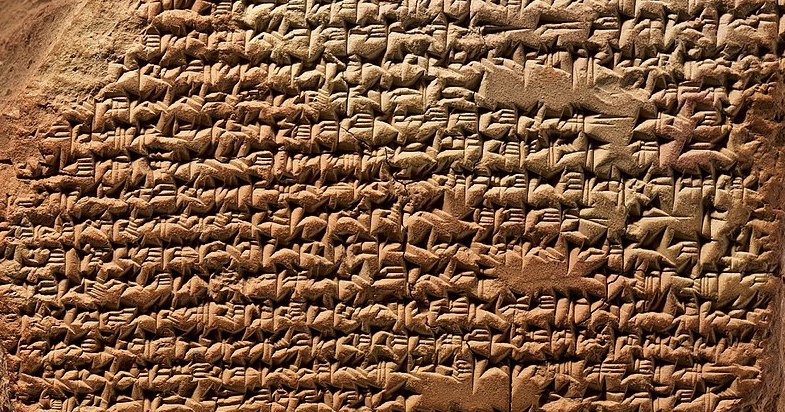
Sumerian script on a cunneiform tablet

Supplementary Materials
Part VI, SM 3

How the Ancient Sumerians Created
the World’s First Writing System

Bartle Bull on the Mesopotamian
Origins of Modern Civilization

November 22, 2024

“In Uruk he built walls, a great rampart, and the temple of blessed Eanna for the god of the firmament Anu, and for Ishtar the goddess of love. Look at it still today: the outer wall where the cornice runs, it shines with the brilliance of copper; and the inner wall, it has no equal. Touch the threshold, it is ancient.”
–The Epic of Gilgamesh, ca. 1750 BC


In the middle of the fourth millennium before Christ, men and women could feed themselves and their families, much of the time, but almost nobody else. They did not yet have the wheel. They could fight, but they did not have the capacity to make war. They could not read or write, for there was no writing. Without writing, there was no history. There were stories but no literature. Art was something that people might produce on their pottery, but never for a living. There were customs but no laws. There were chiefs but no kings, tribes but no nations. The city was unknown.

And then, around that time, civilization was born: urban life, based on nutritional surplus and social organization, characterized by complexity and material culture, much of it made possible by writing. This happened in a very particular part of the world: the flood-prone, drought-wracked, frequently pestilential plain of southern Iraq, where the rivers Tigris and Euphrates meet the Persian Gulf. The plain could be fertile, very fertile, but only when people worked together to irrigate it and control the floods with channels and earthworks; this necessity, most likely, accounts for much of the early surge in social complexity that distinguished the area. Later civilizations would arise independently in two great river valleys not so far away, the Indus and the Nile, but the original organized, literate, urban culture was produced by a far crueler and more challenging environment than either of those.

The need for a single script to serve a geography using two such dissimilar languages almost interchangeably was a great spur to the development of early Mesopotamian writing.

This first civilization came to be known as Sumer. By about the year 3000 BC, a city called Uruk near the mouth of the Euphrates River, just inland of the head of the Persian Gulf, had eighty thousand residents. A thousand years later Iraq, the land along the Euphrates and its sister stream, the Tigris, would be named for this early metropolis of Uruk. Sharing the land of Sumer, about the size of Belgium, with a dozen other city-states, Uruk was not always the foremost among its rivals in the land. But for most of its existence, spanning the two millennia of the Sumerian world, Uruk was the greatest city on earth.

The Sumerians invented kingship, priesthood, diplomacy, law, and war. They gave the West its founding stories: the opposition of darkness and light at the Beginning; the Flood, with its ark and dove and surviving patriarch; the tower of Babel; the distant ancestors of Odysseus and Hercules. The Sumerians established the outlines of our political, legal, and temporal structures too, with the first kings and assemblies, the first written laws, the first legal contracts, and the sexagesimal system of counting that regulates the hours and seconds of our days.

The Sumerians wrote the first epics and constructed the first monumental buildings. They invented the wheel, the sailing boat, the dome, and the arch. They were the first people to cast, rivet, and solder metals. They were the first to develop mathematics, calculating the hypotenuse of a right triangle two thousand years before Pythagoras and enabling extraordinary achievements in civil engineering. Compiling methodical lists of plants and animals, the Sumerians were the first people to apply rational order to our knowledge of the natural world.

The Sumerians wrote down almost everything they knew, much of it on disposable clay tablets that have survived the millennia. Some thirty-nine centuries after the last of the Sumerians died, another inventive and curious people, the Victorians of the nineteenth century AD, initiated a remarkable period of foreign exploration in Iraq. Thanks to this colorful and dramatic intellectual adventure, which began in the 1840s, today we can follow the course of Sumerian lawsuits, track Sumerian inventories, and study the terms of Sumerian marriages, wills, and loans. We read the overtures of Sumer’s diplomats. We follow in detail the provisioning of Sumer’s armies and the triumphs or disasters of their expeditions. We know intimately the pleadings of Sumerian students for more money from their fathers, and the pleadings of their fathers for more diligence from their sons. We track the transactions of Sumerian merchants in copper or onions. We admire the complex and perfect calculations of Sumerian engineers.

Human life on the alluvial plain of the two rivers at the birth of civilization five thousand years ago was precarious. Again and again, through the ancient stories and archaeological records that illuminate the dawn of history, plagues and pestilence swept the hot, low country. Terrifying floods killed and destroyed everything within reach of the raging waters that came every spring when the snow melted in the mountains five hundred miles and more to the north, in what is now Armenia and southeast Turkey. At Ur in Sumer’s far south, the great archaeologist Sir Leonard Woolley, digging in 1929, discovered a layer of “perfectly clean clay” more than eight feet thick separating the remains—pottery and much more—of two distinct cultures from some time before 3000 BC. A single flood, in other words, had created a temporary lake that deposited this eight-foot-thick layer. The catastrophic scale of such a deluge is almost beyond the powers of imagination. Woolley naturally surmised that it was the great flood of Genesis. Other floods have left similar records in southern Iraq. Most were smaller than Woolley’s Ur deluge. One left eleven feet of new flood soil.

Meanwhile neighbors from the higher, rougher country to the east, north, and west were greedy for the wealth of the settled plain, then as now. The invasions of barbarians from the Persian hill country, the Kurdish and Turkish mountains, and the Arabian steppe sometimes paused, but never ended. Within Sumer, Uruk and its neighboring city-states fought against each other almost constantly during the twenty-odd centuries of Sumerian civilization.

The soil of southern Iraq is a dusty, flinty accumulation of silt from the two shifting rivers that originate far to the north. In the areas where Iraq’s alluvial soil is not dry, it is marshy, especially in the south; it was more so in ancient times, when the Tigris and Euphrates were bigger. The ground is home to no minerals or ores, although bitumen seeps from the earth in places. The land contains no stones for building. Almost no tree, aside from the date palm, grows on it successfully. Trade with the far-off source-lands of raw materials—for tin and copper to alloy into bronze for weapons, for gold and silver to please the rich and the divine, for hardwood timbers for the roof beams of palaces and temples—required the pooling of resources. Organization and leadership were required to conduct commerce at scale with places as far afield as Anatolia for tin, Lebanon for cedar timbers, “Oman for copper, south-west Iran for carved stone bowls, eastern Iran for lapis lazuli, the Indus for carnelian.”

*

The water of the two great rivers irrigated the rainless plain. It also raged as a violent killer, to be restrained with dykes and channels. This required cooperation on a much larger scale than the individual village or town could offer. Better irrigation led to increasing harvests. As the land of Sumer became crowded with more and more people, food was another reason for increasingly sophisticated social arrangements. Each of these catalysts—trade, water, sustenance—also led to humanity’s first organized conflicts. War was born. Every Sumerian city had its own principal deity, and the many gods also sent men into their earliest battles there on the hot plain.

*

Late in the fourth millennium BC, a couple of thousand years after the advent of agriculture with the Neolithic revolution, Sumer was one of several distinct cultures around the world. In none of these cultures had true urban life and, with it, civilization yet developed. Then the Sumerian genius produced its greatest innovation: writing.

The eighty thousand people living in Uruk by 3000 BC sheltered behind walls that were forty feet high and six miles long. Archaeologists estimate these to have cost over five million man-hours to build. The fourth-millennium city occupied about 1.7 square miles, a little bit less than imperial Rome at its peak (2.1 square miles) and larger than classical Athens.At the archaeological site of Uruk, the residential buildings, workshops, and barracks have not yet been excavated. Thus it is still the case that “very little about the actual conditions of life in the city is known.” Yet this is certain: Uruk was the world’s only major city of the fourth millennium BC, marked by public buildings that were “unprecedented and unrivaled at the time.” Most of the labor for such civic projects in Sumer came from free laborers requiring recompense for their work. Trade in livestock and agricultural produce fed them and the residents of nearby towns. The Sumerians needed a way to keep track of it all. This was the setting in which writing was born.

The earliest writing and the earliest direct precursors of writing, all from the second half of the fourth millennium, have been found at Uruk. Initially, clay tokens the size of a thimble would be formed to represent the sorts of things that a person might own and trade, such as sheep. For convenience, these tokens would then be put into a larger, hollow clay ball a little smaller than a grapefruit. These clay spheres, called “bullae,” served as something like sealed wallets or envelopes for the information within. On its exterior, the bulla would then be impressed with authenticating marks from cylindrical seals rolled upon the clay surface.

At Uruk some of these bullae have been found with additional marks impressed onto their surfaces. These marks indicated the number of tokens contained inside. It was an obvious step. The next step then suggested itself. With the contents marked on the exterior, there was no need for the little tokens rattling around inside. By 3300 BC, the information was instead simply scratched onto the surface of the spheres. The Sumerians had invented writing.

It is the only invention that has ever rivaled that of agriculture for its transformational effect upon human existence. Eventually flat clay tablets replaced the bullae.

At this stage writing was almost purely pictographic. Characters signified their objects through more or less recognizable images. Any given pictograph might mean several different things. “Mountain”—a right-side-up pyramid formed by three convex half circles—also meant “foreign lands,” for Sumer was completely flat. Consequently the same character also signified “conquest.” Shown together with the symbol for “woman,” a downward-pointing triangle with a notch at the bottom tip, the two symbols meant a woman captured from far away: “slave-woman.”

Pictographs were originally drawn on wet clay with a sharp-pointed object. Clay was an ideal medium for the Sumerians. It was cheap and abundant on the floodplain. Clay tablets were easy to make and prepare, although it is still not known how the larger ones were kept wet and impressionable. Sumerian scribes eventually wrote for the most part as we do, from left to right, top to bottom.

A typical tablet might be two to three inches high and half again as wide, with writing often going all the way to the margins. Incisions toward the bottom of archaic Iraq’s writing tablets tend to be visibly less deep and clear than those at the top of tablets, as the drying clay became harder to work. Once the inscribed clay had dried in southern Mesopotamia’s hot sun, it would endure for scores of centuries, and possibly forever, if left somewhere still and dry. Tablets made from such cheap and ubiquitous material were easily discarded once no longer needed. To the delight of archaeologists dozens of centuries later, they were thrown into heaps or used to fill the spaces beneath floors.

The original pictographs were for the most part recognizably indicative of something physical: a plow or a mountain, a head or a hand. But clay as a two-dimensional medium is ill-suited to both detail and curves. Around the year 2900, scribes discovered that impressing a sequence of lines with a straight-edged implement such as a cut reed was easier than tracing with a pointed implement. Reeds are flat, with a spine along one edge. Thus the mark made by each impression of the cut-off reed comprised a straight line with a wedge at its tip. By 2100, Sumerian scribes possessed a fast, well-developed script. Almost four thousand years later, in 1700 AD, cuneiform was named after the Latin word for wedge, cuneus, by the court interpreter of Eastern languages at the court of William III of England.

The rigid straight lines of the new technique pushed the characters away from the representational and toward the symbolic and the stylized. As centuries passed, the pictographs lost their illustrational quality. They were now “ideographs.” “Mountain,” for example, became three semicircles. By 2500 BC the recognizably representational had disappeared.

Here was the evolution from the ideographic to the phonetic. The impact was revolutionary. The boundaries of writing were now as infinite as those of speech.

A representational writing system has significant limitations. It is not practical to have a symbol for everything. The symbols must mean the same to all who use the writing. Users must memorize thousands of these symbols and must also be familiar with that which is being expressed. Tenses, cases, and voices are mostly impossible to depict. In the first centuries of writing, an image illustrating a foot meant “walk,” “stand up,” “ground,” “foundation,” and more besides simply “foot.” This made things difficult enough, but how would one say, “She will walk”? Or, worse, “Will she walk?” or “How will she have walked?” The ideographic method also had great limitations, as it connected writing not to words themselves, but rather to whatever it was that the words expressed. Ideographic writing bypassed spoken language, in other words. Restricted to known events and objects, unconnected to the spoken word, such a system can never cover all that language covers.

The next great innovation in the development of writing derived from puns. Early in the third millennium before Christ, Sumerian scribes perceived that homophones allowed them greatly to expand the verbal territory covered by the symbols they had mastered. For example, the Sumerians originally lacked a pictograph for their word sum, “to give.” To signify “give” in writing they used the pictograph for another word (“garlic”) that also was pronounced “sum.” In English such a visual pun is called a rebus. We might remember these from school. The picture of an eye next to that of a reed is one such, challenging us to remember dimly, the Sumerians with the sentence “I read.”

With this development, writing was now attached to sounds, to the “signifier” and not the “signified.” By the time of what is known as the Old Babylonian period, about 1500 BC, the Sumerian discovery of the power of paronomasia had helped the Uruk period’s written lexicon of two thousand characters halve in number, even as it covered more meaning. Writing was more accessible. During the Old Babylonian period even a king might be able to read, where hitherto that skill had been largely the province of scribes.

*

Shortly after the earliest development of writing, an ominous cloud appeared on Sumer’s northern horizon: a people called the Akkadians. In contrast to the native Sumerians, the Akkadians were Semitic pastoralists living in what came to be known as the Arabian Desert, the huge, dry steppe to the south and west of the Mesopotamian floodplain. By about 3000 BC, the Akkadians had moved eastward out of the desert. They settled north of Sumer in the part of Iraq that later came to be known as Babylonia.

The Sumerians and Akkadians lived next to each other for a thousand years. The two peoples mixed and fought constantly. There was a great degree of bilingualism, and all manner of sharing between the two languages over time. But the Sumerian and Akkadian tongues are entirely different. How, in such a setting, might a Sumerian scribe record the name of an Akkadian merchant? The need for a single script to serve a geography using two such dissimilar languages almost interchangeably was a great spur to the development of early Mesopotamian writing. Eventually the increasingly cosmopolitan quality of life on the Mesopotamian floodplain would force the script to make itself usable by people of different tongues.

The demands of the emerging southern Mesopotamian sprachbund required that the script deliver more and more of the nuances of speech. With writing no longer able to ignore spoken language, a crucial change happened. Most of writing’s symbols came to represent not meaning—an object, activity, or idea, for example—but rather sound. Here was the evolution from the ideographic to the phonetic. The impact was revolutionary. The boundaries of writing were now as infinite as those of speech. Once the Sumerian script became phonetic, the civilization that cuneiform defined would spread until it reached from Iran to the Mediterranean and from the Persian Gulf to Anatolia.

*Excerpted from Land Between the Rivers: A 5,000-Year History of Iraq by Bartle Bull. Copyright © 2024 by Bartle Bull. Reprinted with the permission of the publisher, Atlantic Monthly Press, an imprint of Grove Atlantic, Inc. All rights reserved.
__________________________________


amazon link
 
The epic, five millennia history of the region between the Tigris and Euphrates Rivers that was the birthplace of civilization and remains today the essential crossroads between East and West

At the start of the fourth millennium BC, at the edge of historical time, civilization first arrived with the advent of cities and the invention of writing that began to replace legend with history. This occurred on the floodplains of southern Iraq where the great rivers Tigris and Euphrates meet the Persian Gulf. By 3000 BC, a city called Uruk (from which “Iraq” is derived) had 80,000 residents. Indeed, as Bartle Bull reveals in his magisterial history, “if one divides the 5,000 years of human civilization into ten periods of five centuries each, during the first nine of these the world’s leading city was in one of the three regions of current day Iraq”—or to use its Greek name, Mesopotamia.

Inspired by extensive reporting from the region to spend a decade delving deep into its history, Bull chronicles the story of Iraq from the exploits of Gilgamesh (almost certainly an historical figure) to the fall of the Iraqi monarchy in 1958 that ushered in its familiar modern era. The land between the rivers has been the melting pot and battleground of countless outsiders, from the Akkadians of Hammurabi and the Greeks of Alexander to the Ottomans of Suleiman the Magnificent. Here, by the waters of Babylon, Judaism was born and the Sunni-Shia schism took its bloody shape.

Central themes play out over the millennia: humanity’s need for freedom versus the co-eternal urge of tyranny; the ever-present conflict and cross-fertilization of East and West with Iraq so often the hinge. We tend to view today’s tensions in the Middle East through the prism of the last hundred years since the Treaty of Versailles imposed a controversial realignment of its borders. Bartle Bull’s remarkable, sweeping achievement reminds us that the region defined by the land between the rivers has for five millennia played a uniquely central role on the global stage.

Bartle Bull has written from the Middle East for the New York Times, Washington Post, Wall Street Journal, Financial Times, Daily Telegraph, Foreign Policy, Die Welt, and other publications. He is the only western journalist to have been embedded with the Mahdi Army in Iraq. He sits on the Visiting Committee of the Department of Ancient Near Eastern Art at the Metropolitan Museum in New York City. His 2017 Showtime documentary film Cradle of Champions, following three young athletes competing in the world’s oldest amateur boxing tournament, received numerous awards and rave reviews. 


~ Continue to Part VI, SM 3 ~


Evolution of Worship & Religion