Quotes & Sayings


We, and creation itself, actualize the possibilities of the God who sustains the world, towards becoming in the world in a fuller, more deeper way. - R.E. Slater

There is urgency in coming to see the world as a web of interrelated processes of which we are integral parts, so that all of our choices and actions have [consequential effects upon] the world around us. - Process Metaphysician Alfred North Whitehead

Kurt Gödel's Incompleteness Theorem says (i) all closed systems are unprovable within themselves and, that (ii) all open systems are rightly understood as incomplete. - R.E. Slater

The most true thing about you is what God has said to you in Christ, "You are My Beloved." - Tripp Fuller

The God among us is the God who refuses to be God without us, so great is God's Love. - Tripp Fuller

According to some Christian outlooks we were made for another world. Perhaps, rather, we were made for this world to recreate, reclaim, redeem, and renew unto God's future aspiration by the power of His Spirit. - R.E. Slater

Our eschatological ethos is to love. To stand with those who are oppressed. To stand against those who are oppressing. It is that simple. Love is our only calling and Christian Hope. - R.E. Slater

Secularization theory has been massively falsified. We don't live in an age of secularity. We live in an age of explosive, pervasive religiosity... an age of religious pluralism. - Peter L. Berger

Exploring the edge of life and faith in a post-everything world. - Todd Littleton

I don't need another reason to believe, your love is all around for me to see. – Anon

Thou art our need; and in giving us more of thyself thou givest us all. - Khalil Gibran, Prayer XXIII

Be careful what you pretend to be. You become what you pretend to be. - Kurt Vonnegut

Religious beliefs, far from being primary, are often shaped and adjusted by our social goals. - Jim Forest

We become who we are by what we believe and can justify. - R.E. Slater

People, even more than things, need to be restored, renewed, revived, reclaimed, and redeemed; never throw out anyone. – Anon

Certainly, God's love has made fools of us all. - R.E. Slater

An apocalyptic Christian faith doesn't wait for Jesus to come, but for Jesus to become in our midst. - R.E. Slater

Christian belief in God begins with the cross and resurrection of Jesus, not with rational apologetics. - Eberhard Jüngel, Jürgen Moltmann

Our knowledge of God is through the 'I-Thou' encounter, not in finding God at the end of a syllogism or argument. There is a grave danger in any Christian treatment of God as an object. The God of Jesus Christ and Scripture is irreducibly subject and never made as an object, a force, a power, or a principle that can be manipulated. - Emil Brunner

“Ehyeh Asher Ehyeh” means "I will be that who I have yet to become." - God (Ex 3.14) or, conversely, “I AM who I AM Becoming.”

Our job is to love others without stopping to inquire whether or not they are worthy. - Thomas Merton

The church is God's world-changing social experiment of bringing unlikes and differents to the Eucharist/Communion table to share life with one another as a new kind of family. When this happens, we show to the world what love, justice, peace, reconciliation, and life together is designed by God to be. The church is God's show-and-tell for the world to see how God wants us to live as a blended, global, polypluralistic family united with one will, by one Lord, and baptized by one Spirit. – Anon

The cross that is planted at the heart of the history of the world cannot be uprooted. - Jacques Ellul

The Unity in whose loving presence the universe unfolds is inside each person as a call to welcome the stranger, protect animals and the earth, respect the dignity of each person, think new thoughts, and help bring about ecological civilizations. - John Cobb & Farhan A. Shah

If you board the wrong train it is of no use running along the corridors of the train in the other direction. - Dietrich Bonhoeffer

God's justice is restorative rather than punitive; His discipline is merciful rather than punishing; His power is made perfect in weakness; and His grace is sufficient for all. – Anon

Our little [biblical] systems have their day; they have their day and cease to be. They are but broken lights of Thee, and Thou, O God art more than they. - Alfred Lord Tennyson

We can’t control God; God is uncontrollable. God can’t control us; God’s love is uncontrolling! - Thomas Jay Oord

Life in perspective but always in process... as we are relational beings in process to one another, so life events are in process in relation to each event... as God is to Self, is to world, is to us... like Father, like sons and daughters, like events... life in process yet always in perspective. - R.E. Slater

To promote societal transition to sustainable ways of living and a global society founded on a shared ethical framework which includes respect and care for the community of life, ecological integrity, universal human rights, respect for diversity, economic justice, democracy, and a culture of peace. - The Earth Charter Mission Statement

Christian humanism is the belief that human freedom, individual conscience, and unencumbered rational inquiry are compatible with the practice of Christianity or even intrinsic in its doctrine. It represents a philosophical union of Christian faith and classical humanist principles. - Scott Postma

It is never wise to have a self-appointed religious institution determine a nation's moral code. The opportunities for moral compromise and failure are high; the moral codes and creeds assuredly racist, discriminatory, or subjectively and religiously defined; and the pronouncement of inhumanitarian political objectives quite predictable. - R.E. Slater

God's love must both center and define the Christian faith and all religious or human faiths seeking human and ecological balance in worlds of subtraction, harm, tragedy, and evil. - R.E. Slater

In Whitehead’s process ontology, we can think of the experiential ground of reality as an eternal pulse whereby what is objectively public in one moment becomes subjectively prehended in the next, and whereby the subject that emerges from its feelings then perishes into public expression as an object (or “superject”) aiming for novelty. There is a rhythm of Being between object and subject, not an ontological division. This rhythm powers the creative growth of the universe from one occasion of experience to the next. This is the Whiteheadian mantra: “The many become one and are increased by one.” - Matthew Segall

Without Love there is no Truth. And True Truth is always Loving. There is no dichotomy between these terms but only seamless integration. This is the premier centering focus of a Processual Theology of Love. - R.E. Slater

-----

Note: Generally I do not respond to commentary. I may read the comments but wish to reserve my time to write (or write from the comments I read). Instead, I'd like to see our community help one another and in the helping encourage and exhort each of us towards Christian love in Christ Jesus our Lord and Savior. - re slater

Friday, June 3, 2016

NASSCAL: Studies in Christian Apocrypha - How to Submit Essays, Editions, Monographs, etc.


The North American Society for the Study of Christian Apocryphal Literature


NASSCAL Monograph Series:
Studies in Christian Apocrypha

The North American Society for the Study of Christian Apocryphal Literature (NASSCAL) is pleased to announce Studies in Christian Apocrypha, a book series produced in collaboration with Polebridge Press.

Christian Apocrypha is a term encompassing Christian texts—such as the Gospel of Thomas, the Acts of John, and the Apocalypse of Peter—that are not included among, but nevertheless bear some relation (in form, content or otherwise) to the texts of the New Testament. Apocrypha have been part of the Christian tradition almost from the beginning. Indeed, so ubiquitous is apocryphal literature that it must be embraced as a fundamental aspect of Christian thought and expression.

The Studies in Christian Apocrypha series will feature work on the Christian Apocrypha from any time period and in any of its myriad forms—from early “lost gospel” papyri, through medieval hagiography and sermons incorporating apocryphal traditions, up to modern apocryphal “forgeries.” 

We welcome submissions in the form of monographs, critical editions, collected essays, and multi-author works. The series is also the venue for the proceedings of the bi-annual NASSCAL meetings.


Series Editors

Tony Burke, York University
tburke@yorku.ca

Janet Spittler, University of Virginia
jes9cu@virginia.edu

Pierluigi Piovanelli, University of Ottawa
piovanel@uOttawa.ca

Stephen Patterson, Willamette University
spatters@willamette.edu

How to Submit Proposals 

Initial inquiries should take the form of a 3–5 page proposal outlining the intent of the project, its scope, its relation to other work on the topic, and the audience(s) you have in mind. Please include a current CV and 1–2 sample chapters, if available. Send proposals and inquiries to Tony Burke at tburke@yorku.ca.


Wednesday, June 1, 2016

New Atheism's Rise on Christianity's Lack of Focus on Social Justice


Reasons an atheist would leave religion

Let me speak in generalities and impressions today as a Christianity looking at the "popular church of contemporary society"... and let us focus on why Christianity is loosing its faithful to the ranks of "bewilderment, disillusionment, and disappointment." It is my assumption that it is not Christianity itself that is the problem when focusing on Jesus but its lack of grace and mercy when unapplied to the world around itself by focusing on truth-claims, judgments, and criticisms. By ignoring the importance of social justice the church misdirects its dogmas causing its mission to suffer as well as its image. Now let me explain briefly what I mean....

---

Why is new atheism on the rise? Its not simply over dissatisfaction with the Christian faith but because the Christian faith does not address the binding issues of social justice in a consistent manner. As such, the movement towards a new atheism is not so much a "mark of a disbelieving age" as it is the mark of an "unworthy religion" making itself irrelevant for a whole host of reasons not the least of which is the refusal to recognize its unloving and unethical treatment of people different from itself.

Hence, if a religion brings out the "ugly side of its people" than why would it be attractive except for its hate and prejudice? More simply, the rhetoric of religious injustice is its own expression of death and disillusionment. Not of unbelief! ... As many would have you believe. But the refusal of that religion to meaningfully address the many elements of needful social justice.

For example, when you have Republican politicians denouncing Muslims and Mexicans, women and transgenders, gays and minorities, beset in mob rallies of violence, punching, and angry shouts of hate, at which point has religious-based political agendas served to move the religiously faithful to a point of religious disillusionment as versus religious motivation to serve the poor, the oppressed, the needy, the lost and overlooked?

More simply, a faith that is bankrupt in its policies of justice to the oppressed is a faith not worth following. But for a religion that is to proceed in postmodern expectation and attraction, that faith must have within its core beliefs a works-based faith of justice, mercy, and compassion if it is to keep it's religious faithful while drawing disbelievers into its folds

Thus it is not so much an issue of disbelief (atheism) as it is an issue of a loveless, compassionless belief wrapped in oppression, discrimination, and hate. This then is where disillusionment sets in for the earnest participant of religion. Such a religion shows itself to be unworthy, inhuman, and ungodly. It is a religion worth leaving, denouncing, and abandoning.

R.E. Slater
May 29, 2016

*Reference - "New Atheism" [Wikipedia] - https://en.wikipedia.org/wiki/New_Atheism


* * * * * * * * * *


Atheist teen girl holding a banner (Shutterstock)

Rawstory
Hitchens, Dawkins and Harris are old news — a totally different Atheism is on the rise
http://www.rawstory.com/2016/05/hitchens-dawkins-and-harris-are-old-news-a-totally-different-atheism-is-on-the-rise/

by Chris Hall, Alternet
May 25, 2016

It’s surprising just how much media analysis, both mainstream and progressive, continues to take as given the notion that atheism can be defined and discussed solely by looking at the so-called “New Atheists” who emerged roughly between 2004 and 2007. It’s easy to understand the appeal: Richard Dawkins, Sam Harris and Christopher Hitchens became prominent representatives of atheism because they were all erudite, entertaining and unafraid to say what they thought. A lot of people, myself included, were drawn to their works because they were forthright and articulated things we had kept locked away, or simply hadn’t found the words for.

But in 2016, Hitchens is dead, and using Dawkins or Harris to make a case for or against atheism is about as relevant as writing about how Nirvana and Public Enemy are going to change pop music forever.

More and more, the strongest atheist voices are talking about nonbelief less as an end in itself, but as part of a larger conversation about social justice. It could hardly be any other way: atheism is growing not only in numbers, but in diversity. When Dawkins, Harris and Hitchens were at their most prominent, a frequent (and credible) criticism was that the faces of atheism were all white, male and affluent. To make the same claim now is to deliberately ignore some of the most vital atheist and skeptic voices that have emerged in the last 10 years.

Greta Christina, the author of Coming Out Atheist describes the changes in organized atheism: “[T]he movement has become much more diverse — not just in the obvious ways of gender, race, and so on, but simply in terms of how many viewpoints are coming to the table. The sheer number of people who are seen in some way as leaders… has gone up significantly…. And the increasing diversity in gender, race, class, and so on are important. We have a long way to go in this regard, but we’re doing much, much better than we were. And that’s showing up in our leadership. It’s absurd to see Dawkins, Hitchens and Harris as representing all organized atheism — it always was a little absurd, but it’s seriously absurd now.”

Just as in any other group, there are scores of people in atheist and skeptic communities who don’t want to have discussions about racism, sexism, homophobia, transphobia, and other bigotries, or say they’re irrelevant to the agenda at hand. The increase in diversity isn’t happening quietly or easily, and it’s often brought out the ugliest sides of people who base their entire identities on being rational and humane. Direct challenges to racism and sexism haven’t traditionally been the domain of the large organizations like American Atheists or the Secular Coalition for America. It’s been far more typical to fight incursions against separation of church and state or educate against pseudoscience like homeopathy.

It’s not that these aren’t important issues: separation of church and state is one of the linchpins of American democracy. As the Supreme Court’s recent decision in Town of Greece vs. Galloway shows, it’s also extremely fragile, and there is a very loud and insistent portion of America who would like to see it disappear entirely.

But such a narrow focus also means that atheist and skeptic groups have a history of looking at these issues in isolation, without considering how race, gender, or class play into them. That isolation has been one of the great limiting factors in the growth of movement atheism. Too many activists and groups trapped themselves in rhetorical Möbius strips, where their conferences and literature were dominated either by debunking the same pseudoscience over and over again, or fighting cases of church-state intrusion that were more relevant as abstract principles.

But the more people step forward and identify themselves as nonbelievers, the more it’s become obvious that this narrow focus is unsustainable. Although the top positions in many organizations are still dominated by white men, an increasing number of the most passionate voices bringing new people into the movement are people of color, women, transgendered, or queer.

Jamila Bey, the communications director of the Secular Student Alliance, summed up the concerns of many in a recent interview: “There are people who say, ‘Why are we talking about racism? We would rather argue that Chupacabra are fake.’ And fine, that is their right. On the other hand, I don’t get to divorce my critical thinking from my blackness, from my femaleness, from my position as a mother. So when I see the only affordable child care in my community being offered at churches, that’s an issue for me that makes me say ‘Wait a minute, there’s a problem here. Why am I not being afforded the opportunity for my child not to be indoctrinated just so my kid has somewhere to play and meet other children?’ I can’t divorce my whole life from my skepticism and for anybody who says, well , talking about female issues or talking about issues that impact black people, oh, that’s taking away from skepticism, I go, well that’s really easy for you to say. This is my life. I can’t divorce the issues. You can choose to not care about them or whatever, but don’t tell me I’m diminishing skepticism because I’m talking about the reality of what my life is.”

Those last few words speak directly to the very reason behind organized atheism: almost everyone who deconverts from religion and declares themselves a nonbeliever does so because of a compelling need to talk about reality. Whether it’s because we couldn’t reconcile the fossils in the earth with the story of creation we were told by our parents and clergy, or because of a need to lay claim to our sexuality without first checking for the approval or condemnation of a deity, the desire to discard what we perceive as falsehoods and speak honestly about the realities of our lives is one of the most commonly shared passions of atheists as a whole.

So, even for many of us who play life on the lowest difficulty setting, who get all the goodies that come along with white skin, cis-gender maleness and middle-class backgrounds, when old-school atheists attempt to dismiss social justice issues as “mission drift,” it seems like a betrayal of the very principle that was most attractive about standing up and identifying as an atheist in the first place. For those who don’t get those goodies, the betrayal is much more intimate.

#

If Dawkins, Hitchens and Harris brought a single essential insight to modern atheism, it was the idea that atheists could and should be unapologetic about their disbelief. For Heina Dadhaboy, who blogs on Skepchick, that was critical as she moved away from the traditional Islamic beliefs of her family.

“I think the fact that [Dawkins] was so unapologetic is why a lot of us became quite taken with his writings. It wasn’t so much what he was saying or how he was saying it, it was just the fact that he never apologized or capitulated for being an atheist.” That shamelessness helped Dadhaboy to assert her own voice as an atheist. Like most of mainstream culture, her family expected that if she was going to be an atheist, she would at least have the good sense to pay lip service to religion’s superior worldview.

“They expected me to capitulate,” she says. “They expected me to follow their rules and even if I didn’t believe in their religion, to agree with them that it’s more moral and makes more sense. Reading Dawkins was like, ‘Hey, I don’t need to do that.'”

Heina Dadhaboy, Greta Christina, Jamila Bey, and scores of others found their own voices, rather than becoming mere echoes of the New Atheists who were anointed by the media all those years ago. James Croft, the research and education fellow at the Humanist Chaplaincy at Harvard, says there are already generational differences in how they’re viewed. “Frankly, people like Richard Dawkins and even Sam Harris to some extent, are not viewed positively by young atheists now,” he says. “They actually don’t think that they’re that great. You still find people at the conventions who love them of course, but it does seem like they’re already a bit passé….They kind of pushed a door open, and that represents an opportunity, but the real task is to step through that door with some positive proposal of what life after religion has to look like.”

The first steps through that door have already been taken by atheist women, queers and people of color. Progress has not come easily, by any means. In some ways, it’s been outright nightmarish. The standard use of harassment and rape threats against women who make even relatively mild critiques of gender has put some of the ugliest, sickest parts of atheist communities on public display. It has even cost the movement voices; in 2012, blogger Jen McCreight proposed a new wave of secular activism called “Atheism Plus,” which would explicitly embrace social justice as part of its mission.

“It’s time for a wave that cares about how religion affects everyone and that applies skepticism to everything, including social issues like sexism, racism, politics, poverty, and crime,” she wrote. “We can criticize religion and irrational thinking just as unabashedly and just as publicly, but we need to stop exempting ourselves from that criticism.” The campaign of harassment and abuse that followed, combined with stresses in her personal life, eventually drove her to stop blogging and speaking at atheist events. McCreight recently began writing again at a new blog, The Jenome, which does not focus on atheism.

But despite the organized hatefulness, racism, misogyny, transphobia, or just the malign neglect of old-school atheists, those who are demanding that atheism become more intersectional and diverse are not becoming silent or fading away into the background. It’s becoming more and more obvious that these critiques are essential if organized atheism is to transcend its stereotype as a refuge for privileged eccentrics.

#

I can’t say when exactly I became an atheist. There was no flash of light, no road to Damascus moment where I suddenly dropped the Episcopalianism I was raised in. I stopped being a Christian sometime in early high school, but for years afterward, I tinkered with a wide range of mysticism and spiritualities, until I finally realized there was no “there” there.

What made me ultimately accept my atheism as an identity is that about the same time I began to fall away from Christianity, I began to be concerned about social justice. Atheism appealed not only as a logical conclusion, but as a more humane and just way of living. To make ethical decisions without the revelations from a deity means that the responsibility for those decisions ends with you, and no one else. Even more importantly, when you accept that there is no world beyond this one, you have to turn your eyes away from the sky and look at the people around you.

When Elliot Rodger went on his shooting spree in Isla Vista, the harm was not to the immortal souls of the people he shot and killed. His bullets tore into their bodies and devastated the lives of people in the real world. It was not a crime against god, or the spirit world, or Allah, or karma, but against fellow human beings who were alive and breathing and may have lived for decades more if he hadn’t pulled the trigger.

But those gunshots didn’t kill just because of chemistry and physics; the bullets were driven just as much by Rodger’s poisonous misogyny as by a sudden expansion of gases in the barrel of the gun. We are social creatures, and racism, misogyny, classism, and other prejudices affect our lives in ways that are just as solid as the earth orbiting the sun or our immune systems’ response to a vaccine. The activists who insist that atheism address matters of social justice are not distracting the movement from its purpose or being divisive; they are insisting it deliver on the promises that attracted so many of us to it in the first place.


Phillip J. Long - Discussion of 1 Enoch, Part 2


Enoch and the Essene Hypothesis
https://readingacts.com/2016/05/25/enoch-and-the-essene-hypothesis/

by Phillip J. Long
May 25, 2016

The book known today as 1 Enoch [is] not a single book, but rather a series of short books written over a period of time. They share some themes and interests, most obviously revelations given to Enoch. Since four of the five major sections of the book were found among the Dead Sea Scrolls, it would appear the Qumran community valued the books. But just because a book appears in a library is not sufficient evidence to conclude the owner of the book agrees with the contents. (For example, how many books in your personal library reflect what you actually believe?)

Gabriele Boccaccini argues in favor of a close relationship between the books of Enoch and the Qumran community. While there is no evidence to suggest the Essene community produced the documents which later became known as 1 Enoch. Boccaccini rightly notes the importance of this literature to the community, which he describes as a “a parent-child relationship.” (Boccaccini, Beyond the Essene Hypothesis, 12). He believes “the mystery of Essene and Qumran origins is largely hidden in the Enoch literature” (Boccaccini, 13).

There are problems with this proposal, however. As Boccaccini admits, the presence of an anti-Zadokite Enoch in a pro-Zadok Essene library is troubling. Other elements which are important in the sectarian literature of Qumran are missing. “The Enochian texts offer some theological surprises to the thoughtful reader who is sensitive both to what is there and what is not there” (Nickelsburg, 1 Enoch, 5). No sacrificial cult in Jerusalem, for example: “Soteriology is knowledge in Enoch, divinely revealed secret knowledge” (Nickelsburg, 1 Enoch, 6).

Reconstructing the community which might have created this literature is clearly difficult. Commenting on the possibility of reconstructing 1 Enoch’s community, Nickelsburg rightly warns, “We see darkly in a tarnished and scratched mirror, and our interpretations of the images often present only one of several possibilities” (Nickelsburg, 1 Enoch, 3). In Boccaccini’s reconstruction, the influence of Hellenism on the religion and practice of Israel is the impetus for the creation of this literature. As Hellenism made inroads into Jewish society in Palestine, those who argued for traditional Jewish values found themselves in a struggle for the hearts of the people.

That Israel is God’s elect is clear from the Hebrew Bible, but how that election relates to Jewish boundary markers was not always clear. The Hebrew Bible demonstrates clearly that God will judge between the righteous and the sinner, the elect and the non-elect. The Community which produced the material in 1 Enoch seems to have looked forward to a judgment of God which would sort out the true elect from the false.

*Bibliography: Gabriele Boccaccini. Beyond the Essene Hypothesis: The Parting of the Ways between Qumran and Enochic Judaism (Grand Rapids, Mich.: Eerdmans, 1998).


* * * * * * * * * * *


The Book of Watchers – 1 Enoch 1-5
https://readingacts.com/2016/05/27/the-book-of-watchers-1-enoch-1-5/

by Phillip J. Long
May 27, 2016

1 Enoch 1-5 is an introduction to the Book of the Watchers (1 Enoch 6-36). Nickelsburg argues the superscription to the book is an allusion to Deuteronomy 33:1 and he translates it to make the allusion more clear.

Deuteronomy 33:1 - This is the blessing with which Moses the man of God blessed the people of Israel before his death.

1 Enoch 1:1 - The words of the blessing with which Enoch blessed the righteous chosen who will be present on the day of tribulation, to remove all the enemies; and the righteous will be saved.

Chapter 1 describes a “day of tribulation” (יום צרה, εἰς ἡμέραν ἀνάγκης) during which the ungodly will be destroyed and a great cataclysm. The chapter is rich with apocalyptic language here: mountains and high places falling down, earth split asunder, etc. This tribulation is a time when the “God of the universe” will come forth from his dwelling and “march upon Sinai and appear in his camp” (1:4). This awesome event will cause all to tremble, even the Watchers, the angelic beings who constantly observe the actions of God.

This arrival of God is for judgment, as 1:9 states: “He will come with ten millions of his holy ones in order to execute judgment upon all.” This verse is used by Jude in the New Testament, but here in 1 Enoch it is the theme for the whole Book of the Watchers. With respect to the plot of the book, the judgment is the coming Flood, but it is clear the writer of 1 Enoch is thinking beyond the Flood to a future judgment of God on the wicked in his own day. Like Noah and his family, the elect of the writer’s day will be preserved from this coming judgment: “to the righteous he will grant peace.” The phrase “the elect” will be repeated throughout the Book of Watchers.

Chapters 2-5 are speculative wisdom not unlike Job 38-41. The writer invites his readers to examine the orderliness of creation and observe that God does not change. The natural order is a progression of seasons which follow very precise patterns and laws. In 5:4 he turns this into a condemnation of the wicked: “But as for you, you have long transgressed and spoken slanderously….” Verse seven then turns to the righteous, who will have “joy and peace in the earth.”

After the judgment, wisdom will be given to the elect who will all live and not return again to sin, being preserved from the plagues and wrath (5:7). This is not necessarily immortality since verse eight says they will live out the complete designated number of their days. Verse 9, however says their lives and happiness will “increase forever.” Isaacs says some manuscripts modify this to “and their lives shall be increased in peace,” taking away some of the ambiguity OTP, 1:15 note v, on verse 10). Nickelsburg agrees with this translation.

Like many of prophetic books, 1 Enoch begins by sounding several key themes. First, judgment is coming on the wicked. Like the Flood, this will judgment will be a cataclysm which destroys all. But second, the elect will be preserved in from this coming tribulation. Like Noah’s family, Enoch’s community may suffer, but they will be ultimately preserved and vindicated when the final judgment arrives. These are themes found in many apocalyptic texts; in the New Testament, Revelation promises judgment is coming and the preservation of the elect through that time of persecution.


* * * * * * * * * * *


The Fallen Angels – 1 Enoch 6-8
https://readingacts.com/2016/05/31/the-fallen-angels-1-enoch-6-8/

by Phillip J. Long
May 31, 2016

Chapter 6 begins the actual Book of the Watchers. In the biblical story of the Nephilim, the sons of God saw the daughters of men were are beautiful so they married them and had children (Gen 6:1-4). These children were called the Nephilim, the “mighty men who were of old, the men of renown.” In Genesis, the story shows how far the wickedness of humans had become: humans interacted sexually with spiritual beings. No details are given on how this might be possible, but the next verse in Genesis says “the wickedness of man was great in the earth, and that every intention of the thoughts of his heart was only evil continually.” This brief story is tantalizing: who are these “sons of God” and what were the Nephilim? 1 Enoch offers an expansion of this biblical story in chapters 6-11.

In 1 Enoch, the sons of God are the “sons of heaven,” angelic beings led by Shemihazah. The name Shemihazah (שׁמיחזה, šemîḥăzāh) means “My name has seen” and is sometimes vocalized as Semyaz of Semyaza (Nickelsburg, 179). “Name” refers to God, so the name refers to constantly watching God. This is ironic since God will see this rebellion and render judgment on the Shemihazah. Some readers want to find some reference to Satan as the leader of “fallen” angels. As the story progresses, however, Azazel emerges as the ringleader (but later Enoch will intercede on behalf of Azazel). This is an example of how foolish (and impossible) it is to project modern Christian angelology on 1 Enoch. Azazel is not the modern version of Satan at all!

This is FAKE
The two hundred angels take an oath to descend to Mt Hermon, find women to marry and have children with them. 1 Enoch 6:7-8 lists the names of the leaders of these angels. Most have names have some reference to God (Remashel, “evening of God” or Kokabel, “star of God” ). The most interesting of these names is Dan’el, a name associated with the Ugaritic literature and often offered as an explanation of the legendary character of Daniel.

In chapters 7 and 8 the angels make good on their oath and take women as wives. They teach humans “magical medicines, incantations, the cutting of roots and about plants.” The origin of folk-medicine is therefore ascribed to these angelic beings. The children of the angels are giants standing three hundred cubits (an improbable 1800 yards tall!) These giants eat so much food the humans cannot feed them anymore. The giants proceed to eat humans as well as all other kinds of animals.

The text notes especially that they drank the blood of animals, “sinning against them.” In the biblical flood story, the Noahic covenant includes a command about consuming blood. 1 Enoch 7-8 is a reflection upon this command which was probably given because the antediluvian world did in fact consume blood.

In addition to teaching humans to interpret a wide range of signs, they teach humans medicinal magic. The angel Azazel teaches humans metal-working, including making of ornaments and weapon making. Azazel also teaches them to make eye-shadow and other physical ornamentation. This may be a polemic against pagan practice of using make up in their religious ceremonies. Other angels teach the humans how to track the stars (astrology and divination) and the signs of the moon. These angels are responsible for teaching humans all sorts of the sinful practices. Humanity cries out as a result of this oppression, a cry which “goes up to heaven.”

This detailed expansion of the biblical stories blames wicked angelic beings for revealing mysteries to humans which will result in sin. It is not Adam’s rebellion in the garden that is responsible for human evil, but wicked angelic beings who do not remain in their appointed place. What is more, the great Flood is not the result of human sin, but the rebellion of these angelic beings.

This is a significant re-writing of the worldview of Genesis 6. What is the author’s motivation for this shift of blame?


* * * * * * * * * * *


Reading 1 Enoch in Ethiopic
https://readingacts.com/2016/06/01/reading-1-enoch-in-ethiopic/

by Phillip J. Long
June 1, 2016


This is a brief follow-up to my earlier post on finding a translation of Enoch. Several people have offered suggestions in the comments to supplement my opinion that the “best value” translation is the Fortress Press reprint of Nickelsburg and Vanderkam from the Hermeniaseries. But if you want to read the Ethiopic text of of 1 Enoch, the resources available tend to be very expensive and hard to find.

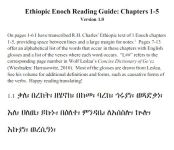
James Hamrick has created a number of Reading Guides for reading 1 Enoch. He is a Graduate Student at Ludwig-Maximilians-Universität München, blogs at The Ancient Bookshelf. He has posted a few these to Academia.edu. He uses the text from R.H. Charles and creates a worksheet with a vocabulary list. Hamrick does not offer any grammatical comments, but for a beginning student these worksheets will make for good practice.

Hamrick posted similar documents for Ethiopic Jubilees as well as a set of Ge’ez Flashcards.


* * * * * * * * * * *


The Archangels Render Justice -1 Enoch 9-11
https://readingacts.com/2016/06/02/the-archangels-render-justice-1-enoch-9-11/

by Phillip J. Long
June 2, 2016

In 1 Enoch 9 we learn the rest of the angels are watching the progress of the events on earth. Michael, Sariel (Isaacs follows the Ethiopic, Surafel; manuscripts have Uryan of Ur’el Raphael (Rufa’el) and Gabriel. They hear the cries of the humans and respond in a prayer to God himself. After praising God they point out to him the activities of Azazel on earth. They blame him for teaching humans the “eternal secrets” and Shemihazah for allowing the other angels to sleep with the humans and produce the hybrid giants.

The Lord responds to this prayer in chapter 10 by sending out a number of angels with specific tasks. An angel named Sariel (Ethiopic, Asuryal) is sent to the “son of Lamech” (Noah) to warn him of the coming flood. This angel is to instruct the son of Lamech on how to flee from the flood and “preserve his seed for all generations.”

In verses 5-8 the angel Raphael is sent to bind Azazel hand and foot and to throw him into the darkness. Both Jude 6 and 2 Peter 2:4-5 refer to angels who fell as “bound in chains in darkness.” Compare this also to Matthew 22:13 where the unprepared guest is ousted from the wedding banquet and is bound and thrown to “the place where there is weeping and gnashing of teeth.”

In 9: 9-10 Gabriel is sent to destroy the children of the angels (now called “Watchers”). These giants are described as “bastards and children of adultery.” Verse 10 says these giants hoped to live for five hundred years, which may be taken as how long they hoped to live before judgment came upon them, although it may simply refer to the length of their lives. There is no reference to the long lives of humans in 1 Enoch before the flood, so the five hundred-year life-span may be what is in mind.

In verse 11 Michael is sent to warn Semyaz he is about to be judged and bound for seventy generations under the mountains, until the day of judgment, in a pit of fire. Again, a similar theme is found in Jude 6 and Revelation 20:10-15.

After the time of judgment the world will be cleansed and the righteous will flourish: 10:18-19 mentions agricultural blessings; 10:21 describes the earth as cleansed from all pollution. God’s speech concludes in Chapter 11 with a brief description of the “storehouse of blessing” which will be opened after the time of judgment, a time when “peace and truth shall become partners again in all the days of the world and in all the generations of the earth.”

Looking back to the inspiration for this story in Genesis, the evil world is destroyed by the Flood, but this does not eradicate sin (Gen 9:20-29). 1 Enoch describes the world after the Watchers are destroyed as a time of peace and truth “for all eternity.” A similar apocalyptic pattern of coming judgment followed by a time of ultimate peace is certainly found in Revelation 20-22.

Tuesday, May 24, 2016

The Loeb Classical Library - Early Greek & Latin Literary Works Thru the Ages


RESOURCES

Wikipedia - Loeb Classical Library

The Loeb Classical Library (LCL; named after James Loeb /loʊb/) is a series of books, today published by Harvard University Press, which presents important works of ancient Greek and Latin literature in a way designed to make the text accessible to the broadest possible audience, by presenting the original Greek or Latin text on each left-hand page, and a fairly literal translation on the facing page. The General Editor is Jeffrey Henderson, holder of the William Goodwin Aurelio Professorship of Greek Language and Literature at Boston University.

Harvard University Press - Loeb Classical Library Online

edonnelly.com - Loeb Classical Library Online

Noet Library Builder - link here

Link to Library Builder


DISCUSSIONS & EDITORIALS


The bright ghosts of antiquity

On the enduring legacy of the Loeb Library.

The gist of an old joke—it has a dozen local iterations—is that the Loeb Classical Library translations are so baffling that you have to consult the original Greek or Latin on the left-hand page to decipher the English translation on the right.
Funny or not, the wisecrack catches the condescension long directed at the Loebs, that venerable series of Greek and Latin classics in uniform volumes with facing English translations. Professors of classics in particular used to frown upon them. Until recently, merely to be seen on campus with a Loeb was to court scandal. There were gradations of disgrace. Those Loeb editions of Boethius, Bede, and Augustine I saw on the shelves of the professor who taught me Anglo-Saxon: those were permissible for an English scholar. But I, as a classics major, was to eschew the very same volumes. Even as an undergraduate, though I prized my Loeb edition of The Republic, edited and imaginatively annotated by Paul Shorey, I knew better than bring it to my seminar on Plato. That same tact—that same hypocrisy—accounts for the care I took, as a graduate student, to avoid detection as I sifted the used bookshops of Cambridge for second-hand Loebs. For many of us, the pleasure we took in the Loebs was tinged with guilt.
But attitudes are changing. Once treated as evidence of the decline of Western civilization, the Loeb Classical Library is now, in its centennial year, more often regarded as, if not quite a pillar of our culture, at least one of its more enduring and useful props. The centenary invites consideration of how the Loebs have both reflected and, increasingly, shaped our literary culture.
First, to deal with that joke: Are the Loeb translations really so convoluted? They are not. What is true, though not true enough to justify the slur, is that some of the translations, especially those of the Library’s first few decades, do make hard going for the reader, not because they are incomprehensible but because they are written in one of two different varieties of translationese. About the first kind, theTimes Literary Supplement reviewer got it right when he complained that the 1913 Loeb Catullus was translated not into English exactly, but that other dialect, “the construing lingo beloved of schoolboys, but abhorred by man and gods.” He had in mind such clunking touches as “remains to be slept the sleep of one unbroken night” for Catullus’ suave nox est perpetua una dormienda, a solution which confirms, as though to satisfy a schoolteacher, the translator’s grasp of the future perfect passive, whatever the cost to English idiom.
The second kind of translationese aims for a lofty register, vaguely archaic with its sprinkling of yea verilies and forsooths, an English of no recognizable time or place. You get it in the 1924 prose translation of the Iliad, by A. T. Murray, where Menelaus has just hurled his spear at Paris:
Through the bright shield went the mighty spear, and through the corselet, richly dight, did it force its way; and straight on beside his flank the spear shone through his tunic; but he bent aside and escaped black fate. Then the son of Atreus drew his silver-studded sword, and raising himself on high smote the horn of his helmet; but upon it his sword shattered in pieces three, aye, four, and fell from his hand.
Not for reading at long stretches, but Murray, here and throughout, is in fact a good guide to the sense of Homer’s Greek. His Loeb is not to be read, but consulted, by the undergraduate stuck on a construction, or the former student having a fresh look at Greek in middle age, or by the curious coming to Greek for the first time. For these purposes the Loebs have always been valuable. The truth about those old Loeb translations is not that they are, as the joke has it, incomprehensible, but honorably serviceable. Admittedly, if your Greek is good enough, it is easier to follow the thread of the original than to pick your way through the Spenserian pastiche of “richly dight” and “shattered in pieces three, aye, four.”
But then if your Greek were good enough, you wouldn’t be reading the Loeb edition, would you? Therein lies a key to the academic animus against the Loebs: the anxiety that such convenient translations are as much a cause of the decline of Latin and Greek as a symptom. There is some justice in such fretting. The temptation, when you are supposed to be construing a knotty passage of Thucydides, to resolve the problem with a stolen glance at the right-hand page, proves too much for many students. (Credite expertoalas.) So it is understandable for teachers to see the Loebs as an all-too-convenient crib which erodes the discipline needed to master the ancient languages.
The prejudice has even deeper sources. The Loebs represent a step in the democratization of classical literature, a process underway since the nineteenth century, when an aspiring middle class, together with working-class autodidacts, clamored for access to the Greek and Latin masterpieces which their merely English education had denied them. A large translation industry rose to meet the demand for workmanlike but serviceable renderings of classical literature. A boon, surely? The classics finally reaching the wide audience they deserve? Yes, but. The people tended to get not the classics exactly, but the classics in paraphrase; they turned to translations, but not to the Latin and Greek languages. In that sense, the more popular the classics became, the more concessions had to be made for ignorance of the ancient languages themselves. Few classicists have ever held the extreme view that in order to preserve the ascendency of the discipline no quarter must be given to accessibility. But many of them have felt a twinge of regret at this or that further popular accommodation.
The last twenty years or so have brought a number of such concessions. In 1990, for example, the Greek scholar Sir Hugh Lloyd-Jones broke with tradition by writing the preface to his new Oxford edition of Sophocles not, as had been customary, in Latin, but in English. His chief reason (that readers of Greek can no longer be assumed to have already mastered Latin) was perfectly sound, and it was generous of Lloyd-Jones to make the preface accessible to those who would otherwise be needlessly excluded. Yet one could approve of the innovation while at the same time feeling that it reflected the decline of the tradition.
Similarly: until a few years back, scholars never felt the need—would never have stooped—to translate the Greek and Latin passages they quoted in their books and articles. Now publishers ordinarily require them to do so. Again, even those who welcome such a development may also feel it to be another nail driven in the coffin of classical studies. The Loebs embody that paradox. I might concede that Kindles and Nooks both extend more widely the blessings of reading, while at once hastening the demise of reading, or the kinds of reading I prefer. In such a way, the Loeb Library has sometimes been thought to hasten the demise of classics as a discipline even as it preserves and promotes them. The Loebs are among the best emblems of the mixed blessing that is the democratization of the classics.
Given the altruism of its founder, it is a shame the Loeb Library has suffered these resentments. The son of the head of a major New York banking firm, James Loeb (1867–1933) could hardly escape a career in the family business, where he made a tidy fortune. His heart, though, lay with the Greek studies he had loved as a Harvard undergraduate, so when the stress of banking drove him to early retirement, he was eager to direct his resources into the service of the classics. He announced his plan for the Loeb Classical Library in 1911; within two years the first thirty volumes had appeared. For the remaining twenty-two years of his life he supervised the project and, upon his death, bequeathed the whole enterprise to Harvard University.
By the early 1970s, the Library had run into trouble. Its trustees were not being replaced when they died or retired. The business office in Massachusetts was not kept abreast of the activities of the editorial office in London. Production costs were exceeding income. The Library might have gone under if not for the appointment, in 1973, of a new trustee, the Harvard classicist Zeph Stewart (from whose unpublished account of the Loeb’s history I am drawing). With great foresight, he appointed both a new general editor, Latinist George Goold, and a canny business manger, Brian Murphy, whose respective skills were to save the Library from extinction.
The next two decades brought the Library financial stability, so that by 1990 Goold could inaugurate a program of revising, and in some cases, replacing, old editions, while at the same time commissioning entirely new volumes. Amid this flourishing Goold retired and, to the Library’s further good fortune, was succeeded by Jeffrey Henderson of Boston University. Henderson is probably the world’s leading Aristophanes scholar, and his own Loeb editions of Aristophanes are exemplary of the high quality of the Library’s volumes—in the case of some of the more obscure authors, the only editions available—under his general editorship. The translations can no longer be sneered at: they are clear, idiomatic, and accurate, and (as in Henderson’s Aristophanes) no longer bowdlerized. Introductions, notes, and other apparatus, though intended for non-specialist readers, meet high scholarly standards. Three to five new editions appear annually, and there are plans for the whole Library to be digitized and placed online, where its contents can be searched and manipulated. Because the Library has coincided with the ascension of English as the global lingua franca, classics departments around the world make it a point to acquire the whole set—a notable reversal of the old invidium academicum. Remarkably, the Library now turns a profit which, in accordance with the stipulation of James Loeb, is directed, in the form of grants, to support the work of classicists and archaeologists. Altogether, it is one of the few cultural institutions which is getting better and better. The days for condescending to the Loeb Classical Library are over.
We have hardly begun, though, to take stock of the Library’s contribution to literary culture. One unwritten chapter in the history of English literature is the story of how the Loebs have gone into the making of new literature in the past hundred years. The moment that the Library entered the consciousness of English writers can be pinpointed to May 14, 1917 when, in the pages of the Times Literary Supplement, a major novelist stuck up for the Loebs as striking a blow for every reader who happens not to be a professional classicist, but an amateur in all its worthy senses. Among which class of readers the author—Virginia Woolf—was pleased to count herself:
To those who count themselves lovers of Greek in the sense that some ragged beggar might count himself the lover of an Empress in her robes, the Loeb Library, with its Greek or Latin on one side of the page and its English on the other, came as a gift of freedom to a very obscure but not altogether undeserving class. The existence of the amateur was recognized by the publication of this Library, and to a great extent made respectable. He was given the means of being an open and unabashed amateur, and made to feel that no one pointed the finger of scorn at him on that account; and in consequence, instead of exercising his moribund faculties almost furtively upon some chance quotation met in an English book he could read a whole play at a time, with his feet on the fender.
To fend off the reproach that would attach to the Loebs was more of a feat than Woolf’s generous defense of the amateur could achieve, as we have seen. But she was right (despite classicists’ fear that bilingual editions would discourage mastery of the languages) in predicting that the Loebs would sometimes lead readers back to the Latin and Greek they had once studied and half-recalled:
With such treatment, too, his little stock of Greek became improved, and occasionally would be rewarded with one of those moments of instant understanding which are the flower of reading. In them we seem not to have read so much as to recollect what we have heard in some other life.
This is an acknowledgment that a culture of the classics—in which non-specialist readers enjoy a reasonable and feeling acquaintance with ancient literature—is as important as the discipline of the classics, that narrower society of professionals who must uphold standards of scholarly excellence. The Loebs, Woolf foresaw, could minister to the one group without outraging the other. She prophesied that the Library would become an institution: “We shall never be independent of our Loeb.” Gibraltar may tumble, but our Loeb is here to stay.
Yet none of Woolf’s insights is as important as the fact of their having issued from Virginia Woolf. For the Loebs, as the twentieth century rolled on, would resonate not only with the general reader but also novelists, playwrights, and especially poets. Among these was W. H. Auden, a poet of strong classical temperament who nevertheless required the occasional bit of help with his Latin. The Loebs supplied this need, but they also entered into his writing. When, in his 1937 radio play Hadrian’s Wall, he needed to put words into the mouth of an ancient Briton resisting Roman invaders, Auden lifted whole sentences, almost unaltered, from Maurice Hutton’s 1914 Loeb edition of Tacitus’ Agricola. In doing so, he was revisiting the scene of an earlier, subtler, plundering. As John Fuller has shown, Hutton’s elegant construal of one of Agricola’s rhetorical epigrams, slightly altered, found its way into Auden’s 1931 poem “Now from my window-sill I watch the night.”
Auden concealed his debts to the Loeb Library, but a recent development finds poets making the Loebs not only a source, but also a subject, for their poetry. It’s as if a formerly unseen stage prompter, accustomed to whispering lines to the actors, had been invited onto the stage himself. Nearly two decades ago, the American poet Donald Hall, in The Museum of Clear Ideas (1993), set about clearing some fresh poetic ground for himself by making a modern adaptation of each of the thirty-eight poems in Horace’s first book of odes. Among them is the so-called “Cleopatra Ode,” which celebrates the victory of Octavian—the future Augustus—over Marc Antony and his Egyptian consort. The first stanza famously calls for a relaxation of wartime austerity:
Nunc est bibendum. nunc pede libero
pulsanda tellus; nunc saliaribus
      ornare pulvinar deorum
            tempus erat dapibus, sodales.
If you consulted the current Loeb edition, you would find the following translation by the superb Latinist Niall Rudd:
Now let the drinking begin! Now let us thump the ground with unfettered feet! Now is the time, my friends, to load the couches of the gods with a feast fit for the Salii!
But Rudd’s translation is very recent: it appeared in 2004. Before then, anyone coming to Horace through the Loeb Library would have been in the hands of the Cornell University professor Charles E. Bennett, whose 1914 translation of the odes enjoyed an extraordinary ninety-year run. For a great many readers in the twentieth century—teenage me included—Bennett’s Horace was the first encounter with that poet’s lyrics. His rendering of the Cleopatra Ode begins like this:
Now is the time to drain the flowing bowl, now with unfettered foot to beat the ground with dancing, now with Salian feast to deck the couches of the gods, my comrades!
Even in 1914 this may have felt, to some readers, as though Bennett were addressing them from the top of fairly lofty stilts. Eighty years on, this kind of diction offered Donald Hall an occasion for comedy. The opening of Hall’s version of the poem, whose aggiornamentoturns on celebrating the defeat, at the polls, of an odious U.S. senator, accordingly plays not only upon Horace’s ode, but also teasingly frets about Bennett’s particular translation of it:
Nunc est bibendum. To condescend the phrase
into the preferred demotic—Latin that
      plain folks talk, picking up Anglish from
            the cowboy and High Dutch from the sergeant—
we may translate the suggestion, “let’s get burnt,”
or choose the style of C. E. Bennett (Cornell
      University, nineteen-fourteen):
            “Now is the time to drain the flowing bowl.”
What is a credible register in which to voice Horace in 1993? “Let’s get burnt” will not quite do, but neither anymore will Bennett’s “Now is the time to drain the flowing bowl.” Dramatizing the translator’s predicament, Hall pokes fun at Loeb translationese. Part of the force of his poem lies not only in the rhetorical distance it achieves from Bennett’s grandiloquence, but also in drawing attention to that distance. To take the trouble to signal the distance in time (and not merely “1914,” but “nineteen-fourteen”), also bolsters the effect, as does citing, as the Loeb title-page does, the translator’s credentials (“Cornell University”). To invoke all this is to impute long familiarity with Bennett’s Loeb, as though from distant school or college days, revisited now with an adult’s ironic detachment. The Loebs by now are no longer only stepping-stones to classical culture (as in Woolf’s review) or (as in Auden) a trove of hints for English writers. They are an institution, and as such susceptible of debunking. They are also part of our past, part of a lifetime’s mental furniture, worthy subjects of literature when our mental furniture wants rearranging.
It’s not just Bennett’s translation, though, that Hall is looking at as he rewrites the Cleopatra Ode. The face-en-face format of the Loebs encourages binocular vision, and Hall shows himself duly attending to the Latin on the left-hand page, in that his English poem reconstructs exactly the syllable-count of Horace’s Latin stanzas: two lines of eleven syllables each, then nine in the third, and ten in the fourth. One of the potentialities of the Loebs is that they may lead the curious from the English back to the Greek or Latin, even if only, at the very least, to an apprehension of the shapes of the original poem’s stanzas. (In my own case, a lifetime’s appreciation of Horace was precipitated not by reading Bennett’s prose translations, but by my fascination at the sight of the intricate stanza forms opposite, though I could not yet read the Latin.) The mere presence of the ancient originals on the facing page can shape—in Hall’s case, literally shaped—the English of modern writers who allow their eyes to wander from recto to verso. This binocular effect is embodied most tellingly in Hall’s noticing that Bennet’s line “Now is the time to drain the flowing bowl,” though presented as prose, reads like a line of iambic pentameter, and its ten syllables correspond conveniently to the ten syllables required in the second stanza’s fourth line. To have the Greek or Latin, and not just the translation, in sight can be a spur to invention.
On the eve of the Loeb’s centenary, Seamus Heaney published “The Riverbank Field” in The Human Chain (2010), an elegant meditation upon, and rewriting of, a passage from Virgil’s Aeneid which takes the relevant volume of the Loeb Classical Library as its point of departure:
Ask me to translate what Loeb gives as
“In a retired vale . . . a sequestered grove”
And I’ll confound the Lethe in Moyola
By coming through Back Park down from Grove Hill
Across Long Rigs on to the riverbank—
Which way, by happy chance, will take me past
The domos placidas, “those peaceful homes”
Of Upper Broagh. Moths then on evening water
It would have to be, not bees in sunlight,
Midge veils instead of lily beds; but stet
To all the rest: the willow leaves
Elysian-silvered, the grass so fully fledged
And unimprinted it can’t not conjure thoughts
Of passing spirit-troops, animae, quibus
altera fato Corpora debentur, “spirits,” that is,
 “To whom second bodies are owed by fate.”
What’s new here is the presence of the single, unqualified word—“Loeb”—as all that Heaney needs to summon a range of ideas and feelings. The idea, for instance, of a received cultural standard, needing no introduction or explanation, a baseline from which Heaney can effect a creative deviation, transposing Virgil’s Elysian Fields into the topography of his own Irish homeland.
More than that, though: this is a poem about ghosts, spirits who, though they have long ago shed their mortal bodies, yet linger in existence, available to converse with whatever mortals who, like Aeneas, can find the key to their world. The Loeb Classical Library is such an underworld, an Elysian Fields where the brightest ghosts of antiquity of all ages are gathered together, like the company of pagan poets in Dante, available for conversation with the living. And up to this point in the poem, the words of H. R. Fairclough’s Loeb translation, altered only by ellipses, serve Heaney well enough.
It’s in the last third of the poem, though, that Heaney takes leave of the Loeb, to speak instead “in his own words,” as when, a schoolboy, he had been called upon by the Latin master to construe a passage:
And now to continue, as enjoined to often,
“In my own words”:

“All these presences
Once they have rolled time’s wheel a thousand years
Are summoned here to drink the river water
So that memories of this underworld are shed
And soul is longing to dwell in flesh and blood
Under the dome of the sky.”
Every good translation is a rebirth. Old works in ancient languages are latent potentialities craving fresh embodiment. Heaney honors the Loeb by respectfully parting ways with it; he sheds the older incarnation of Virgil in order to effect this new one. His method (translation and adaptation) is at one with his theme (reincarnation); the Loeb is not only the poem’s source, but part of its potent substance. “We shall never be independent of our Loeb”: but what had been a question of dependence for Virginia Woolf becomes, in Heaney, a matter of fruitful interdependence.
I have a little apocalyptic fantasy that involves the collection of Loebs in my local library. It’s a complete set, from Homer’s rosy-fingered dawn to the twilight of Ammianus Marcellinus. The very sight of it is reassuringly tidy: all the sprawling energies of a thousand years of Greek and Roman thought and song, distilled and compacted into these snug matching volumes, the Greek bound in olive drab, the Latin in scarlet. Run your fingers over the spines. Here are The Classics.
Then comes a nuclear holocaust. My local library, like others around the world, is mostly pulverized, but an accident involving molten rubber preserves the case of Loebs intact within a sealed airtight cavity beneath the rubble. Centuries elapse and deposit their layers of sediment. Above ground, the descendants of the survivors plod on, speaking a crude version of English, and when their vestigial civilization is at last stable enough to permit cultivation of the liberal arts, their curiosity turns to the prior civilization, ours, whose evident sophistication is attested only in the occasionally exposed ruin, or in fragments of excavated texts. Of this second category, a half-page of Danielle Steele, the corner of a Dunkin’ Donuts advert, and the odd shred of Paradise Regained are all scrutinized, edited, and interpreted with equal zeal. The fragments are exasperating: they imply a vast literature, and behind it a teeming culture, all tantalizingly out of reach.
Until one day when excavation unseals that underground cavity, and for the first time in so many centuries, sunlight falls on those green and red spines. The whole Loeb Classical Library, dedicated to preserving whatever could be salvaged from an even earlier lost civilization, has itself survived intact. The excavators fall upon the cache and discover not only the English (which they can mostly make out, though it appears to them as remote as Chaucer to us) but also, to their astonishment, on the facing pages, two strange, even more ancient languages, one with an unfamiliar alphabet. Amid a storm of speculations it is posited that the English is the key to the other two tongues, and in time a latter-day Champollion steps forward and reconstructs the grammar of Latin and Greek. His successors, pioneer scholars of the recovered ancient languages, are at first awestruck—what are these voices speaking out of the dust?—and then electrified, as they begin to read and assimilate Homer and Sophocles and Lucretius and Augustine. These voices must be emulated; the standards are daunting but stimulating; though ancient, they point the way to something new. Academies are organized for teaching the new languages; young souls (they will become poets and historians and scientists) are once again smitten by the songs of Sappho and Catullus, the grave brilliance of Thucydides and Tacitus, the searching effervescence of Plato’s Socrates and Aristotle’s dogged earthbound inquisitiveness. The post-apocalyptic world shrugs off its torpor, hums with ideas and energy and hope.
I suppose what I mean by all this is that it is good to know that the Loeb Classical Library is there, patiently waiting, in case any civilization (not least our own present one) should require a renaissance.

* * * * * * * * * *

JOHN HARVARD'S JOURNAL | TWO TEXTUAL TRADITIONS

Loeb Classical Library 1.0

The Loeb classics, newly available online


WHEN JAMES LOEB designed his soon-to-be-launched series of Greek and Roman texts at the turn of the twentieth century, he envisioned the production of volumes that could easily fit in readers’ coat pockets. A century later, that compact format is still one of the collection’s hallmarks. Beginning in September, however, the iconic books will be far handier than Loeb had hoped: users of the Loeb Classical Library (LCL) will have the entire collection at their fingertips. After five years of dedicated work on the part of the library’s trustees andHarvard University Press (HUP), which has overseen LCL since its creator’s death in 1933, the more than 520 volumes of literature that make up the series will be accessible online. Besides allowing users to browse the digitized volumes, which retain the unique side-by-side view of the original text and its English translation, the Digital Loeb Classical Library will enable readers to search for words and phrases across the entire corpus, to annotate content, to share notes and reading lists with others, and to create their own libraries using personal workspaces. 
LCL managing editor Michael Sullivan, whose position was created earlier this year to supervise the virtual library, said that the digitization project is “a major leap forward in the history of the Loeb.” According to HUP executive editor-at-large Sharmila Sen, the launch of the digital LCL marks “a moment of rebirth” for the historic collection. She explained that in the years preceding the library’s 2011 centenary, the trustees and HUP administrators began to think about how to make the LCL “relevant to the twenty-first century.” Even though online databases of Greek and Latin literature have existed for years, said the library’s general editor,Jeffrey Henderson, a classics professor at Boston University, the digital Loeb will be unprecedented in its accessibility and scope: for the first time, readers without knowledge of Greek and Latin will be able to explore a vast range of the classical literary heritage online through high-quality, modern translations. He added that the project, which cost the LCL foundation more than $1 million, will serve as a model for the digitization of other HUP series, noting, “It’s strange that the oldest literature becomes the model for the digital age.”
Consolidating a vast literary corpus involving two different alphabets into an interconnected, elegant, and easy-to-use website required much behind-the-scenes work, Sen said. Designing the software for the digital library and transferring the data have concluded, she noted, but the project overseers view the current product—which will be available by subscription to institutions and individuals—as only a 1.0 version. The website will be a dynamic workspace, Henderson pointed out, adding that user feedback will help the editors increase its functionality. 
According to LCL executive trustee Richard Thomas, Lane professor of the classics, the digital library will have a remarkable pedagogical function. Instructors, he explained, will be able to link the digital texts directly to their syllabi—a feature he expects to be particularly useful in his own Latin courses. Assistant professor of classics Paul Kosmin plans to use the virtual library for his survey course, “Classical Studies 97a: Greek Culture and Civilization,” which attracts both students familiar with the ancient language and those who are not. Accessing the bilingual Loebs online during section, Kosmin explained, will equalize the learning experience. “It’s going to be a wonderful, wonderful resource,” he noted, adding that his students will be able to analyze texts together on the digital platform using the annotation feature. Emma Dench, professor of the classics and of history and a scholar of ancient Rome (see Harvard Portrait, March-April 2010, page 49), said the up-to-date online versions will replace out-of-copyright translations—which do not “read very nicely” and are less authoritative than the Loebs—that she has often had to use in the classroom. The virtual library, she added, will be especially valuable for instructors who teach courses that require many classical texts.
The impact of the digitization project will extend beyond classical studies, Thomas pointed out.  The virtual library, he said, will be a “scholarly tool not just for classicists, but for those in English literature, Romance languages, philosophy, history, political science.” Cogan University Professor Stephen Greenblatt wrote in an e-mail to Harvard Magazine that he can imagine using the digital LCL to explore Shakespeare’s indebtedness to Roman authors like Plutarch, Ovid, and Cicero. “[The classics] remain, after thousands of years, a vital intellectual, scientific, cultural, and spiritual matrix,” he added. Frankfurter professsor of law Noah Feldman [title updated 8-18-2014] said the virtual library will be useful in his courses on constitutional law and legal theory. “I would far rather refer students to a good text,” he explained, “than have them wandering around on the Internet.” He added that the digital LCL will be particularly helpful for an undergraduate general-education course on power and constraint that he is now designing.
Teaching aside, scholars and authors plan to use the digital library to conduct research. Kosmin, whose work on the Hellenistic period involves visiting archaeological sites and exploring the itineraries of ancient monarchs, will no longer need to carry all the relevant Loebs with him during his travels. Wien professor of drama and of English and comparative literature Martin Puchner (see Harvard Portrait, May-June 2013) said that the Loeb website will facilitate his research for a book about the history of world literature that will feature several classical authors. “I use [the Loeb series] to engage classical texts whose original language I know but not as fluently as I would like to,” he noted. Beyond the Harvard community, British novelist and historian Tom Holland said that he will browse the digital library to inform his forthcoming book about the Julio-Claudian dynasty, instead of paging through several printed volumes from beginning to end.
According to editors and faculty members, the digitization project will not endanger the familiar red- or green-covered volumes. But keeping the print series, which will continue and expand, in sync with the online version will present new challenges, noted Henderson. “It’s important that people don’t get the idea that the print library is obsolete or that the most recent version is online,” he explained, “so we’re going to revise each in tandem.” Henderson added that he does not believe that the availability of the series online will harm print sales because the two libraries serve different purposes. Dench pointed out, “There is for me a limit to how much I actually want to read a book cover-to-cover on the Internet.” She suggested that the launch of the website may even increase print sales as more people become aware of the collection.
Digitizing the Loeb will help preserve a literary heritage that, Sen noted, “has survived many technological upgrades” since antiquity. According to Feldman, the online project has a larger importance. “The commitment that the University and Harvard University Press have to these volumes is symbolic of our commitment to humanistic knowledge and education,” he suggested. “It’s wonderful and hugely important that that commitment not be seen as something archaic, but as something that’s alive.”