 |
| Illustration by R.E. Slater and ChatGPT |
physics and biology, in which reality is understood as coherence,
Cosmic Becoming Cycle → poetic and metaphysical expansion
Embodied Process Realism → formal philosophical framework
Processual Divine Coherence → theological bridge
Preface - Why This Bridge Matters Now
The study of consciousness has, for centuries, been organized around a set of enduring philosophical divisions. Chief among these is the distinction between dualism and monism - a division that has shaped how thinkers have approached the relationship between mind and world, subject and object, experience and matter.
In its classical form, this divide asks whether reality consists of one kind of substance or two. From this question have emerged the dominant traditions of the philosophy of mind: substance dualism, materialism, idealism, and their many contemporary variants. Even today, introductory treatments of consciousness, such as those presented by Zachary Fruhling, continue to rely on this framework as a way of organizing the field (as reference, see his 3-Part Philosophy Class here).
There is good reason for this.
Dualism and monism represent the most general ways of answering the question of what reality is composed of. They provide a conceptual scaffolding within which a wide range of theories - physicalist, emergentist, panpsychist, and idealist - can be situated and compared. In this sense, they are not merely historical categories, but enduring orientations that continue to structure philosophical thought.
And yet, as the study of consciousness has deepened, it has become increasingly clear that this framework, while foundational, may no longer be sufficient.
The problem is not that dualism and monism are wrong.
The problem is that they may be incomplete.
They ask what reality is, but not always how reality operates. They tend to frame the question in terms of substances or fundamental kinds, rather than in terms of relations, processes, and conditions of emergence. As a result, the discussion can become constrained by the very categories it inherits.
This tension becomes especially evident in contemporary debates.
On one side, reductive physicalism seeks to explain consciousness entirely in terms of physical processes, often at the cost of dismissing or minimizing the reality of lived experience. On another, panpsychist and idealist approaches affirm the primacy or ubiquity of consciousness, but risk resolving the problem by asserting what must still be explained. Between these poles, emergentist and systems-based accounts attempt to describe how consciousness arises, yet often struggle to articulate the conditions under which such emergence becomes possible.
In recent work, particularly within process-relational philosophy, a different approach has begun to take shape. Drawing on the insights of thinkers such as Alfred North Whitehead and extended in contemporary dialogue by figures such as Andrew M. Davis and Matthew Segall, this approach reframes reality not as a collection of substances, but as a field of relational becoming.
Within this context, the question of consciousness is no longer simply whether it is fundamental or emergent, mental or physical, one or many.
It becomes instead a question of how relational coherence gives rise to interiority within an evolving process of embodiment, singular or dual/binary.
It is at this point that the present essay takes its place.
This essay serves as a companion bridge within the broader development of Embodied Process Realism. It does not attempt to resolve the problem of consciousness definitively. Rather, it seeks to clarify the conceptual terrain by revisiting the dualism-monism framework, situating it within contemporary debates, and identifying both its strengths and its limitations.
In doing so, it brings into dialogue a number of influential contemporary voices, including Federico Faggin and Iain McGilchrist, alongside process-relational thinkers, in order to map the range of current approaches to mind and reality.
The aim is not to collapse these perspectives into a single view.
It is to understand how they relate, where they diverge, and what they reveal about the limits of the framework within which they operate.
From this vantage, a different possibility begins to emerge.
Not a rejection of dualism or monism, but a reframing of the question that gave rise to them.
Not simply:
Is reality one or two?
But:
What kind of reality could give rise to experience at all?
It is this question that prepares the way for what follows - not only in this essay, but in the next stage of the series, where questions of identity, value, and teleology will take center stage.
For if consciousness is not first understood in its ontological depth, then the movement toward meaning and purpose risks becoming untethered from the very reality it seeks to interpret.
This essay, then, pauses...
Not to delay the project, but to deepen it.
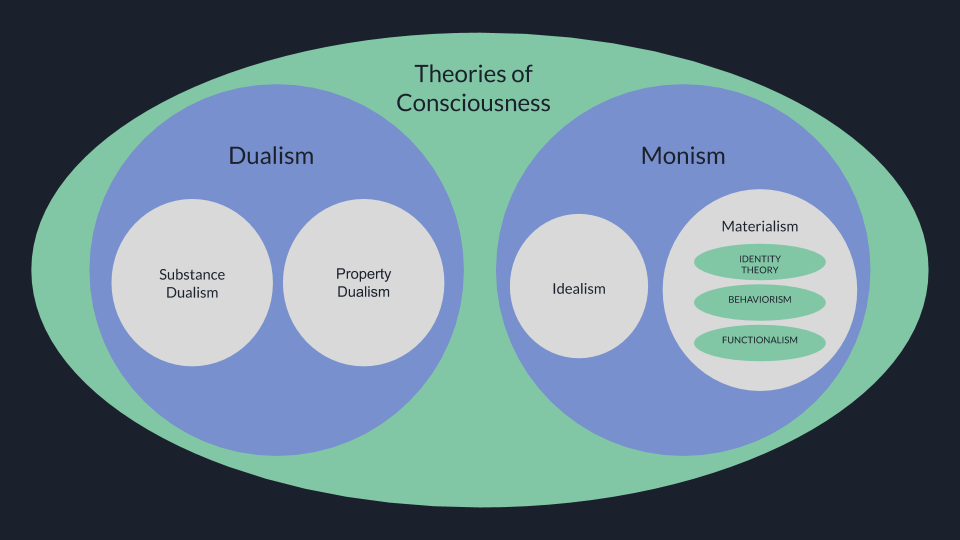
At its simplest, the divide may be expressed in a single question:
Is reality composed of one kind of thing, or more than one?
When applied to the problem of consciousness, this becomes the question of how mind relates to the physical world. Are mental phenomena fundamentally distinct from physical processes, or are they different expressions of a single underlying reality?
From this question emerge the two classical positions.
A - Dualism: Mind and Matter as Distinct
Dualist theories maintain that mind and matter are fundamentally different in kind. The most well-known form of this view is substance dualism, historically associated with René Descartes (Cartesian Dualism), in which reality is divided into two distinct substances:
- res cogitans (thinking substance, or mind)
- res extensa (extended substance, or matter)
On this view, consciousness belongs to a non-physical domain, irreducible to the properties of physical objects. Thought, sensation, and subjective experience cannot be explained solely in terms of spatial extension, motion, or physical interaction.
A more contemporary form, property dualism, softens this division by maintaining a single physical substance while allowing for distinct kinds of properties - physical and mental. Here, consciousness is not a separate substance, but it is still irreducible to physical description.
The enduring appeal of dualism lies in its recognition of the qualitative character of experience. It takes seriously the intuition that consciousness is not merely another physical process, but something categorically different.
And yet, dualism introduces a profound difficulty.
If mind and matter are fundamentally distinct, how do they interact?
This is the classical mind-body problem, which remains unresolved within dualist frameworks. The more sharply the distinction is drawn, the more difficult it becomes to explain how mental states can influence physical processes, or vice versa.
B - Monism: Toward a Unified Reality
In contrast to dualism, monist theories seek to preserve unity. Rather than positing two fundamentally different kinds of substance, monism holds that reality is ultimately of one kind.
However, this unity can be understood in very different ways.
B1 - Physicalism (Materialism)
Physicalist monism asserts that everything that exists is ultimately physical. On this view, consciousness must be explained in terms of physical processes - most commonly, neural activity in the brain.
Contemporary physicalism takes many forms, including:
- reductive physicalism, which identifies mental states with brain states
- functionalism, which defines mental states in terms of their causal roles
- eliminativism, which denies that common-sense notions of mind correspond to real entities
The strength of physicalism lies in its alignment with the natural sciences. It offers a unified account of reality grounded in empirical investigation.
Its central difficulty, however, is well known.
Even if every neural process were mapped in complete detail, it would remain unclear why such processes should give rise to subjective experience at all. The qualitative dimension of consciousness - what it is like to feel, perceive, or think - seems resistant to purely physical explanation.
B2 - Idealism
At the opposite end of the monist spectrum lies idealism, which reverses the direction of explanation. Rather than reducing mind to matter, idealism proposes that reality is fundamentally mental, and that what we call the physical world is derivative of consciousness.
In contemporary forms, this position is often articulated in terms of consciousness as the primary field of reality, with the physical world understood as an appearance or representation within it.
The strength of idealism is that it takes consciousness as universal, thereby avoiding the need to explain how experience could arise from something wholly non-experiential.
Its difficulty lies elsewhere.
If reality is fundamentally mental, how do we account for the apparent stability, regularity, and independence of the physical world? And why does the world resist our perceptions and intentions in ways that suggest an existence not wholly dependent on individual consciousness?
B3 - Neutral and Dual-Aspect Monism
Between physicalism and idealism, a range of intermediate positions have emerged. These include neutral monism and dual-aspect theories, which propose that reality is neither purely physical nor purely mental, but consists of a more fundamental underlying reality that can manifest as both.
Within this space, contemporary forms of panpsychism and cosmopsychism often take shape, suggesting that experientiality is somehow built into the fabric of reality itself.
These approaches attempt to preserve both unity and the reality of experience, but they introduce new questions concerning how different aspects of reality relate to one another.
C - A Framework That Endures - and Strains
Taken together, dualism and monism provide a powerful and enduring framework for organizing the philosophy of mind. Nearly every major theory of consciousness can be understood as either an instance of, or a response to, this basic divide.
And yet, as the field has developed, the limitations of this framework have become increasingly apparent.
It tends to frame the problem in terms of substances or fundamental kinds, rather than in terms of relations, processes, and structures of emergence. It asks what reality is made of, but not always how reality gives rise to the phenomena we seek to understand.
For this reason, while the dualism–monism distinction remains "classically" indispensable as a point of initial orientation, it may no longer be sufficient as a framework of explanation.
To move beyond it, we must ask a different kind of question.
Not only:
Is reality one or two?
But:
What kind of reality could give rise to experience at all?

II - Why Dualism and Monism Frame the Debate (and Where They Fall Short)
The enduring influence of dualism and monism within the philosophy of mind is not merely a matter of historical inheritance. These frameworks persist because they arise from a more general and unavoidable question concerning the nature of reality itself:
Is reality fundamentally unified, or is it divided?
When this question is brought to bear on consciousness, it becomes the problem of how subjective experience relates to the physical world. Dualism and monism thus function as foundational orientations, offering the most general possible answers to this problem.
Dualism preserves difference. It recognizes that conscious experience appears irreducible to physical description and gives that difference ontological weight.
Monism, by contrast, preserves unity. It seeks to avoid explanatory fragmentation by locating all phenomena within a single underlying reality.
In this sense, these frameworks are not arbitrary.
They are the natural conceptual poles of philosophical reflection on mind.
For this reason, nearly every contemporary theory of consciousness can be understood as operating within, or in response to, this basic divide:
- Physicalism develops a monist account grounded in matter.
- Idealism develops a monist account grounded in mind.
- Panpsychism attempts to bridge the gap by distributing experientiality across reality.
- Emergentism retains monism while allowing for new properties to arise from complexity.
Even attempts to move beyond these categories often remain implicitly structured by them.
And yet, their very generality reveals their limitation.
The Limits of the Framework
The difficulty is not that dualism and monism are incorrect.
It is that they frame the problem at a level that may be too abstract to capture the dynamics of consciousness itself.
Three limitations, in particular, become evident.
1. A Bias Toward Substance
Both dualism and monism tend to assume that reality is composed of substances or fundamental kinds of being.
- Dualism posits two substances.
- Monism posits one.
In both cases, the primary question becomes: What exists?—rather than How does what exists come to be what it is?
This orientation can obscure the possibility that reality is not best understood in terms of static entities at all, but in terms of process, relation, and ongoing formation.
2. A Binary Constraint
The dualism–monism divide presents the problem as a choice between two options:
- either mind and matter are fundamentally distinct
- or they are fundamentally one
This binary framing can become restrictive.
It encourages positions to define themselves in opposition to one another, rather than to explore alternative ways of conceptualizing the relation between mind and world. As a result, more nuanced accounts - particularly those emphasizing gradation, emergence, or relational structure - can appear as compromises rather than as fundamentally different approaches.
3. A Misplacement of Explanation
Perhaps most importantly, the framework tends to prioritize metaphysical answers over ontological questions.
It asks what reality ultimately is - physical, mental, or otherwise - before adequately addressing how the phenomena in question arises.
In the case of consciousness, this can lead to premature conclusions:
- Physicalism may reduce experience to mechanism without explaining its qualitative character.
- Idealism may affirm the primacy of mind without explaining the structure of the world.
- Panpsychism may distribute experientiality without explaining how it becomes unified and organized.
In each case, the metaphysical claim risks standing as substitutionary framework for an explanation that has yet to be fully developed.
A Point of Transition
These limitations do not render dualism and monism obsolete. They remain essential as initially orienting concepts, providing a way of mapping the field in elementary parlance and understanding the range of possible positions.
But they suggest that a shift in emphasis is needed.
If the goal is to understand consciousness, then the inquiry must move from asking what reality is composed of to asking how reality gives rise to experience.
This marks a transition:
- From substance to process
- From binary opposition to relational structure
- From metaphysical assertion to ontological investigation
It is at this point that contemporary approaches begin to diverge more sharply - and where new possibilities emerge.
Among these are process-relational frameworks, systems-based theories, and consciousness-first approaches, each of which attempts, in different ways, to move beyond the limitations of the classical divide.
To understand how these approaches relate to one another - and where they converge or conflict - we must now turn to the contemporary landscape of consciousness studies.
 |
| Illustration by R.E. Slater and ChatGPT |
III - Contemporary Voices in Tension
As the limitations of the dualism-monism framework have become more apparent, a number of contemporary thinkers have sought to rearticulate the problem of consciousness in new ways. These approaches do not abandon the classical questions entirely, but they reframe them - often by shifting attention from substances to processes, from static categories to dynamic relations, and from abstract metaphysical claims to lived or embodied experience.
What emerges is not a unified alternative, but a field of tension in which different approaches emphasize different aspects of the problem.
Among these, several voices stand out for the clarity with which they articulate distinct trajectories within contemporary thought.
Within the tradition of process philosophy, developed by Alfred North Whitehead and extended in contemporary work by Andrew M. Davis and Matthew Segall, reality is understood as fundamentally relational and processual.
On this view:
- the basic units of reality are not substances, but events or occasions
- each event is constituted through its relations to others
- experience, in some minimal sense, is intrinsic to this process of becoming
This position is often described as panexperientialism, distinguishing it from stronger forms of panpsychism. Rather than attributing full consciousness to all entities, it proposes that all processes possess some degree of interiority, however minimal.
The strength of this approach lies in its ability to integrate multiple dimensions of the problem:
- it avoids reductive materialism by affirming interiority
- it avoids strict dualism by grounding experience within the same process as the physical world
- it provides a framework for understanding gradations of experience
At the same time, it raises an important question:
To what extent does the attribution of interiority to all processes approach a panpsychist metaphysics?
This marks a point of tension within the process-relational tradition itself.
A different trajectory is represented by thinkers such as Federico Faggin, whose work advances a form of consciousness-first ontology.
In this view:
- consciousness is fundamental and irreducible
- physical reality is derivative or emergent from consciousness
- information, meaning, and experience are primary features of the universe
This approach offers a direct response to the hard problem of consciousness by reversing its terms. Rather than asking how experience arises from matter, it asks how matter arises within a field of consciousness.
The strength of this position is its clarity.
It takes the reality of experience seriously and places it at the foundation of its account of reality.
Its difficulty lies in its immediacy.
By asserting the primacy of consciousness at the outset, it risks resolving the problem through metaphysical declaration rather than through ontological explanation. The question of how structured, differentiated forms of consciousness arise remains - even if the ground is defined as experiential.
A third perspective is found in the work of Iain McGilchrist, whose analysis operates less at the level of ontology or metaphysics and more at the level of epistemology and interpretation.
McGilchrist’s work suggests that many of the difficulties in understanding consciousness arise from the way modern thought has come to conceptualize reality itself. Drawing on neuroscience, philosophy, and cultural analysis, he argues that:
- contemporary cognition is dominated by modes of abstraction and fragmentation
- these modes obscure the relational and contextual nature of experience
- a more adequate understanding of reality requires a return to a form of attention that is open, integrative, and participatory
The strength of this approach lies in its diagnostic power.
It helps explain why reductionist and mechanistic accounts of mind have become dominant, and why alternative perspectives often struggle to gain traction.
Its limitation is that it does not, in itself, provide a full ontological account of consciousness. Rather, it functions as a corrective lens, reshaping how the problem is perceived.
Taken together, these perspectives reveal a number of shared insights:
- a rejection of strict reductionism
- a recognition of the reality and importance of experience
- a movement toward relational, processual, or participatory models of mind
And yet, they diverge in crucial ways.
- Is consciousness fundamental, or does it arise?
- Is interiority universal, graded, or emergent?
- Is the primary problem ontological, metaphysical, or epistemological?
These differences are not merely technical.
They reflect distinct starting points and methodological commitments.
At this stage, the field does not present a single unified direction, but a structured plurality of approaches, each illuminating a different aspect of the problem of consciousness.
To navigate this plurality requires more than choosing between positions.
It requires a framework capable of:
- preserving the insights of each
- identifying their limits
- and situating them within a coherent order of inquiry
It is precisely at this point that the need for a mediating framework becomes apparent.
Such a framework would neither collapse these perspectives into a single view nor treat them as incommensurable. Instead, it would seek to understand how they relate, where they overlap, and how their respective claims might be ordered.
It is toward such a framework that the present essay now turns.
 |
| Illustration by R.E. Slater and ChatGPT |
With the contemporary landscape brought into view, the task now is not to choose among the positions outlined, but to understand how they may be related within a more disciplined framework of inquiry.
It is at this point that Embodied Process Realism (EPR) may be situated.
EPR does not present itself as a competing theory alongside the others. Rather, it offers a reordering of the question through which these theories are approached. Its primary claim is methodological before it is metaphysical:
That the study of consciousness must proceed first through ontology - through an account of how experience arises within the structure of reality - before drawing conclusions about the ultimate nature of that reality.
From this starting point, EPR may be understood in relation to the perspectives already considered.
In relation to the process-relational work of Andrew M. Davis and Matthew Segall, EPR shares a fundamental commitment:
- that reality is relational and processual
- that experience cannot be reduced to purely external description
- that mind is not an isolated interior domain, but arises within a field of relations
At the same time, EPR introduces a point of restraint.
Where process-relational approaches often extend toward panexperientialism, suggesting that all processes possess some degree of interiority, EPR suspends this conclusion. It does not deny the possibility, but neither does it assume it.
Instead, it asks:
How do structured forms of interiority arise within relational coherence?
In this way, EPR remains aligned with process thought while maintaining a stricter ordering of inquiry.
In relation to the consciousness-first perspective represented by Federico Faggin, EPR affirms an important insight:
That consciousness cannot be dismissed, reduced, or treated as an illusion without undermining the very phenomenon under investigation.
However, it departs from this approach at a critical point.
But rather than beginning with the assertion that consciousness is fundamental, EPR seeks to understand how consciousness emerges within the structured persistence of relational processes. It does not reverse the explanatory direction - from matter to mind - but reframes it.
The question is not whether mind or matter is primary, but how the conditions of reality give rise to embodied experience.
In this respect, EPR avoids what might be called premature metaphysical closure.
In relation to the epistemological and phenomenological insights of Iain McGilchrist, EPR finds a strong point of convergence.
McGilchrist’s critique of reductionist modes of thought highlights the ways in which modern cognition can obscure the relational and contextual nature of reality. His emphasis on attention, participation, and the lived world resonates with the process-relational orientation.
EPR builds on this insight by providing an ontological grounding for it.
Where McGilchrist diagnoses the problem at the level of perception and interpretation, EPR seeks to articulate the structure of reality that makes such relational awareness possible. In this sense, it complements phenomenological critique with ontological accountability.
Across these comparisons, a consistent pattern emerges.
EPR does not reject the perspectives it engages. It preserves key insights from each:
- from process thought, the primacy of relation and becoming
- from consciousness-first approaches, the irreducibility of experience
- from phenomenological critique, the importance of participation and embodiment
At the same time, it reorders these insights within a coherent framework.
It begins not with metaphysical assertion, nor with epistemological critique, but with the ontological question of how relational coherence gives rise to embodied interiority. In doing so, it maintains the priority of ontology while holding metaphysical conclusions in suspension, without negation.
This allows EPR to function as a mediating position between panpsychist (metaphysical) and emergentist (ontological) accounts of consciousness and reality.
It neither distributes experience universally nor reduces it to mechanism.
It seeks instead to understand the conditions under which experience becomes possible.
From this vantage, the debate itself begins to shift.
The central question is no longer framed as a choice between:
- mind and matter
- dualism and monism
- reduction and primacy
It becomes instead:
How does a relationally structured reality give rise to embodied forms of experience?
This question does not eliminate the need for metaphysical reflection.
But it situates it.
It places the investigation of consciousness within a prior account of the structure and dynamics of reality itself.
A Point of Transition
With this reframing in place, the classical categories of dualism and monism can be seen in a new light. They remain valuable as orienting concepts, but they no longer define the limits of the inquiry.
What emerges instead is a layered approach:
- ontology establishes the conditions of emergence
- metaphysics interprets the nature of those conditions
- experience becomes the point at which both converge
It is from this layered perspective that the next stage of the series proceeds.
 |
| Illustration by R.E. Slater and ChatGPT |
V - Why This Matters: From Consciousness to Identity, Value, and Teleology
The preceding analysis has sought to clarify the conceptual terrain of consciousness studies by revisiting the classical divide between dualism and monism, situating it within contemporary debates, and reframing the question through a process-relational lens. In doing so, it has argued that the study of consciousness is most fruitfully approached not through premature metaphysical assertion, but through a prior ontological investigation into how experience arises within the structure of reality.
This shift is not merely methodological.
It has direct implications for the broader philosophical trajectory that follows.
For the question of consciousness does not stand alone. It forms the point of transition between the study of reality as such and the study of lived existence within that reality. Once consciousness is understood - not as an anomaly or an assumption, but as an emergent and embodied phenomenon - further questions naturally arise.
These questions concern identity, value, and direction.
From Consciousness to Identity
If consciousness arises within structured relational processes, then the question of identity can no longer be framed in terms of static substances or fixed essences.
Instead, identity must be understood as a form of stabilized continuity within process.
What we call a self is not a thing that persists unchanged through time, but a pattern of integration that maintains coherence across change. It is the ongoing achievement of relational organization - a persistence of form within becoming.
Without a prior account of how consciousness emerges, such a view of identity would lack grounding. It would risk becoming purely abstract or speculative.
But with an ontological account of interiority in place, identity can be approached as a natural extension of that account.
From Consciousness to Value
A similar transition occurs with respect to value.
If consciousness involves interiority—if there is something it is like to be a system—then value enters the picture immediately. Experience is not neutral. It carries qualitative dimensions of better and worse, pleasure and pain, meaning and significance.
From this perspective, value is not imposed from outside the world.
It arises within it.
It is rooted in the very structure of experience itself.
Yet without a clear understanding of consciousness, the relation between value and reality becomes difficult to articulate. Value may be treated as subjective, arbitrary, or reducible to biological function.
An ontological account of consciousness provides a different foundation.
It allows value to be understood as emerging from the same relational processes that give rise to experience.
From Consciousness to Teleology
Finally, the question of direction or teleology comes into view.
If reality is understood as process, and if consciousness emerges within increasingly complex and integrated forms of organization, then it becomes possible to ask whether this process exhibits any form of directionality.
Not a fixed or predetermined end, but a tendency.
A movement toward greater coherence, integration, and complexity.
This does not require the imposition of an external purpose.
It suggests instead that teleology may be understood as immanent within process—as the unfolding of possibilities within a relational field.
Here again, the ontological grounding is essential.
Without it, teleological claims risk appearing as metaphysical speculation or projection. With it, they can be approached as questions arising from the structure of reality itself.
A Necessary Pause
It is for these reasons that the present essay pauses at the level of consciousness.
Not to delay the movement forward, but to ensure that it proceeds on solid ground.
The transition from ontology to questions of identity, value, and teleology marks a significant shift in the series. It moves from the structure of reality to the meaning of existence within that structure.
Such a transition requires clarity.
It requires that the nature of consciousness be understood, not assumed.
Looking Ahead
With this foundation in place, the next stage of the series can begin.
Essay IX will take up the question of identity, exploring how continuity, selfhood, and persistence may be understood within a process-relational framework. From there, the series will move into value and teleology, extending the implications of the present analysis into ethical, existential, and ultimately theological domains.
The aim is not to construct a closed system.
It is to follow the implications of a particular way of understanding reality.
If consciousness arises within relational coherence, then identity, value, and direction must be rethought in its light.
This essay has sought to prepare that transition.
What follows will seek to unfold it.
BIBLIOGRAPHY
This bibliography reflects the layered approach taken in this essay, beginning with classical formulations of dualism and monism, extending through contemporary philosophy of mind and systems approaches, and culminating in process-relational and consciousness-first frameworks. It is intended as both a reference and a guide for navigating the conceptual terrain of consciousness studies.
I. Classical Foundations: Dualism and Monism
Descartes, René. Meditations on First Philosophy. Translated by Donald A. Cress. Indianapolis: Hackett Publishing, 1998.
Spinoza, Baruch. Ethics. Translated by Edwin Curley. London: Penguin Classics, 1996.
James, William. Essays in Radical Empiricism. Lincoln: University of Nebraska Press, 1996.
II. Philosophy of Mind and Consciousness Studies
Chalmers, David J. The Conscious Mind: In Search of a Fundamental Theory. New York: Oxford University Press, 1996.
Dennett, Daniel C. Consciousness Explained. Boston: Little, Brown and Company, 1991.
Nagel, Thomas. “What Is It Like to Be a Bat?” The Philosophical Review 83, no. 4 (1974): 435–450.
Searle, John R. The Rediscovery of the Mind. Cambridge, MA: MIT Press, 1992.
III. Emergence and Non-Reductive Physicalism
Kim, Jaegwon. Mind in a Physical World: An Essay on the Mind-Body Problem and Mental Causation. Cambridge, MA: MIT Press, 1998.
Noble, Denis. The Music of Life: Biology Beyond Genes. Oxford: Oxford University Press, 2006.
Deacon, Terrence W. Incomplete Nature: How Mind Emerged from Matter. New York: W. W. Norton & Company, 2012.
IV. Process-Relational Thought
Whitehead, Alfred North. Process and Reality: An Essay in Cosmology. Corrected Edition. Edited by David Ray Griffin and Donald W. Sherburne. New York: Free Press, 1978.
Whitehead, Alfred North. Adventures of Ideas. New York: Free Press, 1967.
Davis, Andrew M. Mind, Value, and Cosmos: On the Relational Nature of Ultimate Reality. Eugene, OR: Cascade Books, 2018.
Segall, Matthew David. Physics of the World-Soul: Whitehead’s Adventure in Cosmology. Berkeley, CA: Process Century Press, 2021.
V. Panpsychism and Contemporary Metaphysical Approaches
Goff, Philip. Galileo’s Error: Foundations for a New Science of Consciousness. New York: Pantheon Books, 2019.
Strawson, Galen. “Realistic Monism: Why Physicalism Entails Panpsychism.” Journal of Consciousness Studies 13, no. 10–11 (2006): 3–31.
Chalmers, David J. “Panpsychism and Panprotopsychism.” In Consciousness in the Physical World: Perspectives on Russellian Monism, edited by Torin Alter and Yujin Nagasawa, 246–276. Oxford: Oxford University Press, 2015.
VI. Idealism and Consciousness-First Frameworks
Faggin, Federico. Irreducible: Consciousness, Life, Computers, and Human Nature. New York: HarperOne, 2024.
Kastrup, Bernardo. The Idea of the World: A Multi-Disciplinary Argument for the Mental Nature of Reality. Winchester, UK: Iff Books, 2019.
Hoffman, Donald D. The Case Against Reality: Why Evolution Hid the Truth from Our Eyes. New York: W. W. Norton & Company, 2019.
VII. Phenomenology and Epistemological Approaches
Husserl, Edmund. Ideas Pertaining to a Pure Phenomenology and to a Phenomenological Philosophy. Translated by F. Kersten. Dordrecht: Kluwer Academic Publishers, 1983.
Merleau-Ponty, Maurice. Phenomenology of Perception. Translated by Colin Smith. London: Routledge, 1962.
McGilchrist, Iain. The Matter with Things: Our Brains, Our Delusions, and the Unmaking of the World. London: Perspectiva Press, 2021.
VIII. Contemporary Teaching and Overview Resources
Fruhling, Zachary. “Theories of Consciousness.” Video Series. YouTube, 2024.
https://www.youtube.com/results?search_query=Mind+and+Consciousness+Zachary+Fruhling


No comments:
Post a Comment