Quotes & Sayings


We, and creation itself, actualize the possibilities of the God who sustains the world, towards becoming in the world in a fuller, more deeper way. - R.E. Slater

There is urgency in coming to see the world as a web of interrelated processes of which we are integral parts, so that all of our choices and actions have [consequential effects upon] the world around us. - Process Metaphysician Alfred North Whitehead

Kurt Gödel's Incompleteness Theorem says (i) all closed systems are unprovable within themselves and, that (ii) all open systems are rightly understood as incomplete. - R.E. Slater

The most true thing about you is what God has said to you in Christ, "You are My Beloved." - Tripp Fuller

The God among us is the God who refuses to be God without us, so great is God's Love. - Tripp Fuller

According to some Christian outlooks we were made for another world. Perhaps, rather, we were made for this world to recreate, reclaim, redeem, and renew unto God's future aspiration by the power of His Spirit. - R.E. Slater

Our eschatological ethos is to love. To stand with those who are oppressed. To stand against those who are oppressing. It is that simple. Love is our only calling and Christian Hope. - R.E. Slater

Secularization theory has been massively falsified. We don't live in an age of secularity. We live in an age of explosive, pervasive religiosity... an age of religious pluralism. - Peter L. Berger

Exploring the edge of life and faith in a post-everything world. - Todd Littleton

I don't need another reason to believe, your love is all around for me to see. – Anon

Thou art our need; and in giving us more of thyself thou givest us all. - Khalil Gibran, Prayer XXIII

Be careful what you pretend to be. You become what you pretend to be. - Kurt Vonnegut

Religious beliefs, far from being primary, are often shaped and adjusted by our social goals. - Jim Forest

We become who we are by what we believe and can justify. - R.E. Slater

People, even more than things, need to be restored, renewed, revived, reclaimed, and redeemed; never throw out anyone. – Anon

Certainly, God's love has made fools of us all. - R.E. Slater

An apocalyptic Christian faith doesn't wait for Jesus to come, but for Jesus to become in our midst. - R.E. Slater

Christian belief in God begins with the cross and resurrection of Jesus, not with rational apologetics. - Eberhard Jüngel, Jürgen Moltmann

Our knowledge of God is through the 'I-Thou' encounter, not in finding God at the end of a syllogism or argument. There is a grave danger in any Christian treatment of God as an object. The God of Jesus Christ and Scripture is irreducibly subject and never made as an object, a force, a power, or a principle that can be manipulated. - Emil Brunner

“Ehyeh Asher Ehyeh” means "I will be that who I have yet to become." - God (Ex 3.14) or, conversely, “I AM who I AM Becoming.”

Our job is to love others without stopping to inquire whether or not they are worthy. - Thomas Merton

The church is God's world-changing social experiment of bringing unlikes and differents to the Eucharist/Communion table to share life with one another as a new kind of family. When this happens, we show to the world what love, justice, peace, reconciliation, and life together is designed by God to be. The church is God's show-and-tell for the world to see how God wants us to live as a blended, global, polypluralistic family united with one will, by one Lord, and baptized by one Spirit. – Anon

The cross that is planted at the heart of the history of the world cannot be uprooted. - Jacques Ellul

The Unity in whose loving presence the universe unfolds is inside each person as a call to welcome the stranger, protect animals and the earth, respect the dignity of each person, think new thoughts, and help bring about ecological civilizations. - John Cobb & Farhan A. Shah

If you board the wrong train it is of no use running along the corridors of the train in the other direction. - Dietrich Bonhoeffer

God's justice is restorative rather than punitive; His discipline is merciful rather than punishing; His power is made perfect in weakness; and His grace is sufficient for all. – Anon

Our little [biblical] systems have their day; they have their day and cease to be. They are but broken lights of Thee, and Thou, O God art more than they. - Alfred Lord Tennyson

We can’t control God; God is uncontrollable. God can’t control us; God’s love is uncontrolling! - Thomas Jay Oord

Life in perspective but always in process... as we are relational beings in process to one another, so life events are in process in relation to each event... as God is to Self, is to world, is to us... like Father, like sons and daughters, like events... life in process yet always in perspective. - R.E. Slater

To promote societal transition to sustainable ways of living and a global society founded on a shared ethical framework which includes respect and care for the community of life, ecological integrity, universal human rights, respect for diversity, economic justice, democracy, and a culture of peace. - The Earth Charter Mission Statement

Christian humanism is the belief that human freedom, individual conscience, and unencumbered rational inquiry are compatible with the practice of Christianity or even intrinsic in its doctrine. It represents a philosophical union of Christian faith and classical humanist principles. - Scott Postma

It is never wise to have a self-appointed religious institution determine a nation's moral code. The opportunities for moral compromise and failure are high; the moral codes and creeds assuredly racist, discriminatory, or subjectively and religiously defined; and the pronouncement of inhumanitarian political objectives quite predictable. - R.E. Slater

God's love must both center and define the Christian faith and all religious or human faiths seeking human and ecological balance in worlds of subtraction, harm, tragedy, and evil. - R.E. Slater

In Whitehead’s process ontology, we can think of the experiential ground of reality as an eternal pulse whereby what is objectively public in one moment becomes subjectively prehended in the next, and whereby the subject that emerges from its feelings then perishes into public expression as an object (or “superject”) aiming for novelty. There is a rhythm of Being between object and subject, not an ontological division. This rhythm powers the creative growth of the universe from one occasion of experience to the next. This is the Whiteheadian mantra: “The many become one and are increased by one.” - Matthew Segall

Without Love there is no Truth. And True Truth is always Loving. There is no dichotomy between these terms but only seamless integration. This is the premier centering focus of a Processual Theology of Love. - R.E. Slater

-----

Note: Generally I do not respond to commentary. I may read the comments but wish to reserve my time to write (or write from the comments I read). Instead, I'd like to see our community help one another and in the helping encourage and exhort each of us towards Christian love in Christ Jesus our Lord and Savior. - re slater

Friday, December 26, 2025

Gravity, Consciousness, and Processual Emergence: Essay 6 - A Coherent Processual Vision of Processual Reality


Figure 1. From Substance to Process. The meta-
physical shift from static substances to relational becoming.

Figure 1. Classical (scientific) metaphysics understood reality as a hierarchy of static substances - matter, forces, space, and time stacked like immovable blocks. Process philosophy replaces this imaging with a relational field of events, constraints, and becoming. Reality is no longer built from things, but from interactional experiences in motion.
Gravity, Consciousness, and
Processual Emergence

ESSAY 6

A Coherent Processual Vision of Processual Reality

A Review of Processual, Informational and Simulation Systems

by R.E. Slater & ChatGPT-5

Note. The use of illustrations are not decorative. They are conceptual anchors intended to slow reading, clarify structure, and reinforce the process-relational framework developed throughout this essay.


Processual Reality

Nothing is fixed.
It never was.

Nothing is encoded.
Not then, not now, not ever.

Nothing is a simulation -
though all may be a cosmic hologram.

What endures
does so by relationship.

What matters
comes by becoming.

The universe was not made.
But is always in the making.

Processualism
makes these distinctions.


R.E. Slater
December 26, 2025

@copyright R.E. Slater Publications
all rights reserved

Poetic Note. Here I make the following distinctions between non-processual cosmic simulations vs legitimate processual cosmic holograms. The former assumes: A pre-existing substrate (such as a cosmic-like computer, external reality, higher-level universe); Fixed rules encoded in advance; Reality as a rendered output; Time as a clock cycle; Information as stored data; and, Cosmic observers as contained within a system they had not helped constitute. But metaphysically, this is: Substance-based language; Deterministic or quasi-deterministic; and, Externally grounded even when stochastic elements are added, hence, its ontological center lies outside the universe. Thus, the Cosmic Simulation Model is fundamentally non-processual.

Whereas, a processual cosmic hologram assumes something very different: No external substrates; No “computer behind the curtain”; Reality as self-generating relational coherence; Time as emergent sequencing; Information as difference-with-consequence; and, Cosmic observers as actual participatory events. Essentially, "hologram" does not mean “projection from elsewhere.” It means: "Each local event enfolds and expresses the whole relational field." Thus, the Cosmic Hologram Model is fundamentally processual.

Where language misleads - and causes confusion - is that both simulative vs. holographic camps borrow from the same vocabulary: information, encoding, rendering, holographic, computational, etc. However, they each mean radically different things from one another. Simulation language tends to: Reify information into things; Treat laws as instruction sets; and, Treat emergence as execution. Whereas process-holographic language treats: Information as relational; Laws as habits of becoming; and, Emergence as creative advance. And so, though simulation and holographic sound like wordplay, ontologically they differ by quite alot. The first is a non-ontologically generated metaphoric stylistically whereas the latter is ontologically fundamental to the grammar of processual language.

R.E. Slater


Related Previous Essays

Imagining Consciousness, Time & Gravity: Essay 1 - Process as an Integral System


A Gravity Well. Why our universe is not a simulation
but a comprehensive illustration of processual reality.
A recent piece in "Popular Mechanics" needed a rejoiner. Today's article makes its clear why a cosmos running as a cosmic simulation is not the same as a cosmos running as a cosmic hologram. They differ by non-ontologically grounded language while confusing scientific-readers by their wordplay. In short, until science, or science journals, learn to understand and use processual emergence as an ontological category rather than as a metaphor, it will continue to mistake relational becoming for external computation, and event-participation for processual execution. - re slater
Introduction

What follows is not a speculative reaction to a recent headline, nor an attempt to chase novelty by borrowing fashionable metaphors. It is an addendum of recognition.

Over the past months, this body of work has argued - patiently, repeatedly, and from multiple perspectives - that consciousness, time, gravity, and even spacetime itself are not fundamental substances, but emergent systems arising from relational process

These claims were not offered rhetorically, nor as philosophical indulgence, but as a disciplined response to converging evidence across physics, philosophy, and lived experience.

Recent claims that gravity may be “simulation-like” do not overturn this framework. They are late speculations by science attempting to explain gravity.

This essay therefore does not ask whether such theories are intriguing. It asks a more demanding question: why are we still surprised when process appears, and why do we reach for comforting metaphors rather than reckon with process' implications?

The purpose of this additional essay is not to persuade by novelty, but to slow the reader down - to insist that what is now being framed as shocking or groundbreaking has already been named, explored, and situated within a coherent processual vision of reality.

If this feels unsettling, that is not a failure of clarity. It is the cost of thinking carefully in an age that prefers quick non-integrative, speculative exits.


I. The Headline and Its Seduction

A recent wave of articles claims that gravity may be key evidence that our universe is a simulation. The phrasing is dramatic, provocative, and carefully calibrated to capture attention. It suggests that one of nature’s most familiar forces may be doing something far stranger than we ever imagined.

Yet upon closer examination, the underlying research does not actually claim that the universe is simulated. What it suggests is more restrained and more interesting: that gravity behaves as if it were emergent byproduct, arising from deeper informational or relational structures rather than existing as a fundamental force.

The simulation language is not the conclusion of the science. It is an interpretive gloss - a metaphor layered atop technical claims about emergence, entropy, and information. That metaphor resonates with contemporary culture, where computation has become our dominant explanatory frame, but resonance should not be mistaken for necessity.

Physics is not announcing that reality is artificial. It is announcing once again that reality is not built the way we once thought it was.


Figure 2. Gravity is not a force. It is an emergent
geometry caused by fundamental interaction.
Figure 2. Gravity is not a push-or-pull force between objects. In modern physics, it is the curvature of spacetime itself - an emergent geometric effect arising from mass-energy and relational structure. What appears as force is, at scale, the shape of relational-interactive reality.
II. What Gravity Refuses to Be

Gravity has always been the most philosophically troublesome of the fundamental interactions. It is extraordinarily weak compared to the other forces, yet universally influential. It does not behave like a push-or-pull force so much as a geometric condition - a shaping of spacetime itself.

Einstein already displaced the Newtonian picture by showing that gravity is not a force acting within spacetime, but an expression/byproduct/secondary-result of spacetime’s curvature. That alone should have unsettled substance-based metaphysics more than it did.

Recent theoretical developments push this insight further. In approaches such as entropic gravity, holographic dualities, and spacetime emergence models, gravity no longer appears as something fundamental at all. Instead, it arises statistically or relationally, much as temperature arises from molecular motion or pressure from particle interactions. In this sense, gravity is also a descriptor of interactions between forces.

In these models, gravity is not an entity but a regularity - a pattern which appears when relational systems reach sufficient scale and structure.

This is not an attack on gravity’s "reality". Emergent phenomena are not illusions. They are real precisely because they work, because they constrain behavior, because they are stable enough to be measured and predicted. The mistake lies in assuming that “real” must mean “fundamental.”


Figure 3. The Emergent Triad: Time, Consciousness, Gravity.
Each arise from a shared processual field.
Figure 3. Time, consciousness, and gravity are not separate puzzles. Each relational process emerges from the same underlying field of comprehensive relational processes. Simplistically, time arises as ordering, consciousness as experience, and gravity as geometry - each are distinct expressions of a single dynamic becoming.
III. Consciousness, Time, and Gravity: A Shared Problem Space

One of the most important recognitions from our previous essays 1-5 (listed abov e) was that consciousness, time, and gravity are not isolated mysteries, but members of the same family of problems.

  • Each resists reduction to static substance.
  • Each depends upon relational structure.
  • Each manifests only through process and interaction.
  • Each scales differently depending on complexity.
As Emergent Processes:
  • Time is not a background container within which events occur; it is an ordering that emerges from change, memory, anticipation, and causation.
  • Consciousness is not a thing added to matter; it emerges from integrated experiential processes.
  • Gravity, likewise, appears not as an intrinsic force but as a large-scale relational outcome.

This is not coincidence. These phenomena occupy the boundary between structure and experience, between the measurable and the lived. They are precisely where substance metaphysics fails and process ontology becomes unavoidable.

To recognize their emergence is not to dissolve them into vagueness, but to place them correctly within a layered reality.


Figure 4. The universe is not a simulation running atop
of  something else. It is a process generating itself.

Figure 4. Emergence ≠ Illusion. Here we clarify scale-dependent reality and avoid reductionism. Emergent phenomena are not unreal. Temperature, gravity, and thought are all real at their respective scales, even though they depend on underlying interactions. Emergence locates reality in relation and scale, not in metaphysical primitiveness.
IV. Emergence Is Not Illusion

One reason the simulation metaphor gains traction is that emergence is still widely misunderstood. Emergent phenomena are often treated as “less real” than fundamental ones, as if reality were a hierarchy of authenticity.

But emergence processes do not mean unreal. It means that they are dependent, relational, and scale-sensitive.

  • A melody is emergent from vibrations, but no one calls it illusory.
  • Temperature is emergent from molecular motion, yet it determines the physical behavior of systems.
  • A thought is emergent from neural processes, but it can alter the course of a life.

Gravity, understood as emergent, belongs to this same category. Its reality lies not in metaphysical primitiveness but in constraint and consequence.

The insistence that gravity must be fundamental in order to be real is a relic of an outdated ontology - one that cannot survive contact with modern physics.


Figure 5. Why Process Is Avoided as it removes the
comfort found in fixed foundations and eternal controls.

Figure 5. Why Process Is Avoided. Illustrates the psychological and cultural resistance to process ontology. Process philosophy removes the comfort of fixed foundations and external control. Faced with an unfinished, participatory universe, many retreat toward simplifying metaphors or reductions. Process is not rejected because it is unclear - but because it implicates in us the fear of the unknown

V. Why “Simulation” Feels Like an Answer

If emergence is so powerful, why does the simulation metaphor keep appearing in print? Because it offers speculative distance.

To say reality is a simulation suggests:

  • an external programmer,
  • a finished codebase,
  • a prewritten rule set,
  • and a separation between observer and system.

It preserves a comforting hierarchy: something behind the curtain, someone in control envisioning something like "a Wizard at the controls of Oz."

Process thought removes that distance. It says there is no external frame. Reality is not running on something else. It is self-generating, self-relating, and unfinished.

In a processual universe, there is no ultimate backstage. There is only creative advance - events arising from prior events, constrained but not determined, and always open to novelty.

For many readers, that is far more unsettling than the idea of a cosmic computer. The greater majority of people generally insist on speculations of fixity, control, or determined outcomes in order to provide a measure of comfort which is unreflected in life itself. Reality is never fixed, controlled, nor determined. It always moves toward evolving relationships and experiences which add measures of instability, contingency, and risk - yet it is precisely within this openness that novelty, meaning, and creativity arise. What unsettles us is not the absence of certainty, but the recognition that participation replaces prediction, and responsibility replaces assurance, in a universe that is still becoming.


Figure 6. A Process Ontology: Reality is Processual.
Figure 6. Both metaphysically as well as cosmologically, reality is processual. Processual emergence is reality without any speculative need for cosmic simulation. Here, we integrate our full argument into a single process-centered image that Process-relational becoming forms the foundation of reality. From this processual field emerges time, consciousness, and gravity. The “simulation” speculation appears only as a metaphorical overlay - as a cultural lens to inform the reading public, but not as an ontological ground of becoming.
VI. Information Without Reification

Much of the recent scientific discussion frames gravity as an informational phenomenon. This, too, must be handled carefully.

Information is not a substance. It is not a new kind of metaphysical stuff. Information is a relational measure - a way of describing difference, distinction, and constraint within a system.

  • Information requires context.
  • It requires interpretation.
  • It requires relation.

To say gravity is informational is not to say reality is made of bits. It is to say that reality is structured relationally, and that those structures can be formally described.

Process philosophy already has language for this: prehension, relation, pattern, becoming. Information theory does not replace process ontology; it re-describes part of it mathematically.

The danger lies in mistaking descriptive power for ontological depth.


VII. Why Process Thinking Keeps Being Avoided

There is a curious pattern in contemporary discourse. When evidence accumulates that undermines substance-based metaphysics - fixed objects, absolute time, fundamental forces - many are willing to follow the argument right up to the threshold, and then abruptly retreat.

At that threshold stands process. Rather than step forward, readers often:

  • substitute metaphor for ontology (“simulation”),

  • reduce emergence to clever analogy,

  • or flee into homespun antidotes that domesticate the implications (“it’s just information,” “it’s all code,” “it’s probably nothing”).

This avoidance is understandable, but it is not neutral.

Process thinking is demanding because it does not allow us to preserve:

  • a static (intemporal) self,

  • a finished (closed) universe,

  • or a (mitigated) reality that merely is rather than is becoming.

A processual universe is participatory. It implicates the observer. It implicates consciousness. It implicates responsibility.

To say gravity is emergent is to say the universe is not a frozen structure, but an ongoing act of evolving creation. That is a claim with consequences.


VIII. Quiet Confirmation, Not Revelation

What is striking about the current moment is not the novelty of these claims, but their convergence.

Physics is increasingly forced to acknowledge that:

  • spacetime may not be fundamental,
  • locality may be derivative,
  • forces may be emergent,
  • relations may precede objects.

This is not a revolution against process philosophy. It is its empirical confirmation OF process philosophy.

Alfred North Whitehead articulated these processual insights philosophically during Einstein's relativity era and its incipient (Niels Bohr) quantum era that was quickly following, long before they were technically defensible. Contemporary physics now approaches processual reality through mathematics rather than metaphysics.

And though the language differs,
the trajectory continues to converge at an infinite pace.


The 1927 Slovay Conference: Einstein, Curie, Bohr, Planck, Heisenberg, Schrödinger... all in one frame.

IX. Why This Matters

This processual-metaphysical convergence matters because it reshapes how we think about causality, freedom, meaning, and responsibility. A processual universe is not a machine and it is not a simulation. It is a living structure of relations, where novelty is real and outcomes are not prewritten.

To reduce this to spectacle is to miss its significance.

The deeper question is not whether we live in a simulation, but whether we are willing to inhabit a universe that is unfinished - one in which participation matters and (fixed, even scientific) certainty is provisional.


Figure 1. From Substance to Process. The metaphysical
shift from static substance thinking to relational becoming.
Figure 1. Classical (scientific) metaphysics understood reality as a hierarchy of static substances - matter, forces, space, and time stacked like immovable blocks. Process philosophy replaces this imaging with a relational field of events, constraints, and becoming. Reality is no longer built from things, but from interactional experiences in motion.
Conclusion: Reality Is Not a Simulation, but a Process

What recent quantum physics gestures toward is not artificiality, but relational depth. The mathematics does not whisper “programmer.” It speaks quietly, but insistently, of emergence, constraint without determinism, and order without blueprint.

That language already has a name.

It is called process.

To continue translating scientific insights into ever-new, contemporized, metaphors while avoiding their philosophical consequences is to delay the conversation that actually matters. A processual universe does not evacuate meaning. It deepens it by locating meaning where it belongs: in relation, responsiveness, and becoming.

This addendum essay #6 therefore stands as a marker, not a conclusion. It notes that what is now arriving under the banner of “groundbreaking” has been forming for some time within a broader process-relational tradition which deserves more careful attention than it is usually granted.

If the reader feels the urge to step aside, to soften the claim, or to translate it back into something more familiar, that impulse itself is worth noticing. Speculation of this kinds can be helpful in this regard but should not be fundamental as a replacement science for the processual metaphysic extuant in cosmic reality.

Process does not ask for belief, but it does ask for patience, courage, and attention to its processual metaphysic and cosmology.

Those willing to linger may find that the universe is not a simulation after all - but something far more demanding in philosophical and scientific thought, and far more alive.


Bibliography


Gravity, Consciousness, and the Return of Emergence

This bibliography is intentionally interdisciplinary, reflecting the essay’s convergence across process philosophy, theoretical physics, philosophy of time, consciousness studies, and information theory. It privileges works that either (a) explicitly argue for emergence or (b) implicitly require a process-relational ontology.


I. Process Philosophy & Metaphysics (Foundational)

Whitehead, Alfred North.
Process and Reality. Corrected Edition. Free Press, 1978.
→ Foundational articulation of process ontology, emergence, and relational becoming.

Whitehead, Alfred North.
The Concept of Nature. Cambridge University Press, 1920.
→ Early dismantling of substance-based metaphysics and absolute time.

Whitehead, Alfred North.
Science and the Modern World. Free Press, 1967.
→ Critique of scientific materialism; early convergence of physics and metaphysics.

Hartshorne, Charles.
Reality as Social Process. Beacon Press, 1953.
→ Relational metaphysics and emergence applied beyond physics.

Cobb, John B., Jr.
A Christian Natural Theology. Westminster Press, 1965.
→ Process metaphysics as a coherent natural theology (useful for broader corpus).

Rescher, Nicholas.
Process Metaphysics. SUNY Press, 1996.
→ Systematic defense of process as a serious ontological alternative.


II. Emergent Gravity, Spacetime & Physics

Einstein, Albert.
Relativity: The Special and the General Theory. 1916.
→ Gravity as geometry, not force.

Verlinde, Erik.
“On the Origin of Gravity and the Laws of Newton.” Journal of High Energy Physics (2011).
→ Gravity as emergent, entropic phenomenon.

Verlinde, Erik.
“A Note on Holographic Gravity and the Dark Universe.” SciPost Physics (2017).
→ Gravity tied to information and entropy.

Jacobson, Ted.
“Thermodynamics of Spacetime.” Physical Review Letters 75 (1995).
→ Einstein’s equations derived from thermodynamic principles.

Rovelli, Carlo.
Quantum Gravity. Cambridge University Press, 2004.
→ Spacetime as relational, non-fundamental.

Rovelli, Carlo.
The Order of Time. Riverhead Books, 2018.
→ Time as emergent ordering, not fundamental flow.


III. Time, Process, and Becoming

Bergson, Henri.
Time and Free Will. Dover, 2001.
→ Duration as lived process rather than metric abstraction.

Prigogine, Ilya.
The End of Certainty. Free Press, 1997.
→ Irreversibility, time, and process in physics.

Smolin, Lee.
Time Reborn. Houghton Mifflin Harcourt, 2013.
→ Time as fundamental process (useful contrast point).


IV. Consciousness & Emergence

James, William.
Essays in Radical Empiricism. University of Nebraska Press, 1996.
→ Experience as primary datum; proto-process psychology.

Chalmers, David.
“The Hard Problem of Consciousness.” Journal of Consciousness Studies (1995).
→ Useful foil for emergence discussions.

Tononi, Giulio.
Phi: A Voyage from the Brain to the Soul. Pantheon, 2012.
→ Integrated Information Theory (emergence without substance dualism).

Goff, Philip.
Galileo’s Error. Pantheon, 2019.
→ Consciousness and panpsychist emergence (dialogue partner, not endpoint).


V. Information, Computation & Simulation Discourse

Wheeler, John Archibald.
“It from Bit.” In Information, Physics, Quantum, 1990.
→ Information as descriptor, not substance.

Deutsch, David.
The Fabric of Reality. Penguin, 1997.
→ Simulation and multiverse discourse (contrastive).

Bostrom, Nick.
“Are You Living in a Computer Simulation?” Philosophical Quarterly (2003).
→ Simulation hypothesis as cultural artifact.

Floridi, Luciano.
The Philosophy of Information. Oxford University Press, 2011.
→ Information as relational structure, not ontology.


VI. Integrative / Convergent Works

Kauffman, Stuart.
Reinventing the Sacred. Basic Books, 2008.
→ Emergence, creativity, and unfinished reality.

Deacon, Terrence.
Incomplete Nature. W.W. Norton, 2011.
→ Emergence, constraint, and absence as causal.

Barad, Karen.
Meeting the Universe Halfway. Duke University Press, 2007.
→ Relational ontology in physics (useful resonance).

Wednesday, December 24, 2025

The Song of Gilgamesh & Other Ancient Flood Stories IX


Supplementary Materials IX

The Song of Gilgamesh
by R.E. Slater & ChatGPT-5

I. The King of Uruk

In Uruk’s walls the king stood tall,
A giant born of god and clay,
With restless heart and iron will,
He bent the world to his sway.

The people sighed beneath his hand,
And to the gods their cries were cast,
“Send one to match his might and pride,
That this fierce storm may break at last.”


II. Enkidu of the Wilds

From sacred clay the gods did form
A man of earth, of breath, of bone.
Enkidu roamed where lions fed,
His heart untamed, his spirit grown.

But love and song the wild unmade,
And to the city he was led.
He met the king in battle fierce,
And brothers rose where blood was shed.


III. The Cedar Forest

“Let us go where cedars rise,”
Said Gilgamesh with burning fire.
“To fell the beast, to carve our names,
Upon the bark of gods’ desire.”

Humbaba roared — the forest shook —
Yet two hearts struck as one bright flame.
The monster fell, the forest wept,
And men returned with glory’s name.


IV. The Bull of Heaven

Ishtar came with silken hand,
“Be mine, O king, O flame of might.”
But scorned, she summoned Heaven’s bull
To turn their day to endless night.

They struck the beast; its fury bled.
But gods remembered every wrong.
Enkidu, beloved of Gilgamesh,
Fell silent where he once was strong.


V. The Wanderer

The king now roamed the sunless lands,
Where scorpions guard the gates of dusk.
He sought Utnapishtim’s shore,
Where death is hushed and ages rust.

“Tell me the path to endless breath,”
Cried Gilgamesh beneath the stars.
The old one whispered, “None shall live
Beyond the hands of death’s bright bars.”


VI. The Serpent’s Theft

Yet in the deep, a plant of life
Lay waiting in the shadowed stream.
He seized the gift, his hope renewed,
His heart alight with mortal dream.

But from the dark, a serpent came,
It took the flower, shed its skin.
And Gilgamesh, with empty hands,
Stood older than he’d ever been.


VII. The Walls of Uruk

Back to Uruk’s shining gate
The weary king returned once more.
He touched the stones his hands had raised,
And felt their weight, their ancient core.

“No god am I,” he softly spoke,
“Nor shall my body ever stay.
But these proud walls, these deeds of men,
Will sing my name when I’m away.”


Epilogue

So ends the tale of mortal might,
Of love and loss, of gods and men.
The oldest song the clay can hold
Still hums beneath the desert wind.

- ChatGPT


✨ Themes and Legacy
  • Mortality and Meaning: Even the mightiest must face death.

  • Friendship: Enkidu humanizes Gilgamesh, changing him from tyrant to hero.

  • Wisdom through Loss: True greatness is not in living forever, but in living well.

  • Cultural Echo: The flood story in this epic predates and influenced later tales, including the story of Noah.


An  Abridged Retelling of
The Epic of Gilgamesh
by R.E. Slater & ChatGPT-5

  • Importance: It is one of humanity’s oldest remembered stories, dating back over 4,000 years.
  • Date: The earliest written Sumerian tablets are around c. 2100 BCE; the earliest standardized version is around c. 1200 BCE from Akkad.
  • Place: The source of the Legend originates from within Ancient Mesopotamia (modern Iraq).
  • Why it endures: Because it tells the timeless human story of love, death, and the search for meaning.


🌿 1. The Mighty King of Uruk

Long ago, in the city of Uruk, there ruled a king named Gilgamesh - two-thirds god and one-third human. He was powerful and wise, but also arrogant. His people cried out to the gods for relief from his pride and tyranny.

🐂 2. The Wild Man, Enkidu

The gods responded by creating Enkidu, a wild man of the steppe, strong and free, living among animals. A temple priestess tamed him through kindness and love, and he came to Uruk to challenge Gilgamesh.

The two men wrestled fiercely - neither could win. And so, they became best friends, brothers in spirit.

🪓 3. The Cedar Forest

Eager for glory, Gilgamesh persuaded Enkidu to journey to the Cedar Forest, home of Humbaba, a monstrous guardian. Together they defeated Humbaba with courage and divine help, cutting down the great cedars and bringing the wood back to Uruk.

Their fame grew - but so did the gods’ displeasure.

💔 4. The Bull of Heaven and Enkidu’s Death

The goddess Ishtar fell in love with Gilgamesh, but when he rejected her, she sent the Bull of Heaven to punish him. Gilgamesh and Enkidu killed the bull.

For this insult to the gods, the council of heaven declared that Enkidu must die. He fell ill and cursed his fate. Gilgamesh wept bitterly over the loss of his friend.

🕊 5. The Quest for Immortality

Stricken by grief and terrified of his own death, Gilgamesh set out on a journey to find eternal life. He crossed deserts and seas to find Utnapishtim, the survivor of the Great Flood — the Mesopotamian Noah — who had been granted immortality by the gods.

Utnapishtim told him:

“The gods gave eternal life to me alone. Death is the fate of all mortals.”

He offered Gilgamesh a test — to stay awake for six days and seven nights - but Gilgamesh failed. Still, Utnapishtim revealed the secret of a plant that could restore youth.

🐍 6. The Serpent and the Return

Gilgamesh found the plant, but as he bathed in a cool spring, a serpent stole it away, shedding its skin and slithering off. Gilgamesh wept again - but this time, more wisely. He returned to Uruk, realizing immortality belongs to the gods.

🏛 7. The End of the Journey

Standing atop the great walls of Uruk, Gilgamesh admired what he had built.

He understood that human deeds, friendships, and the memory we leave behind are what endure, not eternal life.

“Look at the walls of Uruk,” he said. “They will outlast me. This is my immortality.”


The Epic Of Gilgamesh In Sumerian
by Peter Pringle


The Epic of Gilgamesh - Sumerian Mythology
by "See U in History"


What are the Oldest Remembered Legends?
by R.E. Slater & ChatGPT-5

🏺 1. The “Epic of Gilgamesh” (c. 2100-1200 BCE, Mesopotamia)

  • Origin: Ancient Sumeria (Uruk, in modern Iraq)

  • Written form: c. 2100 BCE on clay tablets in cuneiform (Old Babylonian versions); standardized around 1200 BCE.

  • Language: Sumerian and Akkadian.

  • Plot: Gilgamesh, king of Uruk, seeks immortality after the death of his friend Enkidu.

  • Themes: Friendship, mortality, gods and humans, the flood narrative.

✅ Why it matters:

  • Widely regarded as the world’s oldest surviving literary work.

  • Contains a flood story that predates the biblical Noah narrative.

  • Survived as both oral myth and written epic.


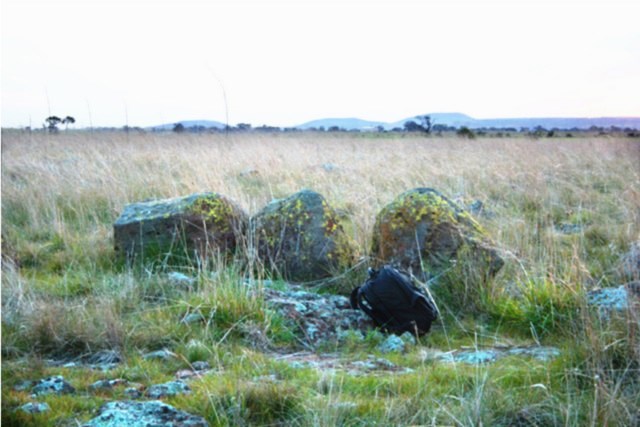
🌊 2. Aboriginal Australian Flood and Landscape Myths (possibly 10,000+ years old)

  • Origin: Indigenous peoples of Australia.

  • Estimated age: At least 10,000 years, possibly older.

  • Medium: Oral storytelling traditions (Dreamtime).

  • Content: Stories describe rising sea levels and the flooding of land bridges - now corroborated by geological evidence.

✅ Why it matters:

  • These oral traditions encode accurate environmental memory over millennia.

  • They may be the oldest continuously told stories in human history.

https://www.veniceclayartists.com/wp-content/uploads/2013/02/Galleries-Kimberley-Found.jpg
https://upload.wikimedia.org/wikipedia/commons/a/a7/Wurdi_Youang.jpg

https://www.uwosh.edu/coehs/cmagproject/ethnomath/legend/images/waynab.jpg


🐍 3. The Descent of Inanna (c. 1900-1600 BCE, Sumeria)

  • Origin: Sumerian city-states.

  • Plot: Inanna (Ishtar), goddess of love and war, journeys into the underworld and dies, then returns to life.

  • Themes: Death and rebirth, feminine power, cosmic order.

✅ Why it matters:

  • One of the oldest myths of descent and resurrection, influencing later myths (Persephone, Osiris, Jesus).

https://upload.wikimedia.org/wikipedia/commons/thumb/5/5c/Ishtar_on_an_Akkadian_seal.jpg/1078px-Ishtar_on_an_Akkadian_seal.jpg

https://upload.wikimedia.org/wikipedia/commons/thumb/d/d7/Seal_of_Inanna%2C_2350-2150_BCE.jpg/1280px-Seal_of_Inanna%2C_2350-2150_BCE.jpg

https://collectionapi.metmuseum.org/api/collection/v1/iiif/321910/1825362/main-image


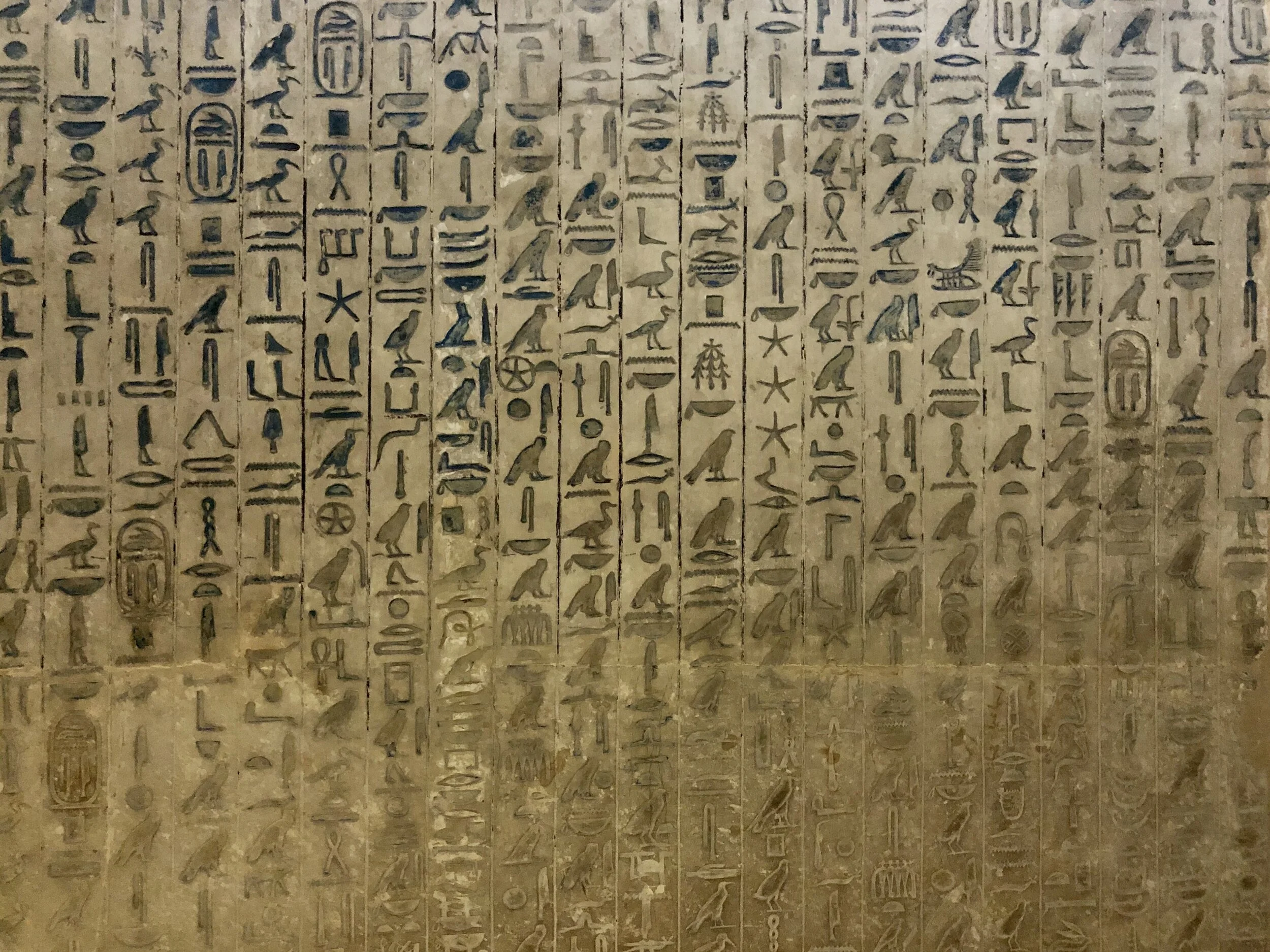
⛵ 4. The Pyramid Texts & Egyptian Creation Myths (c. 2400 BCE)

  • Origin: Old Kingdom Egypt.

  • Content: Creation myths, afterlife journeys, sun god Ra, Osiris myth cycle.

  • Medium: Hieroglyphic inscriptions inside pyramids.

✅ Why it matters:

  • Some of the earliest religious texts ever written.

  • Echo oral traditions that likely go back much further.

https://egymonuments.gov.eg/media/2795/_dsc8493.jpg?center=0.39189189189189189%2C0.5113122171945701&height=423&mode=crop&rnd=133885009530000000&width=645

https://study.com/cimages/multimages/16/357px-nun_raises_the_sun2197777580541391344.jpg

https://images.squarespace-cdn.com/content/v1/56c13cc00442627a08632989/1576335206212-XYPXPMFUF3463VTQDTV1/unaspyramidtexts.JPG


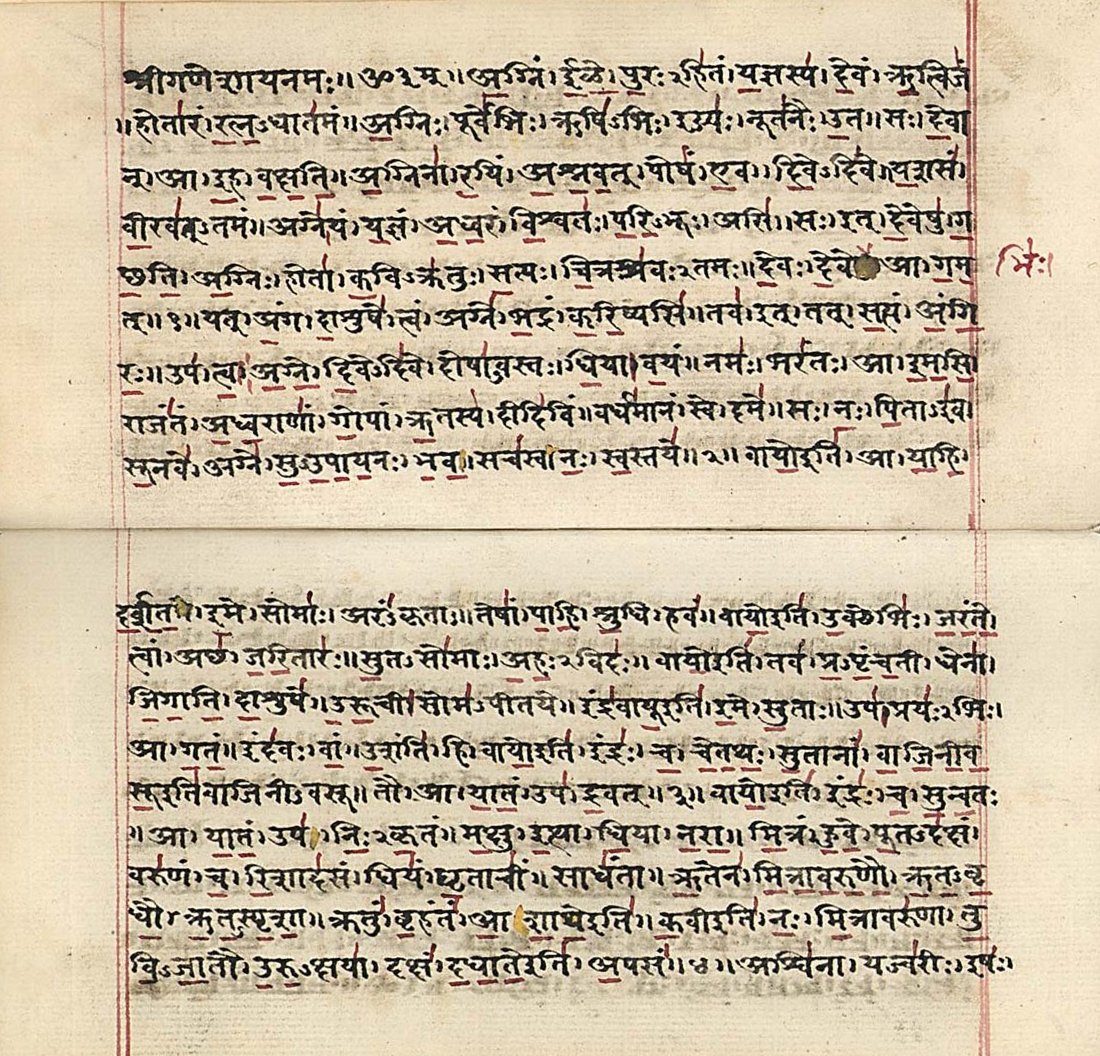
🏞 5. Indo-European and Vedic Creation Hymns (c. 1500-1200 BCE)

  • Origin: Ancient India.

  • Text: Rig Veda (Nasadiya Sukta).

  • Themes: Cosmic origins, the birth of the universe from the “non-existent.”

  • Medium: Oral hymns later written in Sanskrit.

✅ Why it matters:

  • Among the oldest surviving religious-philosophical hymns.

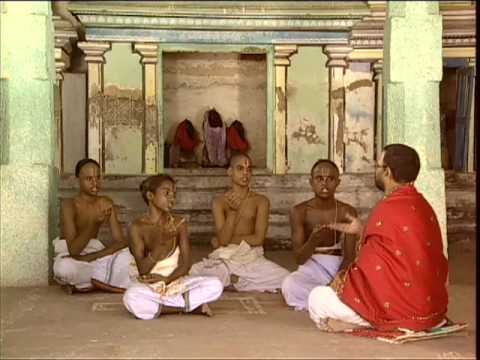
  • Still recited today in traditional Vedic ceremonies.

https://upload.wikimedia.org/wikipedia/commons/0/02/Rigveda_MS2097.jpg

https://img.youtube.com/vi/qPcasmn0cRU/0.jpg

https://cdn.exoticindia.com/images/products/original/books-2019-014/naw399g.jpg


🌍 6. Other Ancient Story Traditions with Deep Time Roots

  • Greek myths (e.g., Titanomachy, c. 800 BCE - but rooted in earlier Indo-European myth).

  • Biblical Genesis (compiled c. 6th-5th century BCE, drawing from earlier Mesopotamian sources).

  • Chinese flood myths (Yu the Great, c. 2000 BCE oral roots).

  • Native American and Polynesian origin stories, often describing migrations and land formations tied to geological events.


🧠 Why These Stories Endure
  • They encode cosmic explanationsethical codes, and environmental memory.

  • Many are mythopoetic - meaning they carry both cultural and existential meaning.

  • Some (especially Indigenous stories) may have survived continuously for 10,000+ years, making them the oldest remembered narratives on Earth.


🏆 Summary of the Oldest Stories Still Remembered

Story / TraditionRegionEstimated AgeTransmissionNotes
Aboriginal Dreamtime MythsAustralia10,000+ yearsOralFlood and landscape myths tied to real events.
Epic of GilgameshMesopotamiac. 2100 BCEWritten & oralOldest written epic.
Descent of InannaSumeriac. 1900 BCEWritten & oralProto-resurrection myth.
Pyramid TextsEgyptc. 2400 BCEWrittenEarly afterlife & creation myths.
Vedic Hymns (Nasadiya Sukta)Indiac. 1500 BCEOral & writtenStill recited today.

👉 Summary:

  • Oldest written story: Epic of Gilgamesh (c. 2100 BCE)

  • Oldest still told story: Aboriginal Dreamtime flood myths (10,000+ years)

  • Oldest religious-philosophical hymn still recited: Nasadiya Sukta (Rig Veda, c. 1500 BCE)


~ Return to Introduction ~


Evolution of Worship & Religion
  • Part IV - The Sacred Made Universal
    • Essay 9 - The Age of Universal Religions
    • Essay 10 - Modernity and the Eclipse of the Sacred
    • Essay 11 - The Rebirth of the Sacred
    • Essay 12 - A Processual Summation of Worship and Religion
    • Essay 13 - The Way of Cruciformity: When God Refused Power


BIBLIOGRAPHY


I. Primary Ancient Texts (Translations & Editions)

George, Andrew.
The Epic of Gilgamesh. 2 vols. Oxford: Oxford University Press, 2003.
Definitive critical edition with transliteration, translation, and commentary.

George, Andrew.
The Babylonian Gilgamesh Epic: Introduction, Critical Edition and Cuneiform Texts. Oxford: Oxford University Press, 2003.
→ Scholarly reference standard for Akkadian tablets.

Dalley, Stephanie.
Myths from Mesopotamia: Creation, the Flood, Gilgamesh, and Others. Rev. ed. Oxford: Oxford University Press, 2000.
→ Includes Atrahasis, Enuma Elish, and flood narratives.

Foster, Benjamin R.
The Epic of Gilgamesh: A New Translation, Analogues, Criticism. New York: Norton, 2001.
→ Highly readable translation with comparative materials.

Kovacs, Maureen Gallery.
The Epic of Gilgamesh. Stanford: Stanford University Press, 1989.
→ Clear academic translation widely used in teaching.

Sandars, N. K.
The Epic of Gilgamesh. London: Penguin Classics, 1972 (rev. ed. 2003).
→ Influential literary translation that popularized the epic.


II. Flood Narratives & Comparative Mythology

Lambert, W. G., and A. R. Millard.
Atrahasis: The Babylonian Story of the Flood. Oxford: Clarendon Press, 1969.
→ Core Mesopotamian flood text predating Gilgamesh Tablet XI.

Pritchard, James B. (ed.).
Ancient Near Eastern Texts Relating to the Old Testament. 3rd ed. Princeton: Princeton University Press, 1969.
→ Comparative flood texts (Mesopotamian, biblical, Egyptian).

Tigay, Jeffrey H.
The Evolution of the Gilgamesh Epic. Philadelphia: University of Pennsylvania Press, 1982.
→ Traces oral-to-written development and flood integration.

Frazer, James George.
Folk-Lore in the Old Testament. London: Macmillan, 1918.
→ Classic comparative myth study (methodologically dated but historically important).


III. Aboriginal Australian Flood & Landscape Memory

Reid, Nick et al.
“Aboriginal Memories of Inundation of the Australian Coast Dating from More Than 7,000 Years Ago.”
Australian Geographer 46, no. 2 (2015): 1–15.

Nunn, Patrick D., and Nicholas Reid.
“Aboriginal Memories of Sea-Level Change and Coastal Flooding.”
Quaternary Science Reviews 55 (2013): 1–11.

Chatters, James C. et al.
Stories Written in Stone: Oral Traditions and Geological Memory.
→ Demonstrates long-term cultural memory of floods.


IV. Egyptian, Vedic, and Ancient Cosmologies

Allen, James P.
The Ancient Egyptian Pyramid Texts. Atlanta: Society of Biblical Literature, 2005.

Assmann, Jan.
Death and Salvation in Ancient Egypt. Ithaca: Cornell University Press, 2005.

Jamison, Stephanie W., and Joel P. Brereton.
The Rigveda: The Earliest Religious Poetry of India. Oxford: Oxford University Press, 2014.

O’Flaherty, Wendy Doniger.
Hindu Myths: A Sourcebook. New York: Penguin Classics, 1975.


V. Oral Tradition, Memory, and Myth Theory

Ong, Walter J.
Orality and Literacy: The Technologizing of the Word. London: Routledge, 1982.

Assmann, Jan.
Cultural Memory and Early Civilization. Cambridge: Cambridge University Press, 2011.

Eliade, Mircea.
Myth and Reality. New York: Harper & Row, 1963.

Lord, Albert B.
The Singer of Tales. Cambridge, MA: Harvard University Press, 1960.


VI. Archaeology, History, and Material Culture

George, Andrew.
“Gilgamesh.”
The British Museum Essays, 2019.

Van De Mieroop, Marc.
A History of the Ancient Near East. 3rd ed. Oxford: Wiley-Blackwell, 2016.

Woolley, Leonard.
Ur of the Chaldees. London: Ernest Benn, 1929.


VII. Modern Interpretive & Philosophical Works

Campbell, Joseph.
The Hero with a Thousand Faces. Princeton: Princeton University Press, 1949.

Armstrong, Karen.
A Short History of Myth. Edinburgh: Canongate, 2005.

Bottéro, Jean.
Religion in Ancient Mesopotamia. Chicago: University of Chicago Press, 2001.

Whitehead, Alfred North.
Religion in the Making. New York: Macmillan, 1926.
→ Relevant for processual interpretations of myth and memory.


VIII. Museum & Digital Resources (Illustrations)

  • British Museum – Gilgamesh Tablets Collection

  • Louvre Museum – Mesopotamian Reliefs and Cylinder Seals

  • The Oriental Institute (University of Chicago) – Cuneiform Archives

  • The Metropolitan Museum of Art – Ancient Near East Collection

(Useful for high-resolution images, reliefs, tablets, and seals.)