Quotes & Sayings


We, and creation itself, actualize the possibilities of the God who sustains the world, towards becoming in the world in a fuller, more deeper way. - R.E. Slater

There is urgency in coming to see the world as a web of interrelated processes of which we are integral parts, so that all of our choices and actions have [consequential effects upon] the world around us. - Process Metaphysician Alfred North Whitehead

Kurt Gödel's Incompleteness Theorem says (i) all closed systems are unprovable within themselves and, that (ii) all open systems are rightly understood as incomplete. - R.E. Slater

The most true thing about you is what God has said to you in Christ, "You are My Beloved." - Tripp Fuller

The God among us is the God who refuses to be God without us, so great is God's Love. - Tripp Fuller

According to some Christian outlooks we were made for another world. Perhaps, rather, we were made for this world to recreate, reclaim, redeem, and renew unto God's future aspiration by the power of His Spirit. - R.E. Slater

Our eschatological ethos is to love. To stand with those who are oppressed. To stand against those who are oppressing. It is that simple. Love is our only calling and Christian Hope. - R.E. Slater

Secularization theory has been massively falsified. We don't live in an age of secularity. We live in an age of explosive, pervasive religiosity... an age of religious pluralism. - Peter L. Berger

Exploring the edge of life and faith in a post-everything world. - Todd Littleton

I don't need another reason to believe, your love is all around for me to see. – Anon

Thou art our need; and in giving us more of thyself thou givest us all. - Khalil Gibran, Prayer XXIII

Be careful what you pretend to be. You become what you pretend to be. - Kurt Vonnegut

Religious beliefs, far from being primary, are often shaped and adjusted by our social goals. - Jim Forest

We become who we are by what we believe and can justify. - R.E. Slater

People, even more than things, need to be restored, renewed, revived, reclaimed, and redeemed; never throw out anyone. – Anon

Certainly, God's love has made fools of us all. - R.E. Slater

An apocalyptic Christian faith doesn't wait for Jesus to come, but for Jesus to become in our midst. - R.E. Slater

Christian belief in God begins with the cross and resurrection of Jesus, not with rational apologetics. - Eberhard Jüngel, Jürgen Moltmann

Our knowledge of God is through the 'I-Thou' encounter, not in finding God at the end of a syllogism or argument. There is a grave danger in any Christian treatment of God as an object. The God of Jesus Christ and Scripture is irreducibly subject and never made as an object, a force, a power, or a principle that can be manipulated. - Emil Brunner

“Ehyeh Asher Ehyeh” means "I will be that who I have yet to become." - God (Ex 3.14) or, conversely, “I AM who I AM Becoming.”

Our job is to love others without stopping to inquire whether or not they are worthy. - Thomas Merton

The church is God's world-changing social experiment of bringing unlikes and differents to the Eucharist/Communion table to share life with one another as a new kind of family. When this happens, we show to the world what love, justice, peace, reconciliation, and life together is designed by God to be. The church is God's show-and-tell for the world to see how God wants us to live as a blended, global, polypluralistic family united with one will, by one Lord, and baptized by one Spirit. – Anon

The cross that is planted at the heart of the history of the world cannot be uprooted. - Jacques Ellul

The Unity in whose loving presence the universe unfolds is inside each person as a call to welcome the stranger, protect animals and the earth, respect the dignity of each person, think new thoughts, and help bring about ecological civilizations. - John Cobb & Farhan A. Shah

If you board the wrong train it is of no use running along the corridors of the train in the other direction. - Dietrich Bonhoeffer

God's justice is restorative rather than punitive; His discipline is merciful rather than punishing; His power is made perfect in weakness; and His grace is sufficient for all. – Anon

Our little [biblical] systems have their day; they have their day and cease to be. They are but broken lights of Thee, and Thou, O God art more than they. - Alfred Lord Tennyson

We can’t control God; God is uncontrollable. God can’t control us; God’s love is uncontrolling! - Thomas Jay Oord

Life in perspective but always in process... as we are relational beings in process to one another, so life events are in process in relation to each event... as God is to Self, is to world, is to us... like Father, like sons and daughters, like events... life in process yet always in perspective. - R.E. Slater

To promote societal transition to sustainable ways of living and a global society founded on a shared ethical framework which includes respect and care for the community of life, ecological integrity, universal human rights, respect for diversity, economic justice, democracy, and a culture of peace. - The Earth Charter Mission Statement

Christian humanism is the belief that human freedom, individual conscience, and unencumbered rational inquiry are compatible with the practice of Christianity or even intrinsic in its doctrine. It represents a philosophical union of Christian faith and classical humanist principles. - Scott Postma

It is never wise to have a self-appointed religious institution determine a nation's moral code. The opportunities for moral compromise and failure are high; the moral codes and creeds assuredly racist, discriminatory, or subjectively and religiously defined; and the pronouncement of inhumanitarian political objectives quite predictable. - R.E. Slater

God's love must both center and define the Christian faith and all religious or human faiths seeking human and ecological balance in worlds of subtraction, harm, tragedy, and evil. - R.E. Slater

In Whitehead’s process ontology, we can think of the experiential ground of reality as an eternal pulse whereby what is objectively public in one moment becomes subjectively prehended in the next, and whereby the subject that emerges from its feelings then perishes into public expression as an object (or “superject”) aiming for novelty. There is a rhythm of Being between object and subject, not an ontological division. This rhythm powers the creative growth of the universe from one occasion of experience to the next. This is the Whiteheadian mantra: “The many become one and are increased by one.” - Matthew Segall

Without Love there is no Truth. And True Truth is always Loving. There is no dichotomy between these terms but only seamless integration. This is the premier centering focus of a Processual Theology of Love. - R.E. Slater

-----

Note: Generally I do not respond to commentary. I may read the comments but wish to reserve my time to write (or write from the comments I read). Instead, I'd like to see our community help one another and in the helping encourage and exhort each of us towards Christian love in Christ Jesus our Lord and Savior. - re slater

Thursday, March 5, 2026

R.E. Slater - A Conversation Before Leaving


A Conversation Before Leaving

by R.E. Slater

“We are not the same person we were yesterday,
nor will we be tomorrow.”
Heraclitus
I

His friends from university were scholars and were gathering together that afternoon because he was leaving. Not retiring. Leaving.

As they arrived by ones and twos, no one could quite explain why the gathering felt heavier than a simple retirement, or a prolonged sabbatical, or like one of those quiet academic disappearances which happen each year.

People just leave. College offices get reassigned. New names are hung outside. Academic books remain on their shelves like fossils of remembrance.

Still, this felt different.

Inside the small cabin its owner, John, a historian by trade, stood near the latticed window, sunlight bending across the wooden floorboards. Packing boxes lay scattered around the room - some, were far too light, as if their owner had learned not to carry too much, hold too much, or burden himself with unnecessary things.

“You could at least tell us where you’re going,” said Sandy, John's girlfriend, half-smiling.

“I could,” John replied from across the room, “but it wouldn’t help,” in slight foreshadowing.

Light laughter followed among his gathering friends. More sympathetic than amused... yet something in the room had begun to shift.

It felt like a liminal interior light that wanted switching on, but at that moment, couldn't. And then, there followed a small suggestion. Half wise-ass, half-serious. Starting as a joke....

II

“What if,” said John, turning thoughtfully from the window, “a man never aged?”

A few stray chuckles echoed through the empty cabin walls.

“Is this a thought experiment?” asked Dan, a field anthropologist.

“If you like.”

“Then how long are we talking?” Harry leaned solemnly forward preparing for debate.

John paused, not theatrically, but as if choosing the smallest of honest answers.

“Say, fourteen thousand years.”

Silence did not fall. It filled the room, breathlessly. A perfect beginning... and the first of several small fractures beginning to form its final reunion.

III

“No,” Responded Dan, immediately to the statement. “This is biologically impossible.”

“Of course,” John nodded. “That’s always the first response.”

“Is there a second?” Sandy asked.

John smiled, faintly, but tenderly.

“Sometimes.”

His friends circled him now - not physically, but intellectually. They took the bait. Their questions sharpened. Old professions rose up donning old armor. Amongst the ground was an anthropologist, a biologist, a Christian theologian, a psychologist, a historian, an archaeologist.

Each voice tried to stabilize the moment as it hungered for hypothetical sparing.

“You’re asking us to suspend everything we know,” asked Dan.

“I’m asking you to imagine it,” John said. “Not to believe it.”

“Why?” Edith asked, settling within, a bit quieter than the rest.

John looked at her differently. Seemingly peering into her being.

“To see what changes.”

IV

“Say it’s true!” Harry finally spoke up. “Then what are you?”

John shrugged.

“A person who kept going. Kept living.”

“That’s not an answer!”

“It’s the only one that makes sense.”

John spoke next, not in grand declarations, but in fragments:

“Say, I experienced a winter that lasted too long. Spoke a language no one remembers. Remembered a child who died before there were names for grief?”

Catching his breath, having stopped a moment in reflection, he continued, “I stopped keeping count after a while. Not the years, but the people who came into, and out of, my life.”

This confused his well-wishers...

“Wait! You’re saying you became different people?”

“No,” John replied. “I’m saying I couldn’t stay the same one,” as the weight of memory was adding up again.

V

Sensing John's internal burden, but not quite sure if he was up to his old parlor games of “What if?” Edith then asked, “What happens when you remember too much?”

John didn’t answer right away. He let it sink into the fellowship's psyche. Let it build. Turn. Begin to grown.

“You forget differently,” he said.

“How then does that make sense?”

“You don’t lose things... they just stop being close.”

The room grew still. Somber. Rethinking their responses - and surprisingly, feeling more emotionally drawn in then on other occassions.

“We think memory keeps us going,” John continued. “But it doesn’t. It changes us. It rearranges what matters in life.”

Sandy quickly remarked, “And you’re not tired? You're not weary?”

John looked at her, even more tenderly than before. He stepped backed and really examined his loving friend.

“I don’t think tired is the right word.”

“Then what is?”

He searched for it. “Full, I think. Stuffed. Like I've ingested too much. Seen too much. Felt too much.” he reflectively said.

VI

At which point the proverbial pot began to come to a breaking point, as they would say.

“Ok, out with it!” Dan snapped. “You’re lying!”

“Probably,” John deferred.

“Or you're delusional!”

“Also quite possible,” continuing to play a game that was becoming all too real.

“Then why continue this charade?”

John tilted his head towards his friends.

“Because you haven’t stopped listening. You're all too willing to play this game with me.”

That landed harder amongst his skeptical friends than anything John had yet offered.

VII

At this point, there arose a story within a story. One with many outcomes, hot feelings, personal outbreaks.

“Have you ever influenced history?” asked Sandy, the resident archaeologist, almost mockingly.

John hesitated, mulling his response.

“Not in the way you mean.”

“Try us.”

He slowly exhaled, not for the first time wishing to bear his soul.

“There was a time,” he added slowly, “when I shared what I had learned - about kindness, mostly. About letting go of vengeance.”

“Go on.”

“I moved on before my words could spread,” he said. “But I heard stories later. They grew.”

Around the room Edith’s voice began to tremble.

“What... are you saying…??”

“I’m saying, stories change when people need them to.”

“That’s not an answer!”

“But it’s the only one I trust,” as John kindly reflected.

VIII

The sun had shifted. The room no longer held the same light. But Edith's turbulent response still lay heavily in the air.

No one had proven anything. No one had disproven anything. And yet, a new gravity was forming. 

Everything felt altered.

Sandy then spoke, almost reluctantly:

“John, if none of this is true… then why does it matter?”

John picked up one of his moving boxes.

“Because you are all still asking the question. You're wondering if behind my words there is a new meaning unfelt in our previous relationships.” 

“That’s not enough!” Cried Art, with the authority of a reasoned academic.

“Yes, I think it might be,” came John's half-turned reply as he carried out a small box to his awaiting pickup outside.

IX

Pausing, at the door, John asked, “But why should we care?”

Not for effect, but as if recognizing something in their intimacy was something he had seen before.

“You don’t need fourteen thousand years,” he said.

No one moved.

“You’re already changing,” he continued. “Every conversation, every loss, every moment you decide to stay or leave —”

He gestured gently around the room holding his package.

“—this is how it happens.”

“Becoming,” Edith whispered.

John nodded.

“Yes. Becoming.”

X

John then left for the cabin's graveled driveway.

No resolution followed. No consensus had formed.

But something remained - not agreement, but tension - the possibility that identity is never quite fixed.

The rising awareness that memory continually reshapes us.

The suspicion that meaning is made, not given. Not inherited. But experienced over time.

And beneath it all - a quieter question formed - one no one would say aloud:

“If we are already becoming… why aren’t we paying attention? Perhaps learning to hold loosely the unnecessary things so that we might draw closer to the things that mattered?”


- R.E. Slater

“We imagine life as something we possess,
yet life is something we always possess as becoming.”
 - R.E. Slater

“Some conversations never end when the speaker in our head leaves -
they remain with us, quietly reshaping what we thought we knew.”
- R.E. Slater

“We rarely notice how much we are changing
until someone asks a question we cannot easily dismiss.”
- R.E. Slater
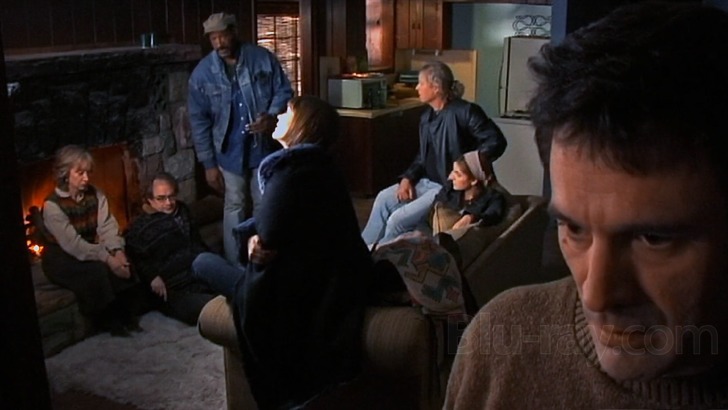
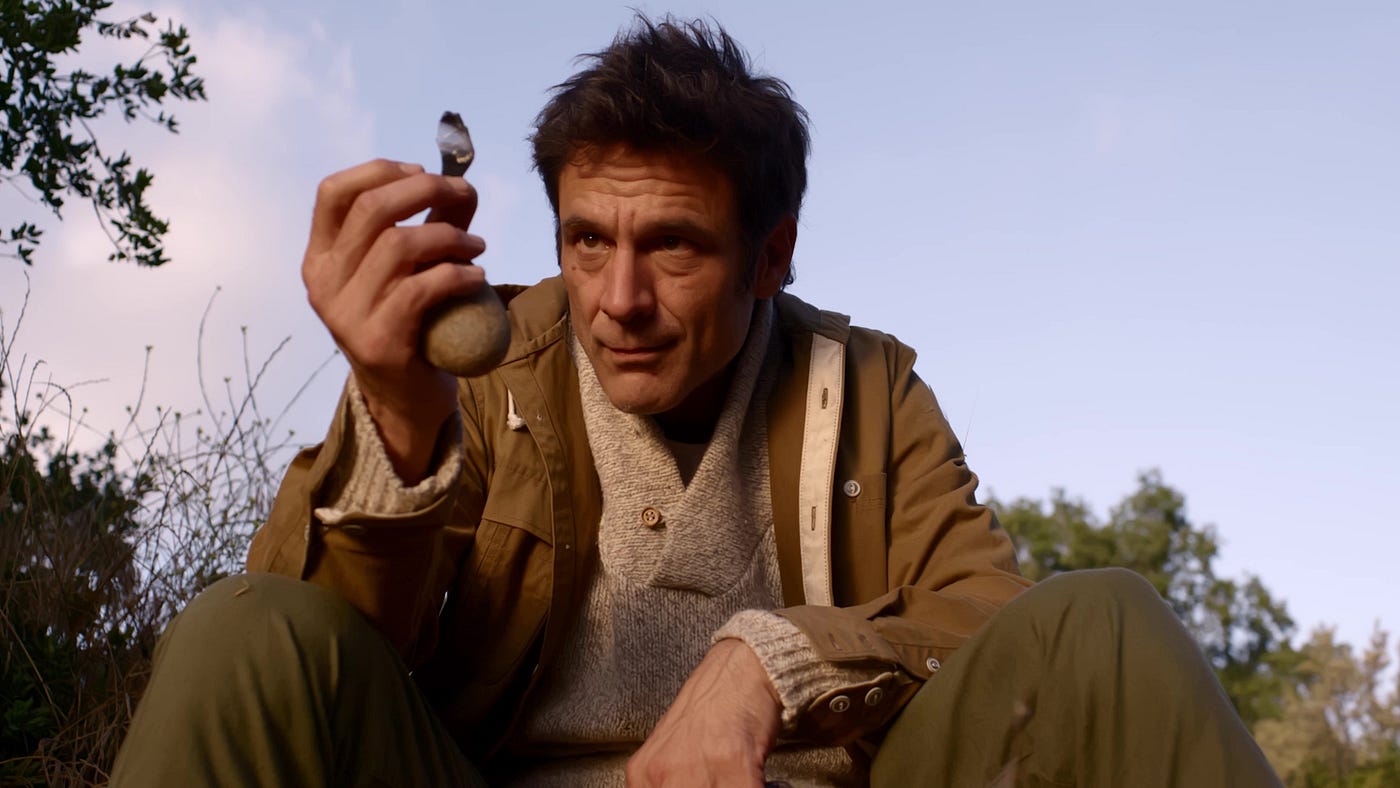


https://images.static-bluray.com/reviews/16333_1.jpghttps://miro.medium.com/v2/resize%3Afit%3A1400/0%2AZeH6XOyObPDRqjRU.jpg

The Man from Earth
(2007)

A Processual Review of Becoming

by R.E. Slater & ChatGPT

“Man is nothing else but what he makes of himself.”
- Jean‑Paul Sartre

“We live forward, but understand backward.”
- Søren Kierkegaard


There are films that rely on spectacle, and then there are films that rely on thought. The Man from Earth, written by Jerome Bixby and directed by Richard Schenkman, belongs firmly to the latter. It is, at its core, a philosophical chamber drama - a single-room conversation that unfolds into a meditation on time, identity, purpose, and the evolving nature of truth.

"A Conversation Before Leaving" was a light re-enactment of the film without spoiling the actual content of its characters. However, all that follows will require the reader to stop and watch the film, as we now go on to analyze its characters, topics, and philosophical weight.

In hindsight, what makes the film remarkable - especially in light of processual interests - is that it enacts becoming rather than merely describing becoming.

The Man From Earth 2007 | 1080p


~ SPOILERS BELOW ~


I. The Setting

IA. The Speakers and Their Disciplines

The conversation in The Man from Earth works because each character represents a distinct academic discipline. Their professional backgrounds shape the way they respond to John Oldman’s extraordinary, if not audacious, claim of longevity. What emerges is a kind of miniature intellectual ecosystem, gathered within a single room.

John Oldman, the central figure of the story, is a professor of history. His role in the conversation is that of catalyst. He introduces the thought experiment that suggests he may have lived for fourteen thousand years, and in doing so initiates the dialogue which drives the entire film.

Dan, an anthropologist, approaches the claim through the lens of evolutionary science. His instinct is immediate skepticism, attempting to dismantle John’s story through anthropology and human biological development.

Harry, a biologist, focuses on the physiological implications of such a claim. Could the human body sustain such longevity? His questions probe the biological limits of life itself.

Edith, a scholar of Christian theology and religious studies, finds herself increasingly unsettled as the conversation unfolds, particularly when John hints that he may have been connected to the historical origins of Jesus Christ.

Sandy, an archaeologist, exhibits a greater openness to the possibility being entertained. Her training in uncovering the past makes her more willing than others to suspend immediate disbelief.

Art Jenkins, a senior archaeologist and respected academic, represents the stabilizing authority of institutional scholarship. His role is to defend the established intellectual order.

Will Gruber, a psychologist and psychiatrist, interprets the conversation through the framework of mental health. He considers whether John’s narrative might reflect delusion, trauma, or psychological coping.

Together, these figures create a dynamic interplay of intellectual perspectives.


IB. Why This Group Works Dramatically

Seen symbolically, the characters form a microcosm of humanity’s knowledge systems.

CharacterDisciplineSymbolic Role
JohnHistoryLiving memory
DanAnthropologyEvolutionary science
HarryBiologyPhysical limitation
EdithTheologyFaith and belief
SandyArchaeologyCuriosity about the past
ArtAcademic authorityTradition and institutional knowledge
WillPsychologyThe human mind

Within this small gathering we see science, religion, history, and psychology meeting face to face.

The conversation thus becomes more than a discussion about one man’s claim. It becomes a meeting point of the different ways human beings search for truth.


II. The Premise as Philosophical Catalyst

The narrative premise of the film is deceptively simple.

A departing professor gathers together several colleagues before leaving town. During their conversation he suggests, quietly but seriously, that he may have lived continuously for fourteen thousand years, stretching back to the Upper Paleolithic period.

From this moment forward, the film unfolds almost entirely through dialogue. Skepticism, curiosity, disbelief, fascination, and existential unease ripple through the room.

Yet the premise is not designed to be proven. It functions instead as a philosophical invitation.

Rather than asserting that John’s story is true, the film asks a different kind of question:

What if such a thing were possible?

In this sense the film mirrors the philosophical approach of Process Philosopher, Alfred North Whitehead. It does not insist upon a fixed metaphysical claim. Instead it offers a speculative proposition - an imaginative possibility through which deeper truths may emerge.

The room thus becomes a laboratory of thought in which each participant must renegotiate their assumptions about time, identity, and experience.


III. Identity as Process Rather Than Substance

John Oldman is not presented as a static being possessing a fixed identity. Instead he appears as a continuous accumulation of experience.

He changes names.
He adopts new professions.
He leaves before anyone notices that he does not age.

In this sense, memory becomes the only thread binding his life together.

This depiction resonates strikingly with Whitehead’s understanding of the self. For Whitehead, the self is not a permanent substance but a society of experiences unfolding through time. Identity arises through the integration of past experiences into present consciousness.

John Oldman can consequently be understood as a dramatic illustration of this principle. His life represents an extended continuity of experience - a living stream of memory stretching across millennia.

And yet, the film quietly presses an even deeper question:

If identity is shaped by memory and adaptation rather than essence, then what ultimately anchors the self?


IV. Time, Memory, and the Weight of Experience

Unlike many narratives about immortality, The Man from Earth does not romanticize endless life.

Instead it presents time as an accumulating burden.

John speaks of languages that no longer exist;
Of cultures that have risen and vanished;
Of relationships that must inevitably end.

Time becomes less like a line and more like sedimentary soil, with layers of experience slowly building upon one after the other.

This image resonates strongly with process philosophy. In process thought, the past never fully disappears. Each moment carries forward the accumulated influence of prior experience.

In this sense the past remains objectively immortal within the present.

John Oldman embodies this condition in dramatic form. He is not simply an old man. He is history itself carried forward through a single stream of consciousness.


V. Religion as an Evolving Narrative

One of the film’s most provocative dimensions concerns religion.

At one point John suggests that he may have once attempted to share ideas of compassion and forgiveness during his travels, and that these teachings later became associated with the figure of Jesus Christ.

Whether this claim is meant literally or metaphorically is never fully resolved.

What matters is the implication that religious traditions may evolve through dynamic, layered reinterpretation and transmission over time.

From this perspective, religious meaning is not static. It emerges through the ongoing interaction between stories, communities, and historical context.

Teachings are remembered, reshaped, translated, and sometimes mythologized.

Such a view resonates with a process-oriented approach to theology, where faith is understood not as a fixed deposit but as an ongoing participatory process.

The religious-cum-faith discomfort this suggestion produces within the room reflects a broader human tension. People often long for certainty in matters of faith. Yet lived history continually reshapes the meaning of inherited traditions.


VI. Knowledge, Skepticism, and the Limits of Certainty

Each participant in the room represents a particular epistemic stance.

  • The scientist seeks empirical proof.
  • The historian remains cautiously open.
  • The psychologist searches for psychological explanations.
  • The theologian defends religious belief.

Yet none of these perspectives ultimately resolves the mystery before them.

Instead, the conversation reveals the limits of certainty itself.

Truth in this context is not delivered as a final conclusion. It emerges through dialogue, questioning, and interpretation.

In process terms, reality is not a finished object waiting to be discovered. It is an ongoing event of interpretation shaped by relationships, perspectives, and experience.


VII. Becoming as the Human Condition

As the discussion unfolds, the central question of the film slowly shifts.

It is no longer simply:

“Is John telling the truth?”

Instead the deeper question becomes:

“What does it mean to exist across time?”

Seen in this light, John Oldman is less a supernatural anomaly and more a dramatic exaggeration of the (continuing) human condition.

Human beings themselves are continually changing:

We adapt to new circumstances.
We reinterpret past experiences.
We carry forward memories that shape who we become.

In this sense, we are all participating in processes of becoming - though our timelines are much shorter.


VIII. A Processual Interpretation

Viewed through a Whiteheadian lens, The Man from Earth can be interpreted as a narrative exploration of process metaphysics.

The film illustrates:

  • the continuity of experience across time

  • the formation of identity through accumulated memory

  • the reinterpretation of traditions through continuous historical change

  • the epistemic humility required in confronting the limits of knowledge

John Oldman becomes less a miraculous figure and more a philosophical thought experiment.

He represents the possibility that identity itself may be nothing more than the ongoing integration of experience.


IX. Why the Film Endures

Despite its modest budget and simple setting, the film has achieved enduring popularity.

Its power lies in the questions it raises.

Human beings long for continuity.
We wrestle with the instability of identity.
We seek meaning within the flow of time.

The film quietly asks:

If one could live long enough to witness the rise and fall of civilizations, would wisdom inevitably follow? Or would such longevity simply deepen the weight of memory?

More profoundly, it invites us to consider whether we ourselves are already personally participating in processes of becoming that we barely recognize around ourselves.


Closing Reflection

The Man from Earth is ultimately less about immortality than about the texture of existence itself.

It suggests that identity is not something given once and for all but something continually formed through experience.

Truth is not something possessed but something pursued.

Meaning is not fixed but emerges through participation in the unfolding story of life.

In this sense the film becomes a cinematic parable of processual becoming.

Human life is not a static declaration. It is an unfolding participation in time, memory, and relationship.


Closing Note: A Doorway to the Series

This story functions as a fitting introduction to the reflections that follow.

It does not attempt to argue why we should care about philosophical questions.

Instead it creates the conditions in which caring becomes unavoidable.

From this point forward the conversation continues through new questions:

Why should we care about reality?
Why should we care about becoming?
Why should we care about others?
Why should we care about truth if it continues to change?

The answers may never arrive in final form.

But the questions themselves invite us into a deeper participation in the unfolding process of life.


After the Conversation
by R.E. Slater

The door closed quietly
behind a man who kept walking.

No answers followed him
down the gravel drive,
but many questions had risen.

Behind were a room of scholars
standing among half-packed boxes
amid evening's lengthening shadows.

They had argued about time,
debated about memory,
held stubbornly to the limits of belief.

But none spoke at the moment.
Each were silent.
Contemplative.

Because somewhere -
between a question, and a story -
something had shifted.

A weight had descended,
and the oldest truth in the room
was not fourteen thousand years old.

A quiet realization arose
that life was not something
one could possess...

Only something
to be participated in as
the oldest of processes in the universe.


R.E. Slater
March 5, 2026
@copyright R.E. Slater Publications
all rights reserved


No comments:

Post a Comment