Quotes & Sayings


We, and creation itself, actualize the possibilities of the God who sustains the world, towards becoming in the world in a fuller, more deeper way. - R.E. Slater

There is urgency in coming to see the world as a web of interrelated processes of which we are integral parts, so that all of our choices and actions have [consequential effects upon] the world around us. - Process Metaphysician Alfred North Whitehead

Kurt Gödel's Incompleteness Theorem says (i) all closed systems are unprovable within themselves and, that (ii) all open systems are rightly understood as incomplete. - R.E. Slater

The most true thing about you is what God has said to you in Christ, "You are My Beloved." - Tripp Fuller

The God among us is the God who refuses to be God without us, so great is God's Love. - Tripp Fuller

According to some Christian outlooks we were made for another world. Perhaps, rather, we were made for this world to recreate, reclaim, redeem, and renew unto God's future aspiration by the power of His Spirit. - R.E. Slater

Our eschatological ethos is to love. To stand with those who are oppressed. To stand against those who are oppressing. It is that simple. Love is our only calling and Christian Hope. - R.E. Slater

Secularization theory has been massively falsified. We don't live in an age of secularity. We live in an age of explosive, pervasive religiosity... an age of religious pluralism. - Peter L. Berger

Exploring the edge of life and faith in a post-everything world. - Todd Littleton

I don't need another reason to believe, your love is all around for me to see. – Anon

Thou art our need; and in giving us more of thyself thou givest us all. - Khalil Gibran, Prayer XXIII

Be careful what you pretend to be. You become what you pretend to be. - Kurt Vonnegut

Religious beliefs, far from being primary, are often shaped and adjusted by our social goals. - Jim Forest

We become who we are by what we believe and can justify. - R.E. Slater

People, even more than things, need to be restored, renewed, revived, reclaimed, and redeemed; never throw out anyone. – Anon

Certainly, God's love has made fools of us all. - R.E. Slater

An apocalyptic Christian faith doesn't wait for Jesus to come, but for Jesus to become in our midst. - R.E. Slater

Christian belief in God begins with the cross and resurrection of Jesus, not with rational apologetics. - Eberhard Jüngel, Jürgen Moltmann

Our knowledge of God is through the 'I-Thou' encounter, not in finding God at the end of a syllogism or argument. There is a grave danger in any Christian treatment of God as an object. The God of Jesus Christ and Scripture is irreducibly subject and never made as an object, a force, a power, or a principle that can be manipulated. - Emil Brunner

“Ehyeh Asher Ehyeh” means "I will be that who I have yet to become." - God (Ex 3.14) or, conversely, “I AM who I AM Becoming.”

Our job is to love others without stopping to inquire whether or not they are worthy. - Thomas Merton

The church is God's world-changing social experiment of bringing unlikes and differents to the Eucharist/Communion table to share life with one another as a new kind of family. When this happens, we show to the world what love, justice, peace, reconciliation, and life together is designed by God to be. The church is God's show-and-tell for the world to see how God wants us to live as a blended, global, polypluralistic family united with one will, by one Lord, and baptized by one Spirit. – Anon

The cross that is planted at the heart of the history of the world cannot be uprooted. - Jacques Ellul

The Unity in whose loving presence the universe unfolds is inside each person as a call to welcome the stranger, protect animals and the earth, respect the dignity of each person, think new thoughts, and help bring about ecological civilizations. - John Cobb & Farhan A. Shah

If you board the wrong train it is of no use running along the corridors of the train in the other direction. - Dietrich Bonhoeffer

God's justice is restorative rather than punitive; His discipline is merciful rather than punishing; His power is made perfect in weakness; and His grace is sufficient for all. – Anon

Our little [biblical] systems have their day; they have their day and cease to be. They are but broken lights of Thee, and Thou, O God art more than they. - Alfred Lord Tennyson

We can’t control God; God is uncontrollable. God can’t control us; God’s love is uncontrolling! - Thomas Jay Oord

Life in perspective but always in process... as we are relational beings in process to one another, so life events are in process in relation to each event... as God is to Self, is to world, is to us... like Father, like sons and daughters, like events... life in process yet always in perspective. - R.E. Slater

To promote societal transition to sustainable ways of living and a global society founded on a shared ethical framework which includes respect and care for the community of life, ecological integrity, universal human rights, respect for diversity, economic justice, democracy, and a culture of peace. - The Earth Charter Mission Statement

Christian humanism is the belief that human freedom, individual conscience, and unencumbered rational inquiry are compatible with the practice of Christianity or even intrinsic in its doctrine. It represents a philosophical union of Christian faith and classical humanist principles. - Scott Postma

It is never wise to have a self-appointed religious institution determine a nation's moral code. The opportunities for moral compromise and failure are high; the moral codes and creeds assuredly racist, discriminatory, or subjectively and religiously defined; and the pronouncement of inhumanitarian political objectives quite predictable. - R.E. Slater

God's love must both center and define the Christian faith and all religious or human faiths seeking human and ecological balance in worlds of subtraction, harm, tragedy, and evil. - R.E. Slater

In Whitehead’s process ontology, we can think of the experiential ground of reality as an eternal pulse whereby what is objectively public in one moment becomes subjectively prehended in the next, and whereby the subject that emerges from its feelings then perishes into public expression as an object (or “superject”) aiming for novelty. There is a rhythm of Being between object and subject, not an ontological division. This rhythm powers the creative growth of the universe from one occasion of experience to the next. This is the Whiteheadian mantra: “The many become one and are increased by one.” - Matthew Segall

Without Love there is no Truth. And True Truth is always Loving. There is no dichotomy between these terms but only seamless integration. This is the premier centering focus of a Processual Theology of Love. - R.E. Slater

-----

Note: Generally I do not respond to commentary. I may read the comments but wish to reserve my time to write (or write from the comments I read). Instead, I'd like to see our community help one another and in the helping encourage and exhort each of us towards Christian love in Christ Jesus our Lord and Savior. - re slater

Sunday, February 1, 2026

The Beatitudes and Their Grammar of Love


The Beatitudes and Their Grammar of Love

How the World Learns to Become Whole

by R.E. Slater & ChatGPT


The Beatitudes are not rules for earning divine favor,
nor ideals for perfect people to follow; but revelations
of how love behaves when it becomes incarnated -
when humanity bends towards healing, love, and peace.
- R.E. Slater

The Beatitudes stand within a vast chorus of wisdom,
revealing across the eons and innumerable civilizations
the quiet truths spoken from time immemorial -
that reality flourishes not through domination,
but through humility, compassion, humility, and peace.
- R.E. Slater

“Reality is never a finished object,
but a love-story continually being written.”
- R.E. Slater


What Are the Beatitudes?

The Beatitudes are a collection of blessings spoken by Jesus which form the beginning of his Sermon on the Mount and can be found in two locations in the synoptic gospels, Matthew and Luke.
  • Gospel of Matthew 5:3–12 (this is the longer, more spiritualized form)

  • Gospel of Luke 6:20–26 (this is the shorter form, with corresponding “woes”)

Below is a clear, traditional listing....


The Beatitudes in Matthew (Matthew 5:3–12)
  1. Blessed are the poor in spirit,
    for theirs is the kingdom of heaven.

  2. Blessed are those who mourn,
    for they shall be comforted.

  3. Blessed are the meek,
    for they shall inherit the earth.

  4. Blessed are those who hunger and thirst for righteousness,
    for they shall be filled.

  5. Blessed are the merciful,
    for they shall obtain mercy.

  6. Blessed are the pure in heart,
    for they shall see God.

  7. Blessed are the peacemakers,
    for they shall be called children of God.

  8. Blessed are those who are persecuted for righteousness’ sake,
    for theirs is the kingdom of heaven.

  9. Blessed are you when people revile you and persecute you and utter all kinds of evil against you falsely on my account.
    Rejoice and be glad, for your reward is great.

Themes Found within the Sermon on the Mount

A Present Kingdom

The Beatitudes describe a present participatory reality, not merely a distant afterlife reward.
  • “Blessed are…” emphasizes current blessedness, not only future compensation.
  • The kingdom of heaven is already breaking into human experience wherever humility, mercy, and peacemaking are embodied.
  • They portray a world in which divine life is active within history, quietly reshaping persons and communities from the inside out.

Here, the Beatitudes announce how reality already works under a loving, abiding, God’s reign.

An Inversion of Values

The Beatitudes overturn conventional hierarchies of power, success, and honor.

  • The poor, mourning, meek, and persecuted are named as favored.
  • Strength is redefined as gentleness, victory as mercy, and greatness as self-giving love.
  • Social, political, and religious assumptions are destabilized.

Rather than blessing dominance, Jesus blesses dependence, vulnerability, and relational openness.

The Character of Christ

The Beatitudes mirror the inner life of Jesus himself.

  • Jesus is poor in spirit, merciful, pure in heart, a peacemaker, and persecuted.
  • They function as a portrait of Christ’s own way of being.
  • To live the Beatitudes is not to follow a checklist, but to share in the life-pattern of Jesus.

They describe not merely what Jesus teaches, but who Jesus is.

A Formation of Persons

The Beatitudes shape inner transformation before outward behavior.

  • They address disposition, posture, and orientation rather than rule-keeping.
  • They cultivate attentiveness to God, compassion toward others, and honesty about one’s own limits.
  • Ethical action flows from a transformed interior.

They are a map of becoming, not a list of achievements.

A Communal Vision

The Beatitudes imagine a distinctive kind of community.

  • A people formed by mercy rather than retaliation.
  • A society oriented toward peace rather than domination.
  • A shared life where suffering is neither hidden nor meaningless.

They sketch the contours of an alternative social order within the world.

Hope Within Suffering

The Beatitudes do not romanticize pain, but they refuse to grant it the final word.

  • Mourning is real.
  • Persecution is acknowledged.
  • Yet both are held within a horizon of meaning, presence, and promise.

Hope arises inside suffering, not after its denial.

Wisdom About Reality

At a deeper level, the Beatitudes function as metaphysical wisdom.

  • Reality bends toward mercy.
  • Humility aligns with truth.
  • Love participates in the deepest currents of the cosmos.
Together, they disclose the grain of the universe.

The Beatitudes Through Israel, Jesus, and Today

The Beatitudes do not emerge in a vacuum. They arise from Israel’s long spiritual memory; take shape within the concrete physical world of Jesus’ own historical moment; and continue to speak with living, generative force into contemporary experience today. They are best heard not as static sayings, but as an unfolding word across time.

To honor this depth, each Beatitude below is explored through three interwoven horizons:

(1) Hebrew Scriptures (Tanakh / Old Testament roots) - locating Jesus’ language within Israel’s wisdom, prophetic, and poetic traditions.
(2) Jesus’ 1st-century Jewish context - hearing how these words would have sounded amid Roman occupation, late Second Temple Judaism, and lived covenantal hopes.
(3) Contemporary significance - discerning how the same wisdom addresses modern interior life, social structures, and ethical imagination.
Read together, these horizons reveal Jesus not as a detached moral innovator, but as a faithful heir, creative interpreter, and prophetic intensifier of Israel’s vision of a world ordered toward humility, mercy, justice, and peace.

Blessed are the poor in spirit

Within Israel’s Scriptures, God consistently draws near to the lowly, broken, and contrite. Humility is portrayed not as self-negation, but as truthful self-awareness before God. The poor in spirit are those who do not ground their lives in status, power, or religious performance, but in receptive dependence.

In Jesus’ world, shaped by Roman domination and sharp social stratification, this saying names an interior posture rather than a mere economic category. To be poor in spirit is to stand before God empty-handed, without appeal to honor, lineage, or moral résumé. It resists both religious arrogance and revolutionary fantasies of salvation through force.

Today, poverty of spirit becomes a quiet refusal of the myth of self-sufficiency. It names freedom from compulsive self-justification and openness to transformation. Those who release the burden of having to be complete discover a deeper belonging. Here, Jesus says, the kingdom is already present.


Blessed are those who mourn

Israel’s Scriptures honor lament as faithful speech. Grief is not hidden from God, but voiced toward God. Mourning includes personal sorrow and communal anguish over injustice, exile, and loss.

In Jesus’ day, many mourned under occupation, economic precarity, and spiritual longing. To mourn was to acknowledge that the world is not yet as it should be. Jesus does not shame this sorrow. He blesses it.

Today, this Beatitude dignifies grief in a culture that often rushes toward distraction. It affirms that honest sorrow is not weakness but depth. Comfort does not erase pain. It accompanies it. God meets people not after grief is solved, but within it.


Blessed are the meek

Biblical meekness names strength that does not need to prove itself. It is power under restraint, courage without cruelty.

In Jesus’ context, meekness stands between violent revolt and passive despair. It refuses domination without surrendering moral agency. The meek trust God’s future more than immediate retaliation.

Today, meekness challenges cultures shaped by outrage, spectacle, and performative aggression. It forms people who are steady, patient, and non-reactive. Such people are capable of inheriting the earth because they do not seek to possess it.


Blessed are those who hunger and thirst for righteousness

Israel’s prophets describe righteousness as covenantal faithfulness expressed through justice, compassion, and right ordering of communal life.

In Jesus’ world, many longed for God to set things right. This Beatitude names a deep ache for moral and relational repair. It is not mere rule-keeping. It is longing for a healed world.

Today, this hunger appears as resistance to cynicism. It is the refusal to make peace with cruelty or inequity. Those who keep longing for goodness, even when disappointed, participate in God’s future.


Blessed are the merciful

Israel’s God is repeatedly described as merciful and gracious. Mercy is central to divine identity.

In Jesus’ day, mercy disrupted honor-shame systems and cycles of revenge. To be merciful was to treat others not according to what they deserved, but according to compassion.

Today, mercy resists cultures of cancellation, scapegoating, and perpetual condemnation. It creates space for restoration. Those who practice mercy discover themselves living inside mercy.


Blessed are the pure in heart

Biblical purity ultimately concerns inner integrity rather than external performance. It names coherence between inner life and outward action.

In Jesus’ context, this saying challenges religious systems that emphasized ritual purity while neglecting the heart. Jesus relocates holiness inward.

Today, purity of heart means wholeness. It is freedom from double lives. It is sincerity in a performative age. Such people see God because they are not constantly hiding from themselves.


Blessed are the peacemakers

Israel’s Scriptures envision peace as wholeness, harmony, and relational flourishing.

In Jesus’ world, peace was often defined by imperial order enforced through violence. Jesus redefines peace as something made through reconciliation, not imposed through fear.

Today, peacemakers are bridge-builders in polarized spaces. They refuse easy enemies. They labor patiently for healing. They resemble God because God is always making peace.


Blessed are those persecuted for righteousness’ sake

Israel’s prophets frequently suffered for speaking truth. Faithfulness has long carried cost.

In Jesus’ context, this Beatitude prepares disciples for resistance, rejection, and danger. It situates their suffering within the long story of prophetic witness.

Today, it names the reality that integrity is not always rewarded. Yet meaning is not measured by comfort. The kingdom belongs to those who remain faithful even when it hurts.


A Cumulative Synthesis

Across Israel’s Scriptures, Jesus’ own life, and the ongoing human story, a consistent pattern emerges. Reality flourishes through humility, mercy, integrity, justice, and peace:

Hebrew Scriptures:
The Beatitudes grow organically from Israel’s prophetic and wisdom traditions.

Jesus’ Day:
They reinterpret those traditions around Jesus’ own embodied way of life.

Today:
They remain a living pattern of human becoming - shaping persons and communities toward humility, mercy, justice, and peace.

The Beatitudes are not entrance requirements for heaven. They are descriptions of how life becomes whole.

They do not describe extraordinary heroes. They describe ordinary people who learn to live gently in a difficult world.

They are not ideals hovering above history. They are a path through history.


Hearing the Beatitudes Across Theological Ecosystems

The Beatitudes do not change. Yet they are heard differently depending upon the theological tradition or imagination that receives them. Every tradition brings with it a metaphysical grammar, an account of power, an understanding of salvation, and an implicit picture of what kind of world God is shaping. These underlying assumptions quietly guide what attitudes are emphasized, what are softened, and what are ignored.

In the classical Orthodox tradition, the Beatitudes are primarily received as ascetical and sacramental wisdom. They are not treated as isolated moral instructions but as stages in the slow healing of the soul. To be poor in spirit is to enter humility. To mourn is to learn compunction. To become meek is to acquire self-emptying love. To grow pure in heart is to undergo interior purification. The Beatitudes form a ladder of transformation oriented toward theosis - participation in the life of God. Their strength lies in their depth of interiority and their insistence that holiness unfolds over a lifetime. Their vulnerability is that they can, at times, drift toward inwardness detached from concrete social transformation, rendering the Beatitudes more contemplative than confrontational, more monkish than integrative, or re-framed as idealized virtues rather than lived social resistance

Within modern evangelical Christianity, the Beatitudes are most often heard as ethical descriptors of what a faithful Christian should look like. They function as marks of regenerated character within a salvation framing. A "saved" person will gradually become more humble, more merciful, more gentle, more pure. This approach has the virtue of accessibility. It connects the Beatitudes to everyday discipleship and personal moral growth. Yet it frequently narrows their scope. The Beatitudes can be received as interior personality traits rather than a radical social vision. Structural injustice, systemic violence, and economic oppression tend to recede into the background, while private piety moves to the foreground.

In MAGA-style politicized Christianity, the Beatitudes often occupy an awkward and unstable place. Their emphasis on humility, mercy, meekness, and peacemaking sits in open tension with narratives of worldly strength, dominance, and national exceptionalism. As a result, they are frequently minimized, selectively quoted, or reinterpreted. Meekness becomes weakness. Peacemaking becomes naïveté. Mercy becomes conditional. Persecution language is redirected toward the loss of cultural privilege rather than solidarity with the vulnerable. In this framework, Jesus is subtly recast not as a suffering servant but as a symbolic defender of power and tribal identity. The Beatitudes, rather than functioning as a center of gravity, become peripherally sidelined.

Process and relational theology hears the Beatitudes through a different register altogether. They are not first encountered as commands, nor merely as ideals, but as disclosures about how reality itself flourishes. They reveal the kinds of relational patterns that generate depth, coherence, and beauty. “Blessed” names alignment with the deepest currents of becoming. Poverty of spirit becomes openness to novelty. Mercy becomes participation in healing processes. Peacemaking becomes co-creation with divine relational aims. God is understood not as enforcing outcomes from above, but as working persuasively within every moment toward greater wholeness. The strength of this attitude is its integration of interior spirituality and social transformation, as well as its resonance with contemporary psychology, ecology, and relational ontology. The Beatitudes emerge as metaphysical wisdom rather than merely moral instruction. In essence, the Beatitudes reveal how reality becomes whole.

Placed side by side, a revealing contrast emerges.

  • Orthodox Christianity says, “Become like Christ.”
  • Evangelical Christianity says, “Live how Christ taught.”
  • MAGA Christianity tends to say, “Use Christ to protect our way of life.”
  • Process theology says, “Participate with Christ in the ongoing becoming of the world.”

Each hearing discloses not only a theology of Jesus, but a theology of reality.


A Comparative Snapshot
 
FrameworkPrimary EmphasisBeatitudes Seen As
OrthodoxSpiritual ascentPath toward union with God
EvangelicalPersonal ethicsTraits of a saved person
MAGA ChristianityPower & identityLargely inconvenient
Process TheologyRelational becomingMap of reality’s flourishing


Jesus as the Embodiment of the Beatitudes

The Beatitudes are often approached as ideals spoken by Jesus. Yet within the Gospels, something more radical is at work. Jesus does not merely teach these blessings. He enacts them. His life functions as their living exegesis.

This is crucial, because it means the Beatitudes are not first a moral program to imitate. They are first a revelation of divine life made visible in a human story.

Jesus is poor in spirit.
He enters the world in vulnerability, not splendor. He refuses to ground his identity in status, control, or domination. He lives in continual openness toward God, receiving rather than grasping.

Jesus is the one who mourns.
He weeps over Jerusalem. He grieves at the tomb of Lazarus. He carries within himself the sorrow of a wounded world. His compassion is not distant sympathy but participatory grief.

Jesus is meek.
He does not crush opponents or seize power. He confronts injustice without becoming its mirror. His strength expresses itself as steadiness, patience, and non-retaliatory courage.

Jesus hungers and thirsts for righteousness.
His ministry is animated by an unrelenting desire for right relationship - between humanity and God, between neighbor and neighbor, between the powerful and the vulnerable. He exposes systems that deform life and announces a different order.

Jesus is merciful.
He eats with those considered unclean. He forgives before repentance is perfected. He restores dignity before demanding reform. Mercy is not peripheral to his identity. It is central.

Jesus is pure in heart.
There is no hidden agenda in him. No double life. No manipulation. His interior and exterior are coherent. What he speaks arises from who he is.

Jesus is a peacemaker.
He refuses the false peace of empire. He also refuses the violent peace of revolution. He inaugurates a third way - reconciliation rooted in truth.

Jesus is persecuted for righteousness’ sake.
His faithfulness leads not to applause, but to rejection, abandonment, and death. The cross is not an interruption of the Beatitudes. It is their culmination.

Seen together, a profound reversal emerges.

The Beatitudes are not a staircase humans climb toward God -
They are the shape God takes in Christ toward humanity.

This re-centers discipleship. Following Jesus does not mean striving to become heroic moral achievers. It means allowing our lives, slowly and imperfectly, to be drawn into the same relational pattern.

Discipleship becomes participation rather than performance.


Christological Synthesis

Jesus does not stand outside the Beatitudes as their examiner.
He stands inside them as their embodiment.

They are not merely instructions.
They are incarnational.

In Jesus, we see what divine life looks like when translated into human form:

not dominating,
not hoarding,
not coercing,
but healing,
opening,
reconciling.

This means the final word of the Beatitudes is not “Try harder.”

It is:

“This is who God is.”

And therefore:

“This is who, or what, reality is becoming.”


THE SHAPE OF THINGS TO BE

The Beatitudes as a Metaphysics of Love

When the Beatitudes are heard through Israel’s Scriptures, embodied in Jesus’ life, and disclosed through a process-relational horizon, a remarkable claim comes into focus.

Love is not simply an emotion.
Love is not merely an ethical command.
Love is not an optional religious virtue.

Love is the deep grammar of reality.

The Beatitudes name what love looks like when it becomes incarnate-flesh inside history. They describe the posture love takes when it moves through finite lives, fragile bodies, wounded psyches, and conflicted communities.

They reveal that love expresses itself as humility rather than domination, as mercy rather than retaliation, as peacemaking rather than conquest, as integrity rather than performance.

This is why the Beatitudes feel simultaneously gentle and dangerous. They do not simply comfort. They deeply reorganize - if not disorientate - one's life.

They quietly announce that neither divine nor human coercion is ultimate.
They expose violence as metaphysically unstable.
They portray compassion as structurally aligned with reality.

In this sense, the Beatitudes are not a strategy for religious success. They are a disclosure of the architecture of existence.


Love and the Nature of Power

At the heart of the Beatitudes lies a revolution in how power is understood. The world regularly equates power with control. The Beatitudes equate power with relational influence.

Power, in this vision, is the capacity to open futures rather than close them. It is the ability to invite rather than force. It is the strength to remain present without hardening.

This aligns with a process-relational understanding of divine action. God does not coerce the world into goodness. God lures the world toward beauty. The Beatitudes describe the shape of that lure.


Love and the Shape of Time

The Beatitudes also reshape eschatology.

They do not describe how to escape history.
They describe how to inhabit history differently.

Every act of mercy becomes a small arrival of God’s future.
Every act of peacemaking becomes a localized incarnation of the coming world.
Every refusal to dominate becomes a micro-resurrection.

The future is not waiting somewhere else. It is pressing gently into the present as a tensional force awaiting acknowledgement, enactment, and performance.


Love and Human Becoming

The Beatitudes assume that humans are not finished beings. We are becoming. Not toward static perfection, but toward deeper relational capacity.

The Beatitudes do not ask, “Are you flawless?”
They ask, “Are you opening?”

Opening to God.
Opening to neighbor.
Opening to your own unfinishedness.

Spiritual maturity is not sinlessness - it is relational availability.


Love and the Character of God

Finally, the Beatitudes tell us who God is:

God is not an aloof monarch.
God is not a cosmic enforcer.
God is not a distant architect.

But God is One who is:

poor in spirit,
merciful,
meek,
pure in heart,
peacemaking,
and willing to suffer for love.

In Jesus, this God becomes visible - and in the Beatitudes, this God becomes intelligible.


A Closing Word

The Beatitudes are not entrance requirements for heaven.
They are not personality tests for the religious.
They are not sentimental poetry.

They are a map of reality’s deepest currents.

They show us:

what kind of universe this is,
what kind of reality we inhabit,
what kind of God is present with us,
and what kind of humans we must become.

And beneath it all, they whisper a single, quiet truth:

If divinity is to mean anything,
it must mean love,
or it must mean nothing.


A Final Word

In summary we may say the Beatitudes are influential across the following fields:
  • Metaphysical & Ontological
  • Immediate & Eschatological
  • Socio-Economic & Political
  • Psychological & Sociological
  • Individual & Communal
  • Christological

All at once.

They describe what kind of universe this is,
what kind of God is present,
and what kind of humans we are becoming.


What Speaks

Across deserts and rivers,
across tablets, scrolls, and whispered fires,
simple sentences keep trying to form:
Be gentle.
Be honest.
Be merciful.

The sages name them in different tongues.
Prophets weep them into the dust.
Poets circle them with trembling ink.

And yet Jesus gathered their fragments
together and spoke each into blessings:
Not to crown the strong,
    but to steady the broken.
Not to enthrone the loud,
    but to lift the low.

In these blessings the earth exhales,
as if remembering its design
and origins.

And everywhere, and always,
humanity has sensed it:
Life grows toward kindness.
Truth bends toward humility.
Love survives by serving.

Humanity did not invent this wisdom.
It inherited it from the world around it.
From the God above it.
From the Spirit within them.

And it is here we must continue
to rediscover the ancient understandings
    and meanings and identities
like rivers unwilling to forget their source
    wending their way to the seas.


R.E. Slater
February 1, 2026
@copyright R.E. Slater Publications
all rights reserved


Appendix 1
Comparison with Biblical Proverbs & Cross-Cultural Wisdoms

1. Poor in Spirit

(Humility, inward poverty, openness)

Hebrew Scriptures

  • Book of Proverbs 3:34 – God gives grace to the humble
  • Proverbs 11:2 – With humility comes wisdom
  • Psalm 51:17 – A broken and contrite heart

Across Human Wisdom

  • Tao Te Ching – “Those who know they do not know are wise.”
  • Dhammapada – Humility opens the path to awakening.
  • Analects – The noble person is modest in speech, abundant in action.

Shared Intuition:
Wisdom begins with unclenching - releasing false self-sufficiency.


2. Those Who Mourn

(Lament, grief, honest sorrow)

Hebrew Scriptures

  • Ecclesiastes 7:2–4 – Better to go to the house of mourning than feasting
  • Psalm 34:18 – God is near to the brokenhearted

Across Human Wisdom

  • Epic of Gilgamesh – Grief awakens the hero to deeper meaning.
  • Tao Te Ching – Softness and yielding overcome hardness.
  • Buddhist teachings on dukkha – Awareness of suffering is the beginning of liberation.

Shared Intuition:
Grief is not failure - it is a threshold to depth.


3. The Meek

(Gentle strength, restrained power)

Hebrew Scriptures

  • Proverbs 15:1 – A gentle answer turns away wrath
  • Psalm 37:11 – The meek inherit the land

Across Human Wisdom

  • Bhagavad Gita – The self-controlled person is truly established.
  • Tao Te Ching – The soft overcomes the hard.

Shared Intuition:
True strength expresses itself as self-mastery, not lordly domination.


4. Hunger and Thirst for Righteousness

(Longing for justice, right order)

Hebrew Scriptures

  • Proverbs 21:3 – To do justice is better than sacrifice
  • Amos 5:24 – Let justice roll like waters

Across Human Wisdom

  • Analects – The noble person seeks righteousness.
  • Bhagavad Gita – One must act according to dharma (right order).

Shared Intuition:
Human beings carry an innate ache for moral harmony.


5. The Merciful

(Compassion, kindness)

Hebrew Scriptures

  • Proverbs 11:17 – The merciful do themselves good
  • Micah 6:8 – Love mercy

Across Human Wisdom

  • Dhammapada – Hatred is not ended by hatred, but by love.
  • Analects – Benevolence is the highest virtue.

Shared Intuition:
Compassion heals both giver and receiver.


6. Pure in Heart

(Integrity, inner coherence)

Hebrew Scriptures

  • Proverbs 4:23 – Guard your heart
  • Psalm 24:3–4 – Commit to clean (guiltless) hands and a pure heart

Across Human Wisdom

  • Tao Te Ching – Simplicity returns one to the source.
  • Upanishads – The self is known through inner clarity.

Shared Intuition:
Wholeness requires alignment between inner life and outer action.


7. Peacemakers

(Reconciliation, harmony)

Hebrew Scriptures

  • Proverbs 12:20 – Counselors of peace have joy
  • Psalm 34:14 – Seek peace and pursue it

Across Human Wisdom

  • Analects – Harmony is the highest value.
  • Buddhist Eightfold Path – Right speech and right action cultivate peace.

Shared Intuition:
Peace is crafted, not accidental.


8. Persecuted for Righteousness

(Suffering for truth)

Hebrew Scriptures

  • Proverbs 29:27 – The righteous are detested by the wicked
  • Jeremiah’s prophetic laments

Across Human Wisdom

  • Apology of Socrates – The just person may suffer for truth.
  • Bhagavad Gita – One must act rightly without attachment to outcome.

Shared Intuition
Truthfulness often carries cost.


Meta-Synthesis

Across cultures, languages, and centuries, a remarkably consistent pattern emerges:

  • Humility over arrogance
  • Compassion over cruelty
  • Integrity over hypocrisy
  • Harmony over domination

The Beatitudes do not invent these truths - they crystallize them. They gather humanity’s long moral memory and give it a concentrated poetic form.

Appendix 2
A Comparative Matrix

Biblical Proverbs & Cross-Cultural Wisdoms

BeatitudeHebrew Wisdom (Proverbs / Psalms / Prophets)Parallel Human Wisdom TraditionsShared Core Insight
Poor in SpiritProv 3:34 – God gives grace to the humbleTao Te Ching – knowing one’s not-knowingOpenness is the doorway to wisdom
Those Who MournPs 34:18 – God near the brokenheartedBuddhism – awareness of suffering as first noble truthGrief deepens perception
The MeekPs 37:11 – Meek inherit the landTao Te Ching – soft overcomes hardGentle strength endures
Hunger & Thirst for RighteousnessProv 21:3 – Justice over sacrificeBhagavad Gita – live according to dharmaHumans long for moral harmony
The MercifulMicah 6:8 – Love mercyDhammapada – hatred not ended by hatredCompassion heals
Pure in HeartProv 4:23 – Guard your heartUpanishads – inner clarity reveals truthIntegrity unifies the self
PeacemakersPs 34:14 – Seek peaceConfucius – harmony is highest goodPeace must be practiced
Persecuted for RighteousnessJer 20 – suffering prophetPlato’s Apology – just person may sufferTruth carries cost


Thursday, January 29, 2026

Who Was Alfred North Whitehead?

A.N. Whitehead

Who Was Alfred North Whitehead?
by R.E. Slater & ChatGPT


“Philosophy begins in wonder.
So did the boy who never stopped asking why.”
- R.E. Slater

“Before the system, before the proof,
there was a boy listening to the world,
learning that wonder itself was a form of truth.”
- R.E. Slater

*The portrait is a formal studio photograph of Alfred North Whitehead from his middle years, most commonly dated to the 1910s–early 1920s, around the period when he was transitioning from Cambridge/London academic life toward his later philosophical phase that would culminate in Science and the Modern World (1925) and Process and Reality (1929).
Photographs of this style were typically produced for:
  • University records and faculty portraits
  • Book frontispieces and lecture announcements
  • Academic directories and professional profiles
The oval matte framing, dark suit, and restrained pose reflect early-20th-century academic portrait conventions—meant to communicate seriousness, composure, and intellectual authority rather than personality. Many reproductions of this same image appear in biographies and archival collections associated with Cambridge University, Harvard University, and philosophy reference works.
The calm, steady gaze and slightly softened expression in this portrait often strike viewers as aligning well with contemporary descriptions of Whitehead: reserved, thoughtful, and quietly humane. 

Alfred North Whitehead (1861–1947) was generally described as a deeply warm, approachable, and intellectually stimulating person, who possessed a "quietly stubborn" and highly disciplined character. While he was a rigorous mathematician and philosopher, he was widely beloved by students and colleagues for his kindness, charm, and willingness to engage with others.

Based on historical accounts, here is a breakdown of his personality and character:

  • Warm and Approachable: Whitehead was considered "universally beloved" due to his habit of helpfulness. He was known to meet with students frequently, even on Sunday evenings, and was described as "rosy-cheeked and cherubic" in his later years at Harvard.
  • Socially Adept and Charming: He was characterized as a man of "cultured charm and humility" who could relate to people in all walks of life. He was not an "armchair philosopher" but rather someone deeply concerned with real-world issues, education, and human connection.
  • Serious: While his work - particularly Principia Mathematica and Process and Reality - involved high-level abstraction and rigour, he was not "sterile." He had a "fine irony free of malice" and a sparkling sense of humor in his discourse.
  • Kind and Supportive Teacher: Bertrand Russell, who was his student, described him as an "extraordinarily perfect" teacher who was never "repressive, or sarcastic, or superior". He took a personal interest in his students, aiming to bring out the best in them.
  • Stubborn and Principled: Despite his gentle demeanor, he was described as "quietly stubborn". He held an "almost fanatical belief in the right to privacy," which led him to destroy all his personal papers before his death.
  • Resilient and Proactive: Although his parents considered him frail as a child, he was actually quite robust and, in school, was even the Captain of Games (rugby, cricket, and football).

In summary, Whitehead was a rare blend of high intellectual capability and deep humanistic warmth, noted for being a supportive mentor and a charming, witty, yet firm individual.


Alfred North Whitehead: Master of Process Philosophy
Philosopher Biography
VIS PHILO


A Commentary on Alfred Whitehead
by R.E. Slater & ChatGPT

Alfred North Whitehead (1861–1947) was a British mathematician and philosopher whose intellectual reach stretched from the heart of mathematical logic to the foundations of metaphysics and the philosophy of life. His name appears on towering works such as Principia Mathematica (co-authored with Bertrand Russell) and Process and Reality, but these texts alone do not capture the fullness of the man behind them - a thinker admired not just for his analytical brilliance, but for his warmth, humanity, and deep regard for the people around him.

Born in Ramsgate, England, into a family steeped in education and public service, Whitehead spent his early years apprenticed to curiosity - roaming the historic countryside around him, reading poetry alongside his studies, and forming an early interest in history, religion, and the rich context of human culture. Though his parents initially kept him at home due to concerns about his health, but once enrolled at a prestigious public school he flourished both academically and socially, becoming Head Prefect and Captain of Games.

Whitehead’s intellectual journey was never merely abstract. From his work on mathematics to his later philosophical explorations, he viewed ideas as living and relational - reflections not of remote conceptual structures, but of the dynamism of life itself. Even his early teaching years at Cambridge and his subsequent educational reform efforts in London showed his deep concern for how learning happens and how it engages the human spirit. He championed teaching that awakened understanding rather than packed students with disconnected facts, insisting that true culture arises from active thought and receptivity to beauty and feeling.

It was in this spirit -  a blend of disciplined rigour and compassionate engagement - that Whitehead became widely beloved as a teacher and mentor. Students at Harvard, where he spent the final decades of his career, recalled him as approachable and charismatic, a professor who drew out the best in those he taught and who could converse with colleagues and learners alike without airs or affectation. His lectures were praised not just for their insight but for their tone - imbued with humility, clarity, and a quiet sense of joy in learning.

Those who knew him personally often remarked on a subtle charm that undercut any stereotype of the reclusive academic. Friends and students remembered a man capable of unexpected humor - a “wicked wink,” a gentle irony - that hinted at layers of thought beneath a gracious surface. One recollection described his conversational style as having a “public naivete” that concealed a strong and unshakeable interior life: a person who gave generously of himself, but whose deepest convictions were quietly but firmly held.

Whitehead’s personal warmth did not dilute his seriousness of purpose. He was known as “quietly stubborn” - not in anger, but in principle - and held strong convictions, including an intense belief in personal privacy that led him to (sadly) destroy his private papers before his death. Yet even this act can be read as consistent with his philosophical emphasis on the individual as a locus of creativity and responsibility.

Ultimately, Whitehead’s legacy is a testament to a life lived at the intersection of clarity and kindness. Principia Mathematica changed the landscape of mathematical logic; Process and Reality reshaped the metaphysical imagination of the twentieth century. But it was his human presence - the mentor who conversed freely with students, the reformer who cared about the purpose of education, the thinker whose humility was as palpable as his intellect - that made him not only a profound mind but a formative influence on those who encountered him.

In Whitehead’s life, the life of the mind - and the life of the heart - were never separate; they were expressions of a worldview in which process, relation, and loving care are foundational to existence itself.


Quotations by Whitehead

The quotes below present Whitehead’s blend of intellectual rigor and lively human insight revealing a thinker who cared deeply about education, experience, creativity, and the precious interplay between ideas and life itself - not merely abstract truth but living wisdom.
📜 Quotes on Thought, Life, and Humanity
  • “Philosophy begins in wonder. And, at the end, when philosophic thought has done its best, the wonder remains.” - Whitehead on the living, human spirit of inquiry, not dry abstraction.

  • “We think in generalities, but we live in details.” - A beautiful expression of how lived experience grounds even the most abstract thought.

  • “Error is the price we pay for progress.” - A humble acknowledgment of human limitation within the creative advance of ideas.

📚 Quotes on Education (Reflecting Care & Human Growth)

  • “The purpose of education is not to fill a vessel but to kindle a flame.” - A classic image of education as igniting passion, not mere memorization.

  • “Education which is not modern shares the fate of all organic things which are kept too long.” - Suggests education must be alive and responsive to human context.

  • “There is only one subject-matter for education, and that is Life in all its manifestations.” - A vivid statement about education as engagement with the full breadth of human experience.

  • “A merely well-informed man is the most useless bore on God’s earth.” - Not a sarcastic quip, but a deep claim about cultivated, humane thought.

🌍 Quotes on Knowledge, Ideas, and Civilization

  • “Not ignorance, but ignorance of ignorance is the death of knowledge.” - A reminder of humility at the heart of true learning.

  • “A great idea is not to be conceived as merely waiting for enough good men to carry it into practical effect. That is a childish view…” - Insight into how ideas are lived and realized in community.

  • “Art flourishes where there is a sense of adventure, a sense of nothing having been done before…” - A joyful link between creativity and human daring.


Understanding Alfred North Whitehead
with Matthew David Segall
New Thinking Allowed with Jeffrey Mishlove


Additional Resources

Jonathan Cobb - Why I Am Not A Whiteheadian


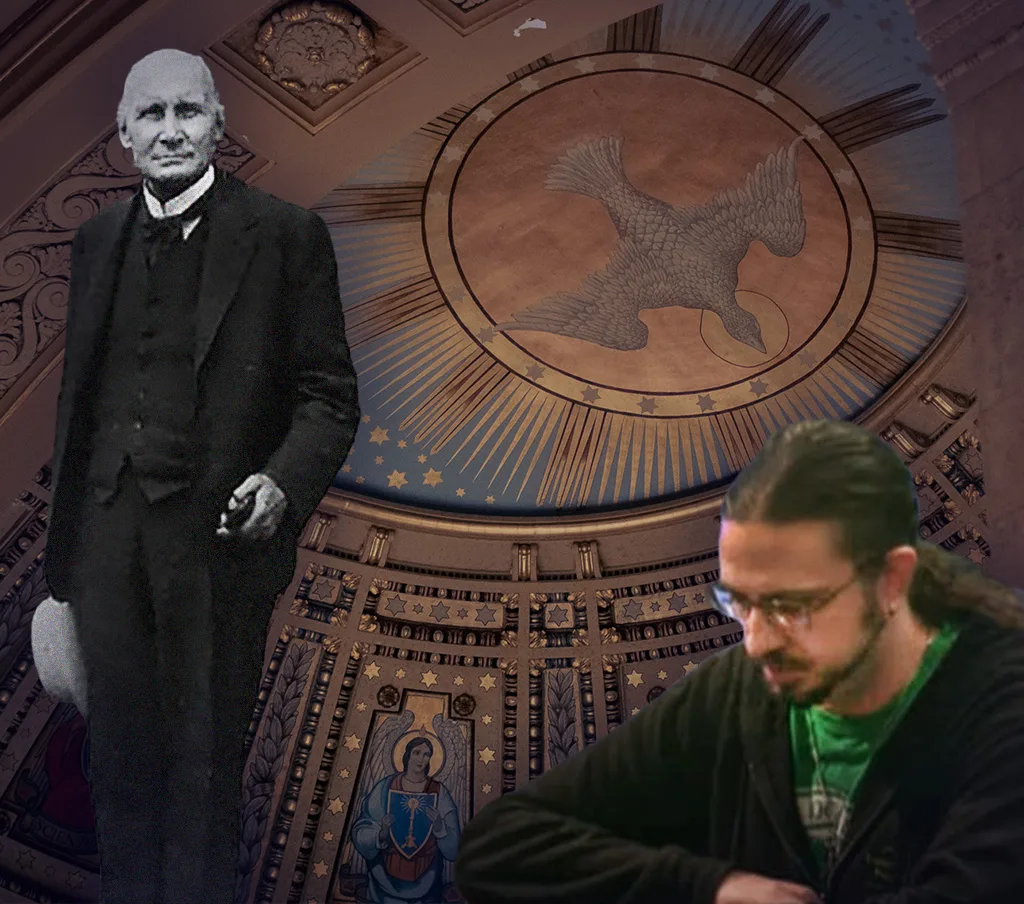
Pictured: Process philosopher Alfred North Whitehead and Jonathan Cobb

Why I Am Not A Whiteheadian
by Jonathan Cobb
January 2, 2026

~ all [comments] and reformating are mine - R.E. Slater ~
I

It’s been just over a year since the passing of my grandfather, John B. Cobb, Jr. It’s quite a thing to grow up with a grandfather so widely renowned. He wasn’t celebrity famous—it’s not like ordinary people would recognize him walking down the street—but he was highly influential and well-regarded in his field of theology, and well outside of it as well, expanding into fields such as ecology and economics. In the last couple decades of his life, thanks to an enthusiastic Chinese student named Zhihe Wang, he gained a huge foothold in China. It’s rather an unusual predicament for a Christian theologian to be embraced by the atheistic Chinese Communist Party, but of course it wasn’t his views on God that concerned them, but rather his views on ecology. He helped establish 36 Process Centers in China and played a pivotal role in developing the CCP’s project of “Ecological Civilization.” The Chinese knew him as “Eco Sage.”

The thing is, my grandfather was not what you’d call a Biblical theologian. His theology did not involve a lot of scouring scripture for insight, though he did write a commentary on the Book of Romans. He was a philosophical theologian, applying metaphysics to the Christian faith, and his metaphysics came from the early 20th century theologian Alfred North Whitehead.

Whitehead is perhaps best known for his work with [his student] Bertrand Russell on the Principia Mathematica, a seminal work in Analytic philosophy seeking to ground mathematics in logic. Its arguments are largely considered obsolete by modern logicians, but they demonstrate Whitehead’s masterful grasp of both mathematics and logic.

Whitehead, however, had a larger vision. Drawing on the vitalism of Henri Bergson, the pragmatism of William James and C. S. Peirce, and the empiricism of John Locke and David Hume, he developed a systematic metaphysics of process. For him, there are three ultimate categories: God, the world, and creativity. Curiously, he pictured creativity as ontologically prior to God, as something that both God and the world partake in. He challenged the traditional view of God as outside of time, instead positing him as an active participant in it.

For Whitehead, time is atomic. It is composed of temporal atoms called “actual occasions,” which are effectively snapshots of the total relations between entities in the universe at any given time. These entities are subordinate to their relation. So if I am in the kitchen drinking tea, it is not “Jonathan (subject) drinks (verb) his tea (predicate) in the kitchen (setting).” It is more a state of affairs consisting of “Jonathan-drinking-tea-in-the-kitchen.” For Whitehead, all phenomena are internally related, meaning they are mutually constitutive. Objects like tables or rocks or people like you or me are, as it were, abstractions from collections of actual occasions, which Whitehead calls “societies” of occasions. The ultimately real things in the world are these snapshots of existence known as actual occasions.

Each actual occasion is born, persists, and then perishes as it informs the next actual occasion, which is infused with novelty by an “initial aim” given to it by God. God in this scheme does not create the initial aim ex nihilo but orders it from a set of possibilities offered by Creativity.
God, in other words, performs a reductive function for Creativity and a persuasive function for the world. This is the “primordial nature of God,” in which he creates through persuasion. When an actual occasion has perished, it is preserved in its presentational immediacy through the “consequent nature of God.” In this way, the past persists and nothing is ever truly lost.
II

I’ve gone on quite a diversion here and there is more that could be said, but since I am going to level a critique at a thinker whose thought is quite complex and profound, I hope to convince any Whiteheadians out there that I am in fact familiar with the source material. Between my brother and my cousins, I was the only grandchild to dive into this stuff and take a keen interest in my grandfather’s work. I was initially drawn to it through the work of Ken Wilber, but found greater rigor and sophistication through Whiteheadian philosophy. From there I became interested in James, Peirce, Bergson, Deleuze, Hegel, and so much more. My grandfather’s work was a springboard into a much wider pool of philosophy.

Curiosity can be dangerous, however, and in my philosophical explorations, I began to find certain aspects of Whiteheadian thought unsatisfying, and started developing a critique of them. At the same time, I was undergoing a transformation in my faith. My grandfather’s theology is very much on the [philosophically] liberal side of the spectrum, showing little care for [church] dogma or tradition. Meanwhile, at the same time I was becoming more politically radicalized, I found myself becoming more theologically conservative. I eventually became confirmed into the Roman Catholic Church, and in the process learned to treat tradition with greater reverence in my theology.

In the first part of this essay, I will lay out my areas of agreement with Whitehead. Whatever my quarrels, I still have great respect for the Whiteheadian project, and see many valuable contributions worth preserving. In the next section, I will lay out my philosophical disagreements with Whitehead’s metaphysics. In the following [(last)] section, I will address my theological issues with process theology, and advocate for a view that, while not strictly orthodox, lines up more faithfully with the traditional teachings of the church. Finally, I will attempt to sketch an outline of my own metaphysical views, which preserve what I find valuable in Whitehead while differing on a few crucial points in a way that I believe allows me to address similar philosophical problems in a more harmonious way.


Points of Agreement

Whitehead’s process ontology seeks to accord a special place to creativity. In contrast to materialistic accounts that see a cosmos consisting solely of efficient causation and material necessity, Whitehead sees a cosmos that gives rise to genuine novelty. Along with this, he sees a role for true freedom. The future, for him, is causally open—something we co-create through our decisions. He extends this agency all the way down, such that each subatomic particle prehends its environment and exercises some agency in its own becoming. This doesn’t mean everything is conscious per se, but that there is a core element of experience and even agency at the heart of the cosmos, in which all things partake in the creative becoming of the universe.

I agree with the spirit of what Whitehead is gesturing toward here, even if I quibble with some of the details. Whitehead is of course not the first philosopher to give novelty and emergence a special place in their system. Heraclitus saw flux as the most fundamental fact of nature. Hegel saw a dialectical tension between terms in which thesis and antithesis led to a newly emergent synthesis. Henri Bergson saw time as pure duration, which we only divide into increments in retrospect. More recently, Gilles Deleuze saw novelty unfolding through a repetition of difference. And now the science of complexity theory is showing how emergence is mathematically structured at the very heart of our reality.

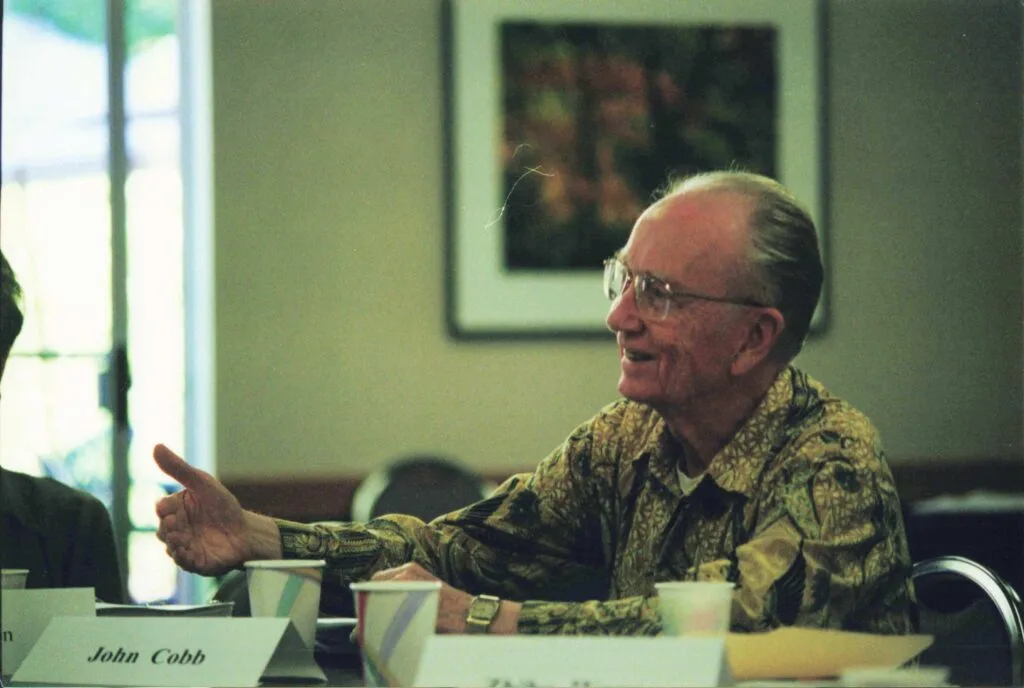
Philosopher Theologian Dr. John B. Cobb, Jr., at Center for
Process Studies conference on religious pluralism, March 2003

In truth, I must say Bergson has been a bigger influence on my thought than Whitehead. His account of memory as the embodied perception of duration has been key to a lot of my ideas. But one thing that Whitehead’s thought brings to the table that Bergson does not is an ecological focus. The Bergsonian emphasis on time as flow is replaced in Whitehead with a scheme of internal relations in which “The many become one, and are increased by one” (Process and Reality, 21). The mutual constitution and dynamic interaction of entities is central to systems theory today. It is my conviction that the science of the future must be ecological, systemic, and dynamic, much like Whitehead’s philosophy.

Whitehead’s philosophy sees value as something really existing in the cosmos. He once remarked that “Scientists animated by the purpose of proving that they are purposeless constitute an interesting subject for study” (The Function of Reason, 16). [That is to say,] the mechanistic paradigm of scientific materialism renders us aliens in a cold, dead world in which our experience of it is a freak anomaly and the perception of value is at best a subjective epiphenomenon and at worst an illusion. For Whitehead, on the other hand, experience is something primary to the cosmos and the most fundamental experience is that of value. Value is something actually realized in the world, and the advance of creativity is the creation and realization of greater value.


Philosophical Objections

Among Whitehead’s more enduring contributions to philosophy is his concept of the “fallacy of misplaced concreteness,” a type of reification in which one treats a concept as if it has causal agency. We may say, for example, that gravity causes an object to fall, or evolution causes an organism to adapt to its environment, when in fact these are concepts invented to explain the very phenomenon being described. On reading Whitehead, however, it seems to me that he commits what I’d call “the fallacy of excessive concreteness.” The actual occasions he describes are pure concreteness in a similar vein to the “atomic facts” described by the early Wittgenstein. It is an elegant system of pure relationality undergoing concrescence—and utterly alien from the world of experience. The world in which I am a subject interacting with objects becomes one in which “I” am part of a series of snapshots that also include the objects and my interacting with them. The sense of distinct identity and continuity of these entities is an emergent abstraction. *Whitehead expresses this by advocating a “becoming of continuity” rather than a “continuity of becoming.” It is not too dissimilar to what Buddhists describe as “emptiness.”
*This is an important correction to express; and it is also what one would expect of process philosophy as it matures from classical Whiteheadian expression to post-Whiteheadian development coupled with contemporary process-relational realism. - re slater
One further note, AN Whitehead developed his process philosophy in the early 20th century during the "old quantum era" of Niels Bohr (c. 1913-1924) which matured alongside the mid-1920s "new quantum mechanics era. While Whitehead's philosophical shift from mathematics to metaphysics began around 1910, his key process-oriented works, Science and the Modern World (1925) and Process and Reality (1929), were written specifically to address the revolutionary changes in physics, including Bohr's atomic model. - re slater
It is not that I think Whitehead’s perspective here is wrong so much as partial. I am in some sense constituted by my relations, yet I have a capacity to relate to things in certain ways and not others. As a human, I have a specific body constitution that allows me to eat certain foods and not others, inhale oxygen and exhale carbon dioxide, have a certain tolerance for heat and cold, and have a certain capacity to socially interact with other members of my species in ways that I can’t interact with other species. As an individual, I have a personality, a particular set of tastes, and a particular point of view. I will relate to certain people as friends, others as enemies, a select few as lovers, and how I relate to them will be a matter of both my nature and theirs, and others with their own different nature will relate to them in other ways. In other words, there is within me a certain capacity to relate in ways that are unique to me, that spring forth from some inner nature of mine. One may, of course, readily point out that this nature is not fixed and eternal, but a result of a particular set of circumstances of my life, from the genetic material that came together to make me to the family environment I grew up in to the set of experiences I had thereafter.

I might counter that there is some particular way I reacted and responded to those experiences that someone in the same situation would not have, but no matter, because what we have here, contra Whitehead, is a continuity of becoming. There is an irreducible this-ness to what is undergoing change as it enters into different sets of relations. There is an irreducible thing that is doing the relating. I can think of no better term for this than “substance.” Whitehead’s philosophy is in large part a systematic polemic against substance ontology. The baroque set of concepts he invents all serve to articulate a comprehensive ontology that replaces substance with atomic events... [one might say, "becoming events." - re slater]

He is not the first philosopher to attempt to do so. David Hume attempted to replace substance with “bundle theory,” in which what we perceive as distinct substances are really just bundles of qualities that we associate through habits of thought. Where these habits of thought arose from and why they were so consistent for what were supposed to be arbitrary associations was left unsaid. For Whitehead, the becoming of continuity involves an “inheritance of the past,” in which past occasions are inherited by the new actual occasion in its process of becoming, thereby establishing a chain of continuity. But if the past is a total set of internal relations, how is there this canalizing of occasions such that I have my personal history and you have yours? How does this happen unless there is a selectivity of relations, in which some relations are more relevant to one individual than another? And how can that relevance be determined for that individual if they are not in fact a discrete individual—in other words, a substance? Buddhists would describe what I am referring to as “relative truth,” in contrast to the “absolute truth” of emptiness. My only gripe with this would be the implied subordination of the one to the other. The one perspective is as real and relevant as the other, and each reveals important things that the other does not.

If substance seems less “real” to Whitehead, it is only because it is less concrete. Substance is properly virtual. It is not a particular quality or relation, but that from which these qualities and relations spring. It is a kind of nothingness by which an entity exists. In this sense, Buddhists are right—beneath all surface phenomena lies emptiness. But it is a productive emptiness—a virtual field of continuous arising. And it is a nested field of such fields. At the ultimate level is the field of reality itself, and then a chain of subordinate fields, each whole unto itself, existing within a larger whole, and containing its own subordinate fields. Our own bodies contain organs which contain cells which contain organelles and so on. The universe is a continuous process of producing new fields, or what we might call substancing.
*As a side note we might compact these statements by saying: "Becoming generates continuity because continuity is already implicit in becoming’s field-like nature." - re slater

Theological Objections

Whitehead’s system had God as a central component, but his God differed markedly from the God of traditional Christian theology. He believed religion had a constructive role to play, and praised Christianity at times, but he was not particularly concerned with reconciling his system with Christian theology. That work was pursued by Process Theology, which my grandfather played a central role in creating. Process Theology applies the God of Whitehead to Christianity and sees it as offering a more robust and rationally defensible system than what it calls “Classical Theism,” which essentially means all Christian theology prior to the 20th century, or if we’re being generous, prior to Schliermacher. When I first got into Process Theology, it was the sense that it could fit more easily into a rational scientific worldview that drew me in. However, I am a curious person by nature, and eventually I felt the need to look into this maligned “Classical Theism” myself and see what the deal was.

One central aspect of Process Theology is its critique of omnipotence. It sees the God revealed in the Gospel as one of persuasion rather than coercion. It contrasts the persuasive power of Christ with the coercive power of Caesar, and critiques theologies that attribute this coercive power of Caesar to God. But it doesn’t take this as merely a commentary on the character of God, but a limitation on his abilities. For Process Theology, God can’t force things to happen, but rather requires the participation of creation. In this way, it claims to answer the Problem of Evil. Does a person die of cancer in spite of their prayers because they’re bad? Because it’s all part of God’s plan? For Process Theology, God would very much like to heal them but is unable to do so. What the Whiteheadian God does offer is empathic connection. Whitehead describes God as “the fellow-sufferer who understands” (Process and Reality, 351). God is responsible for the ordering of possibilities and in that sense does intercede, but cannot do so without limit.

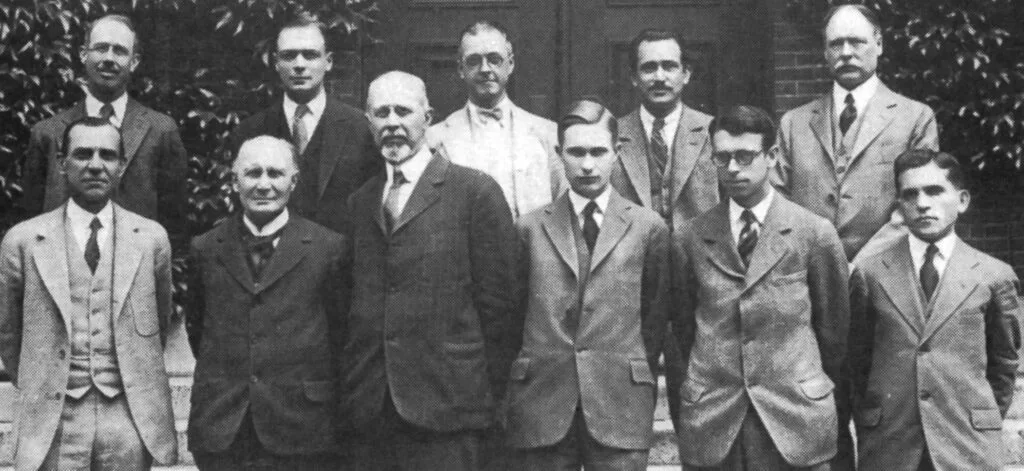
Alfred North Whitehead (front row, second from left) and his colleagues at the Harvard Department of Philosophy in 1929, the same year as the publication of Process and Reality

I am a bit more sympathetic to the question of the image of God invoked by omnipotence. The Gospels go out of their way to contrast Christ and Caesar, and we should be wary of remaking God in Caesar’s image. Process Theology therefore offers a Gandhi-like image of God as passive, persuasive, non-violent. But are Gandhi and Caesar the only options? What of Che Guevara—one who is willing to use force in the service of liberation? Is that not the God who drowned Pharaoh’s army? It is true that Christ in the Gospel shows a path of kenosis, in which force is met with mercy, but the notion that he rejects force altogether is to misunderstand his mission. He was deeply engaged in spiritual warfare against the Powers and Principalities of this world. His multiple exorcisms and healings, driving out the money-changers, and ultimate sacrifice on the cross, were all part of an apocalyptic battle with the forces of darkness.

I can certainly understand and sympathize with the notion that omnipotence is a problematic concept. It gets into tiresome debates such as whether God could create a stone so heavy that he himself could not lift it. There are numerous fruitful replies to such logical puzzles, suggesting that omnipotence does not cover logical impossibilities, and more crucially, must adhere to contingencies, such that whatever God does in the world will necessarily entail effects in other parts of the world, and God’s will can only be understood in terms of the total effect, much of which is obscure to our finite perspective. So I am not so eager to abandon omnipotence as such, provided it has such qualifiers, but I am also not so eager to insist upon it, given such misunderstanding and confusion as it is prone to create. What I would say, however, is the Process critique of omnipotence gets us no closer to answering the Problem of Evil. We know, for example, that some people do make a miraculous recovery from cancer while others do not. Are we to infer that God was capable of curing the one person and not the other? If so, how are we to know where God’s capabilities lie? Are we left with any less mystery than God choosing to spare the one but not the other? Unless we are willing to retreat into pure Deism, divine intervention will necessarily entail the mystery of its selectivity.
*The questions and concerns expressed here are quite natural and ones to which I have responded to many times over the years. As help, I will present an Addendum at the end of the article as how a post-Whiteheadian process theology might approach these church-oriented themes. - re slater
What I am willing to say is that God’s power is of a different nature than the power we are accustomed to. If anything, it is we who have a fallen understanding of what true power is. The kind of power we imagine ourselves having if we were God involves snapping our fingers and making things happen instantly. If history is any indication, this is not how God works. God works on a much longer timescale. He sets events in motion whose effects only become apparent to us in retrospect. My own faith journey has been one of recognizing the hand of grace and providence throughout my life. I have often found myself reflecting on where my life has taken me, and realized that some prayer has been answered. However, it is usually answered over a much longer period of time than I’d hoped, and often in unexpected ways. When I have felt the hand of the divine manifest instantaneously, it is usually not an answer to prayer so much as a karmic lesson. God works on his own time.

Speaking of time, Process Theology is rather unique in conceiving of God as purely within time. It posits a God who is affected by events in the world, and therefore experiences those events with us in real time. It is important to Process Theology that this affectivity is univocal—God experiences our joys and sorrows in the same sense that we experience them. Moreover, just as Process Theology denies omnipotence to God, so too do they deny him omniscience by making him ignorant of the future just as we are. God, in this scheme, may have more information to predict the future, but he does not know the future any more than we do because the future is contingent on the free choices of beings such as us.

Such concerns were deeply familiar to Church Fathers such as Augustine who, nonetheless, insisted upon the eternity of God. For Augustine, and for theologians who followed him, God is outside of time, perceiving all moments in their immediacy. This in no sense contradicted free will, for our free choices are as much a part of God’s providential plan as are God’s choices. It is not that God knows ahead of time what you are going to do, because “ahead of time” is still to place God within time. For God to be outside of time means that he experiences all time simultaneously: he experiences the time before, during, and after you make a decision as if they were a single moment. The Whiteheadian framework seeks to preserve a sense of freedom and creativity that seems threatened by such notions of eternity, but in truth, no such threat exists.

Furthermore, it is my contention that Whitehead’s own framework leads to exactly this conclusion that it seemingly resists. For according to Whitehead, every actual occasion is preserved by God in its presentational immediacy. This means that every decision you have ever made is preserved as if you were making it in the present moment. So too is the present moment preserved in some future moment. Which means that God in the future will have preserved this present moment as it is occurring now, with the free choices you make within it. Which is functionally the same as saying that a future which for us is undecided already exists within God.

One doctrine central to Christianity with which my grandfather quibbled is the doctrine of the Trinity. I always figured this was some idiosyncrasy of his, and there have been Process Theologians who have defended some version of the Trinity. But the more I think about it, the more I realize Process Theology inherently lends itself to a kind of Arianism. For if God is within time, then that means the Father’s generation of the Son and the Holy Spirit occurred within time, and they cannot be co-eternal. There is an implicit subordinationism involved. The Trinity must transcend time or it is no Trinity at all.

Christianity is a religion of paradox. It follows Christ who is both God and Man, a God who is both immanent and transcendent, within and outside of time. It is about faith and works, free will and predestination, this world and the next. Process Theology, and liberal theology in general, tends to inhabit an overly rationalistic space in which these paradoxes are explained away, often by taking one side or the other. My grandfather would say that he is fine with paradoxes but doesn’t think we should go about inventing them. But these paradoxes were “invented” not by some idle philosopher but an early church grappling with the life and nature of Christ. And herein lies one of my fundamental differences with him. My Christianity is apostolic. I stand by the belief that the faith passed on through Christ’s apostles was guided by the same Holy Spirit that possessed them upon the church’s formation at Pentecost. This does not mean it has been right about everything, but that its development of doctrine has been guided by the God that it worships.

Whitehead’s philosophy is heralded as a philosophy of time, but in practice it is often just a philosophy of novelty. The temporality of tradition is all too often ignored. Tradition turned stagnant and obstinate is dead, but a living tradition remains in continuous conversation with its past. It does not make a sudden rupture with all hitherto theology by deriding it as “Classical Theism,” but looks to the past for insight into the present and attempts to see where that tradition might be developed to remain relevant in a changing world.


Where I Stand

I owe a great intellectual debt to Whitehead, to Process Theology, and to my grandfather, but I can no longer accept their conclusions. What I wish to preserve from this tradition is a sense of creativity, emergence, of value as something real in the universe, and of ecological interconnection of all things. But since I find myself at an impasse with so much of Whitehead’s system, I have had to develop my own philosophical system, to which I cannot give sufficient space here, but hope to provide a brief sketch.

Central to my philosophy is the Logos, that order by which all things live and move and have their being. The Gospel of John informs us that Jesus himself is this Logos made flesh. The Logos underlies the rational order to the cosmos that allows us to understand it through mathematics, science, and reason. The science of complexity theory in particular reveals how this order is hard-wired to generate novelty and emergence. Each emergent phenomenon produces what Stuart Kauffman calls the “adjacent possible,” a phase space of possibilities it can actualize. With each possibility that is actualized, a new adjacent possible opens up, leaving the universe causally open and in Kauffman’s words “partially lawless.” In this way, the ordering of possibilities that Whitehead assigns to God is immanent within every emergent entity.

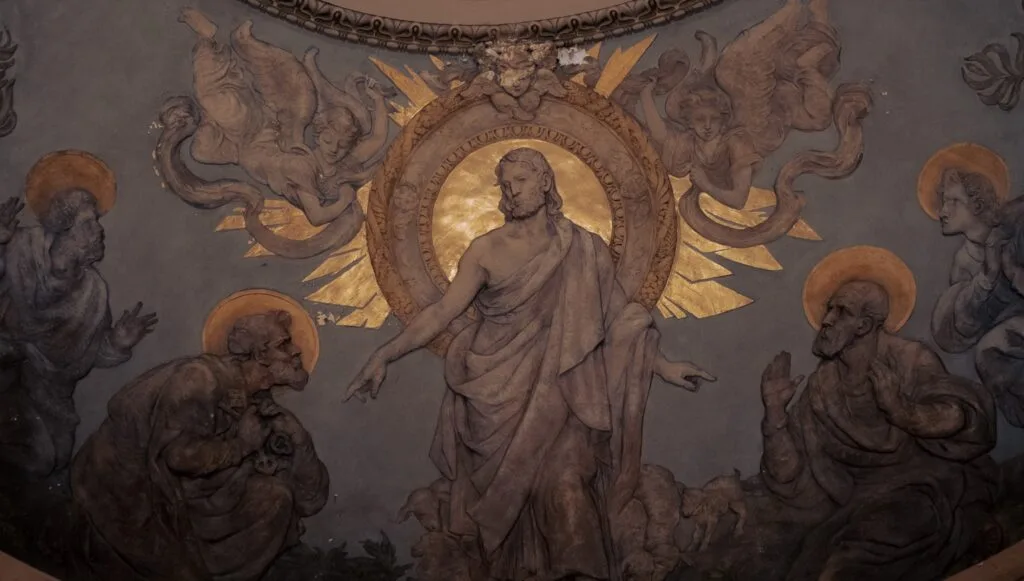
Relief sculpture of the resurrected Christ at the Cathedral of Saint Paul in Minnesota

This immanence within entities means taking them seriously as entities, reducing them neither to constituent parts as reductionist materialism does nor to their relations as Whitehead does. Graham Harman calls these tendencies “undermining” and “overmining.” Of course, insisting on every object being discrete leads to its own mereological problems as well, such as identifying how many distinct clouds are in the sky. But it is less important to clearly identify discrete objects than to recognize that the cosmos has both continuities and discontinuities, connection and discreteness. The Logos is in a constant process of substancing by producing discreteness. Novel formations emerge within the context of a greater whole differentiating itself (or differenciating, to use Deleuze’s terminology). It produces wholes within wholes within wholes.

Time is both discrete and continuous, presentist and eternalist. As J. T. Fraser observed, there is a hierarchy of temporalities operating at different scales, from the atemporal to the sociotemporal. Edith Stein posited that angels exist in a temporality greater than ours but less than God. She also suggested that when our time on this earthly plane is done, we transition from a temporal to an eternal state, renewed in God and yet returning to what we always were.

At the core of reality is frequency, harmony, and rhythm. From the mass of particles to the firings of neurons in our brains, all things operate on frequency. The ancients called this “universal music”—musica universalis—or the “harmony of spheres.” All entities exist as a certain frequency, and their relation to other entities is based on resonance. We exist within a certain shared frequency of reality with all that we encounter, yet we have our own unique frequency within this shared reality. Through art we seek to depict something that resonates with something within us. Through music we seek to resonate with a common frequency. Through ritual we seek to attune ourselves to the frequency of something greater than ourselves.

I am sure Whiteheadians will have their own responses to my objections, and I am certainly receptive to them, though I anticipate that on some things we will find ourselves at a stalemate. No matter. I certainly hope they will not hold it against me, as I find Whiteheadians as a whole to ask interesting questions and discuss novel ideas, and I would hope to continue to be part of that conversation.


Works Cited

Whitehead, Alfred North. The Function of Reason. Boston: Beacon Press, 1971 [1929].

Whitehead, Alfred North. Process and Reality. Corrected edition. Edited by D.R. Griffin and D. Sherburne. New York: The Free Press, 1978 [1929].


Jonathan Cobb has written for Metapsychosis Journal and is the author of Logos and Liberation: The Path of Kenosis. He has a BA in Sociology and Anthropology from the University of Redlands and over a decade of experience in social work. He has experience as a union organizer, has been active in social movements from Occupy to Black Lives Matter, and is affiliated with the Institute for Social Ecology. His grandfather, John B. Cobb, is founder of the Center for Process Studies and the Institute for Ecological Civilization


Illustration by R.E. Slater & ChatGPT

ADDENDUM

Process Theology, Divine Power,
and the Reframing of Theodicy

by R.E. Slater


The following brief statements respond to the preceding theological objections by clarifying how a (post-) process-relational understanding of God reframes omnipotence, divine action, freedom, time, and evil. Rather than positioning process theology as a simple negation of classical doctrines, these points aim to show how its metaphysical reorientation can be understood as a constructive development within the Christian tradition - one that seeks to preserve divine goodness, creaturely freedom, and cosmic intelligibility without collapsing into either coercive determinism or impotent deism. What follows is offered not as a final resolution of these perennial questions, but as a concise set of orienting theses for a post-Whiteheadian, processual articulation of divine power and presence.

Divine Omnipotence

1. Divine power is not best described as coercive control or sheer override capacity, but as ontological creativity: the power by which reality is continually given possibilities for becoming.

2. Process theology does not deny divine power; it redefines power as the capacity to generate, sustain, lure, and integrate becoming rather than to unilaterally override it.

3. Omnipotence, properly understood, is not the power to do anything whatsoever, but the power to do all that is metaphysically possible within a relational world.

4. A world with genuine freedom, emergence, and novelty logically excludes unilateral divine control; this is not a defect in God, but a feature of a world worth creating.

5. God’s power is maximal precisely because it never collapses creatures into puppets.

6. Divine omnipotence is better named omni-creative rather than omni-coercive.

7. God is not a cosmic engineer manipulating parts, but the ground of relational intelligibility itself.


Theodicy

8. The problem of evil is not solved by appealing to either total control or total impotence.

9. Process theology shifts the question from “Why did God cause this?” to “How is God present within this?”

10. God does not will suffering; God works within suffering toward transformation.

11. Tragedy arises from the risky structure of a free, evolutionary cosmos, not from divine sadism or divine absence.

12. God’s goodness is shown not in preventing every evil, but in never abandoning creation to meaninglessness.

13. The cross is not a proof of divine weakness, but the disclosure of the kind of power God has.


Miracles and Selectivity

14. Miracles are not suspensions of natural order, but rare intensifications of relational coherence.

15. Their irregularity reflects the complex contingencies of real processes, not arbitrary divine favoritism.

16. Prayer does not coerce God; it participates in shaping possibilities.

17. Mystery remains, but it is the mystery of complex becoming, not inscrutable tyranny.


Time, Eternity, and Divine Knowledge

18. God need not be either frozen outside time or trapped inside time.

19. God is better conceived as trans-temporal: present to every moment while exceeding any single moment.

20. God knows all possibilities exhaustively and all actualities perfectly, but the future exists as open potential, not fixed script.

21. Divine foreknowledge is compatible with freedom because God knows becoming as becoming.


Substance vs. Process Identity

22. Personal identity does not require a static substance.

23. Identity is a continuity of pattern, memory, aim, and relational history.

24. There is a real “this-ness,” but it is dynamic, not thing-like.

25. We are not substances that change; we are histories that endure.


Trinity and Process

26. Process theology need not imply Arianism.

27. The Trinity can be understood as an eternal relational life rather than a temporal sequence.

28. God’s relationality is not something added later; it is what God eternally is.

29. Process thought offers metaphysical language to rearticulate Trinity, not discard it.


Paradox and Rationality

30. Paradox is not a flaw in theology; it is a sign of depth.

31. Process thought should house paradox, not dissolve it.

32. Christianity is most faithful to itself when it holds together transcendence and immanence, freedom and grace, novelty and continuity.


Tradition and Development

33. Process theology should be understood as a development within tradition, not a replacement of it.

34. Living tradition evolves by reinterpretation, not erasure.

35. Whitehead offers tools; Christianity supplies the narrative.


Closing Statement

36. God is neither the tyrant who controls all nor the spectator who controls nothing.

37. God is the creative, relational depth of reality itself, endlessly calling the world toward richer forms of life.

38. Omnipotence, rightly named, is the inexhaustible power of love that refuses to dominate.