The earliest language written in Mesopotamia was Sumerian, an agglutinativelanguage isolate. Along with Sumerian, Semitic languages were also spoken in early Mesopotamia. Subartuan, a language of the Zagros possibly related to the Hurro-Urartuan language family, is attested in personal names, rivers and mountains and in various crafts. Akkadian came to be the dominant language during the Akkadian Empire and the Assyrian empires, but Sumerian was retained for administrative, religious, literary and scientific purposes.
Different varieties of Akkadian were used until the end of the Neo-Babylonian period. Old Aramaic, which had already become common in Mesopotamia, then became the official provincial administration language of first the Neo-Assyrian Empire, and then the Achaemenid Empire: the official lect is called Imperial Aramaic. Akkadian fell into disuse, but both it and Sumerian were still used in temples for some centuries. The last Akkadian texts date from the late 1st century AD.
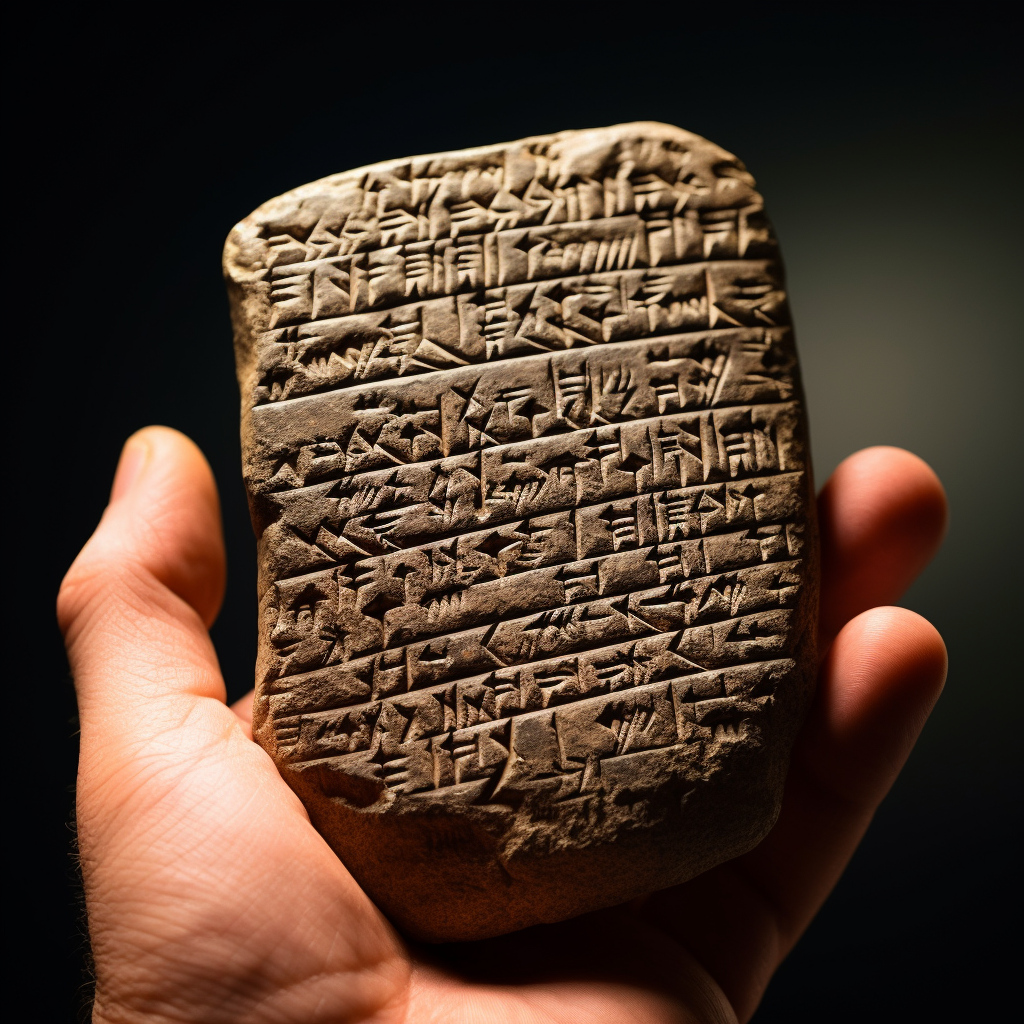
Early in Mesopotamia's history, around the mid-4th millennium BC, cuneiform was invented for the Sumerian language. Cuneiform literally means "wedge-shaped", due to the triangular tip of the stylus used for impressing signs on wet clay. The standardized form of each cuneiform sign appears to have been developed from pictograms. The earliest texts, 7 archaic tablets, come from the É, a temple dedicated to the goddess Inanna at Uruk, from a building labeled as Temple C by its excavators.
The early logographic system of cuneiform script took many years to master. Thus, only a limited number of individuals were hired as scribes to be trained in its use. It was not until the widespread use of a syllabic script was adopted under Sargon's rule that significant portions of the Mesopotamian population became literate. Massive archives of texts were recovered from the archaeological contexts of Old Babylonian scribal schools, through which literacy was disseminated.
Akkadian gradually replaced Sumerian as the spoken language of Mesopotamia somewhere around the turn of the 3rd and the 2nd millennium BC. The exact dating is a matter of debate. Sumerian continued to be used as a sacred, ceremonial, literary, and scientific language in Mesopotamia until the 1st century AD.
The Epic of Gilgamesh, an epic poem from ancient Mesopotamia, regarded as the earliest surviving notable literature.
Libraries were extant in towns and temples during the Babylonian Empire. An old Sumerian proverb averred that "he who would excel in the school of the scribes must rise with the dawn." Women as well as men learned to read and write, and for the Semitic Babylonians, this involved knowledge of the extinct Sumerian language, and a complicated and extensive syllabary.
A considerable amount of Babylonian literature was translated from Sumerian originals, and the language of religion and law long continued to be the old agglutinative language of Sumer. Vocabularies, grammars, and interlinear translations were compiled for the use of students, as well as commentaries on the older texts and explanations of obscure words and phrases. The characters of the syllabary were all arranged and named, and elaborate lists were drawn up.
Many Babylonian literary works are still studied today. One of the most famous of these was the Epic of Gilgamesh, in twelve books, translated from the original Sumerian by a certain Sîn-lēqi-unninni, and arranged upon an astronomical principle. Each division contains the story of a single adventure in the career of Gilgamesh. The whole story is a composite product, although it is probable that some of the stories are artificially attached to the central figure.
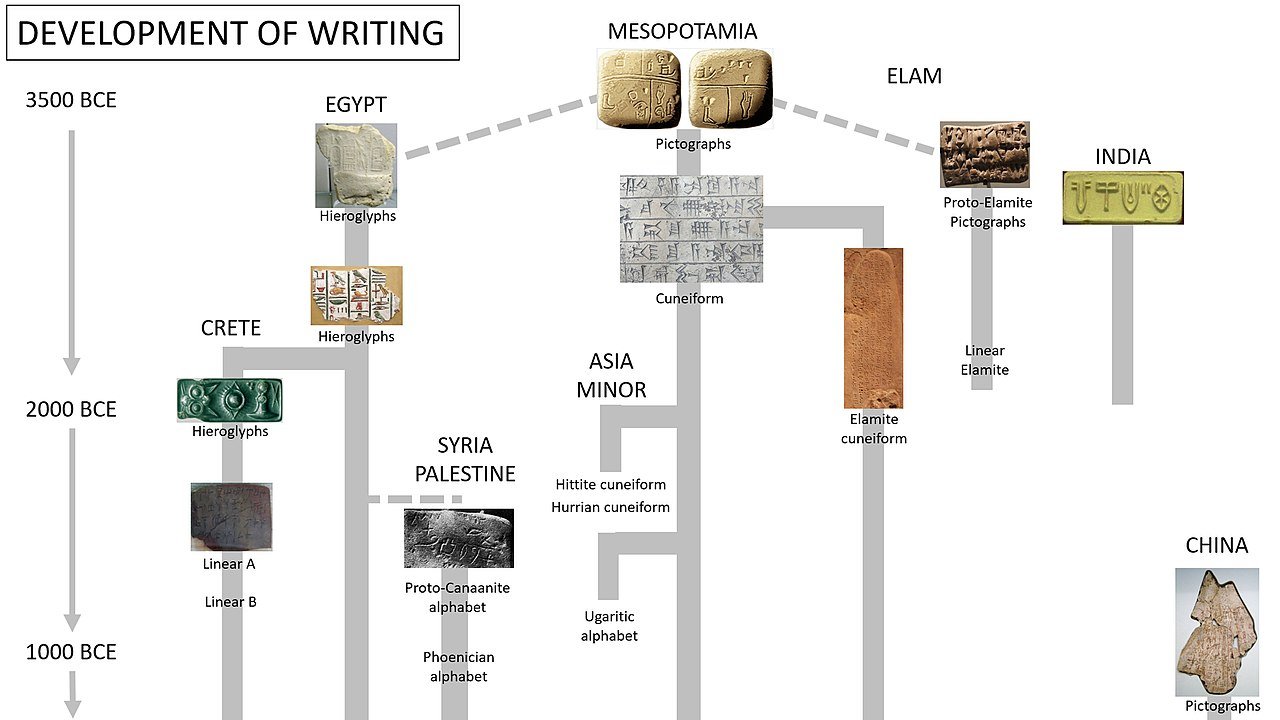
Standard reconstruction of the development of writing. There is a possibility
that the Egyptian script was invented independently from the Mesopotamian script.
Protowriting, ideographic systems, or early mnemonic symbols came before more advanced writing systems in the evolution of writing in human societies (symbols or letters that make remembering them easier).
A subsequent development is true writing, in which the content of a spoken language is encoded so that another reader may reasonably reconstruct the identical utterance written down. It differs from proto-writing, which frequently forgoes recording grammatical words and affixes, making it harder or even impossible to reassemble the precise meaning intended by the writer unless a substantial amount of context is already known in advance.
Writing innovations
The idea that writing originated in a single civilization and was called "monogenesis" persisted for a long time. According to academics, all writing originated in Mesopotamia's ancient Sumer and spread around the world as a result of cultural diffusion. This argument holds that traders or merchants traveling between geographical locations passed on the idea of representing language by written signs, though perhaps not necessarily the specifics of how such a system operated.
The finding of ancient Mesoamerican scripts, far from Middle Eastern sources, demonstrated, however, that writing had been created more than once. In at least four ancient civilizations, including Mesopotamia (between 3400 and 3100 BCE), Egypt (about 3250 BCE), China (1200 BCE), and lowland portions of southern Mexico and Guatemala, writing may have independently originated (by 500 BCE).
Some academics have suggested that ancient Egypt "The earliest authentic examples of Egyptian writing differ from Mesopotamian writing in both structure and style, indicating that they must have emerged independently. Although there is still a chance that Mesopotamian "stimulus dispersion" occurred, the influence could not have extended beyond the dissemination of an idea."
Because there is no evidence of communication between ancient China and the Near Eastern literate civilizations, as well as because Mesopotamian and Chinese approaches to phonetic representation differ, it is thought that ancient Chinese characters are independent creations.
The Vinča symbols
The Rongorongo script of Easter Island, the Vina symbols from about 5500 BCE, and the Indus script of the Bronze Age Indus Valley civilization are all controversial. Since none have been translated, it is unclear if they all represent real writing, protowriting, or something entirely different.
The earliest coherent texts date from around 2600 BCE, and Sumerian archaic (pre-cuneiform) writing and Egyptian hieroglyphs are usually regarded as the earliest authentic writing systems. Both developed out of their ancestors' proto-literate symbol systems between 3400 and 3100 BCE. The Proto-Elamite script belongs to roughly the same time frame.
Writing Methods
Writing systems are distinct from symbolic communication systems. For most writing systems, reading a text requires some knowledge of the spoken language that goes along with it. In contrast, it's not always necessary to have a prior understanding of a spoken language to use symbolic systems like information signs, paintings, maps, and mathematics. Every human group has its own language, which is thought by many to be a natural and essential aspect of mankind.
Writing system development has been intermittent, uneven, and delayed, and old oral communication systems have only been partially replaced. Writing systems generally develop more slowly after they are formed than their spoken counterparts and frequently preserve traits and idioms that have been lost to the spoken language.
Three writing standards are thought to apply to all writing systems. First, writing must be comprehensive; it must have a meaning or purpose, and it must make a point or be able to convey that message. Second, whether they are physical or digital, all writing systems must include some kind of symbol that can be created on a surface. In order to facilitate communication, the writing system's symbols must resemble spoken words or speech.
The greatest advantage of writing is that it gives society a way to regularly and thoroughly preserve information—something that the spoken word could not previously do as successfully. Writing enables communities to communicate knowledge, transmit information, and... [the internet article in incomplete here]
Stages of Development
Sumer, an ancient civilization of southern Mesopotamia, is believed to be the place where written language was first invented around 3200 BCE.
Beginning with the Neolithic pottery phase, when clay tokens were used to keep track of particular quantities of animals or other goods, writing first appeared. These tokens were initially imprinted on the exterior of spherical clay envelopes, which were later used to keep them. Afterwards, flat tablets were gradually introduced in place of the tokens, and signs were recorded using a stylus. Towards the end of the fourth millennium BCE, Uruk was where actual writing was first discovered. Other areas of the Near East quickly followed.
The earliest recorded account of the development of writing is found in a poem from ancient Mesopotamia:
"The Lord of Kulaba patted some clay and wrote on it like a tablet because the messenger's mouth was heavy and he couldn't repeat the message. It has never been possible to write on clay before." - Enmerkar and the King of Aratta, a Sumerian epic written around 1800 BCE
Although there is agreement among scholars as to the difference between prehistory and the history of early writing, there is disagreement as to when proto-writing became "real writing." The criteria are somewhat arbitrary. In the broadest sense, writing is a way of keeping track of information. It is made up of graphemes, which in turn can be made up of glyphs.
Many centuries of shattered inscriptions typically follow the advent of writing in a particular region. The presence of coherent texts in a culture's writing system is how historians determine a culture's "historicity".
Standard reconstruction of the development of writing. There is a possibility
that the Egyptian script was invented independently from the Mesopotamian script.
A conventional "proto-writing to true writing" system follows a general series of developmental stages:
Picture writing system: glyphs (simplified pictures) directly represent objects and concepts. In connection with this, the following substages may be distinguished:
Mnemonic: glyphs primarily as a reminder.
Pictographic: glyphs directly represent an object or a concept such as (A) chronological, (B) notices, (C) communications, (D) totems, titles, and names, (E) religious, (F) customs, (G) historical, and (H) biographical.
Ideographic: graphemes are abstract symbols that directly represent an idea or concept.
Pre-cuneiform tags, with drawing of goat or sheep and number (probably "10"): "Ten goats", Al-Hasakah, 3300–3100 BCE, Uruk culture.
Transitional system: graphemes refer not only to the object or idea that it represents but to its name as well.
Phonetic system: graphemes refer to sounds or spoken symbols, and the form of the grapheme is not related to its meanings. This resolves itself into the following substages:
Verbal: grapheme (logogram) represents a whole word.
Syllabic: grapheme represents a syllable.
Alphabetic: grapheme represents an elementary sound.
Designs on some of the labels or token from Abydos, carbon-dated to circa 3400–3200 BC and among the earliest form of writing in Egypt. They are remarkably similar to contemporary clay tags from Uruk, Mesopotamia.
The best known picture writing system of ideographic or early mnemonic symbols are:
Jiahu symbols, carved on tortoise shells in Jiahu, c. 6600 BCE
Vinča symbols (Tărtăria tablets), c. 5300 BCE[24]
Early Indus script, c. 3100 BCE
In the Old World, true writing systems developed from neolithic writing in the Early Bronze Age (4th millennium BC).
Locations and timeframes
Comparative evolution from pictograms to abstract shapes, in Meso-
potamian cuneiforms, Egyptian hieroglyphs and Chinese characters
Proto-writing
The first writing systems of the Early Bronze Age were not a sudden invention. Rather, they were a development based on earlier traditions of symbol systems that cannot be classified as proper writing, but have many of the characteristics of writing. These systems may be described as "proto-writing". They used ideographic or early mnemonic symbols to convey information, but it probably directly contained no natural language. These systems emerged in the early Neolithic period, as early as the 7th millennium BC, and include:
The Jiahu symbols found carved in tortoise shells in 24 Neolithic graves excavated at Jiahu, Henan province, northern China, with radiocarbon dates from the 7th millennium BCE. Most archaeologists consider these not directly linked to the earliest true writing.
Vinča symbols, sometimes called the "Danube script", are a set of symbols found on Neolithic era (6th to 5th millennia BCE) artifacts from the Vinča culture of Central Europe and Southeast Europe.
The Dispilio Tablet of the late 6th millennium may also be an example of proto-writing.
The Indus script, which from 3500 BCE to 1900 BCE was used for extremely short inscriptions.
The Dispilio tablet is a wooden tablet bearing inscribed markings, unearthed during George Hourmouziadis's excavations of Dispilio in Greece, and carbon 14-dated to 5202 (± 123) BC. It was discovered in 1993 in a Neolithic lakeshore settlement that occupied an artificial island near the modern village of Dispilio on Lake Kastoria in Kastoria, Western Macedonia, Greece.
Even after the Neolithic, a number of societies used proto-writing as a transitional form before adopting formal writing. Such a mechanism might have existed in the quipu of the Incas (15th century CE), often known as "talking knots".
Another example is the pictographs created by Uyaqukbefore the Central Alaskan Yup'ik language developed the Yugtun syllabary around 1900.
Ancient writing
The Bronze Age saw the development of writing in a wide range of cultures. Indus script, Egyptian hieroglyphs, Cretan hieroglyphs, Chinese logographs, Sumerian cuneiform writing, and the Olmec script of Mesoamerica are a few examples. Around 1600 BCE, the Chinese script most likely evolved apart from the Middle Eastern scripts. It is also generally accepted that the pre-Columbian Mesoamerican writing systems, which include the Olmec and Maya scripts, had separate origins. In 2000 BCE, it is believed that the first real alphabetic writing was created for Hebrew laborers in the Sinai by assigning Semitic values to mostly Egyptian hieratic characters (see History of the alphabet and Proto-Sinaitic alphabet).
Ethiopia's Geez writing system is regarded as Semitic. With roots in the Meroitic Sudanese ideogram system, it is most likely of semi-independent origin. The majority of alphabets used today are either direct descendants of this one invention, many through the Phoenician alphabet, or were designed in direct response to it.
The early Old Italic alphabet and Plautus (c. 750–250 BCE) were separated by around 500 years in Italy, while the Elder Futhark inscriptions and early works like the Abrogans (c. 200–750 CE) are separated by a similar amount of time in the case of the Germanic peoples.
Cuneiform writing
The first Sumerian script was derived from a system of clay tokens used to denote different types of goods. This had developed into a system of keeping accounts by the end of the fourth millennium BC, utilizing a stylus with a circular form that was impressed into soft clay at various angles to record numbers. A pointed stylus was used to gradually add pictographic lettering on this to show what was being counted. Writing using a wedge-shaped stylus (hence the name "cuneiform") began to include phonetic features by the 29th century BCE and gradually replaced writing with a round stylus and a sharp stylus by about 2700–2500 BCE.
Cuneiform first started to represent Sumerian syllables around 2600 BCE. Ultimately, cuneiform writing evolved into a general-purpose system for writing numerals, syllables, and logograms. This alphabet was adapted to the Akkadian language starting in the 26th century BCE, and from there to others like Hurrian and Hittite. This writing system resembles Old Persian and Ugaritic scripts in appearance.
Hieroglyphics from Egypt
Literacy was concentrated among a well-educated elite of scribes, who played a crucial role in upholding the Egyptian empire through writing. To become scribes in the employ of temple, royal (pharaonic), and military authority, one had to come from a certain background.
According to Geoffrey Sampson, the general concept of expressing words from a language in writing was likely transmitted to Egypt via Sumerian Mesopotamia. Egyptian hieroglyphs "came into being a little after Sumerian script, and, possibly [were], invented under the influence of the latter." Despite the significance of early Egypt-Mesopotamia links, "no definitive judgment has been established as to the genesis of hieroglyphics in ancient Egypt" due to the lack of direct evidence. However, it is stated and agreed upon that "a very compelling argument can also be made for the independent development of writing in Egypt" and that "the evidence for such direct influence remains fragile."
Egyptian writing does suddenly appear at that time, but Mesopotamia has an evolutionary history of sign usage in tokens dating back to around 8000 BCE. Since the 1990s, discoveries of glyphs at Abydos, dated to between 3400 and 3200 BCE, may challenge the conventional idea that the Mesopotamian symbol system predates the Egyptian one. These glyphs were discovered in tomb U-J at Abydos; they were written on ivory and most likely served as labels for other items discovered there.
Even though he acknowledged that Egypt's geographic location made it a receptacle for many influences, Egyptian scholar Gamal Mokhtar maintained that the inventory of hieroglyphic symbols originated from "fauna and flora used in the signs [which] are essentially African" and that in regards to writing, "we have seen that a purely Nilotic, therefore African origin not only is not excluded, but probably reflects the reality."
Elamite writing
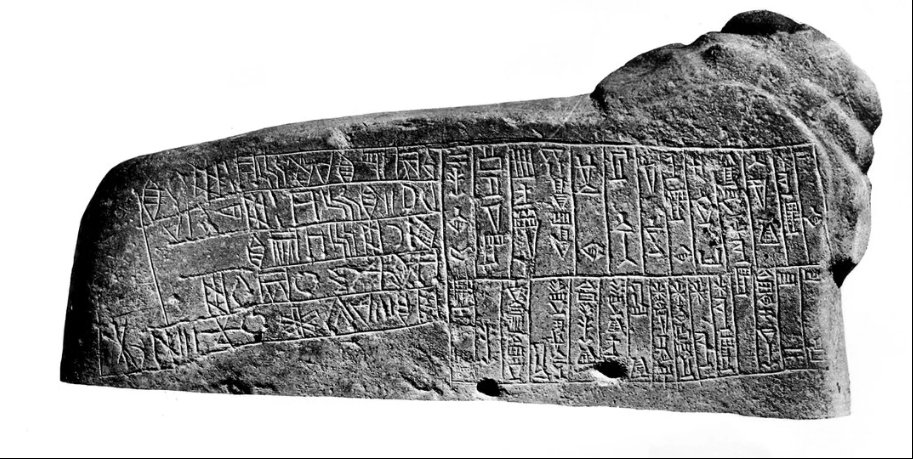
The unintelligible Proto-Elamite writing first appears around 3100 BCE. Around the latter third millennium, it is thought to have evolved into Linear Elamite, which was later supplanted by Elamite Cuneiform, which was adapted from Akkadian.
Indus script
Most inscriptions containing these symbols are extremely short, making it difficult to judge whether or not these symbols constituted a writing system used to record the as yet unidentified language(s) of the Indus Valley civilisation.
The Indus script has been assigned to markings and symbols discovered at numerous Indus Valley civilization sites due to the hypothesis that they were used to transcribe the Harappan language. It is disputed whether the script, which was in use from roughly 3500 to 1900 BCE, is a Bronze Age writing script (logographic-syllabic) or merely proto-writing symbols. According to analysis, it was written in boustrophedon or from right to left.
EARLY SEMITIC ALPHABETS
Around 1800 BCE in Ancient Egypt, the first "abjads," which mapped individual symbols to individual phonemes but not necessarily each phoneme to a symbol, appeared as a representation of the language created there by Semitic workers. However, by that time, alphabetic principles had only a remote chance of being ingrained into Egyptian hieroglyphs for upwards of a millennium.
Did the Proto-Canaanite alphabet take its symbols independently of the hieroglyphs?
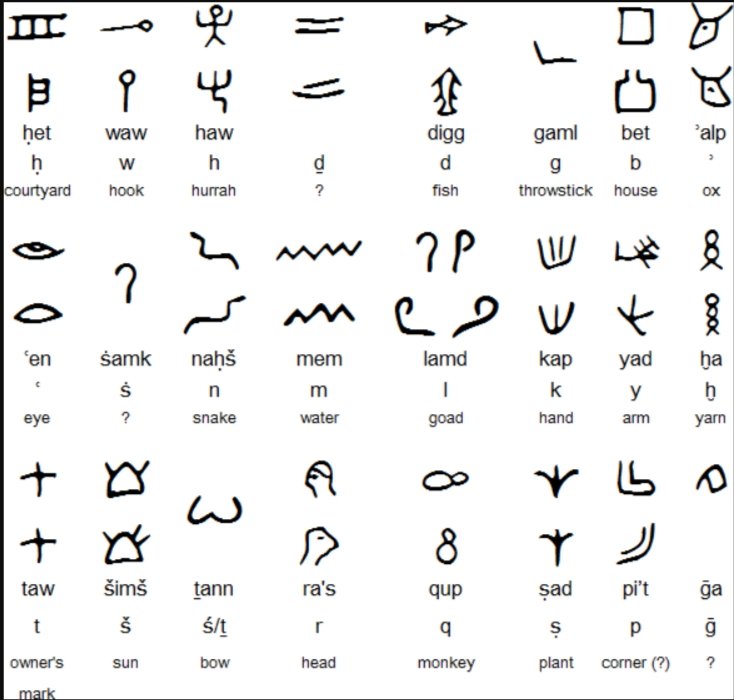
It is only until the end of the Bronze Age that the Proto-Sinaitic script separates into the Proto-Canaanite alphabet (c. 1400 BCE), Byblos syllabary, and the South Arabian alphabet (c. 1200 BCE). These early abjads remained of minor significance for several decades. The untranslated Byblos syllabary most likely had some influence on the Proto-Canaanite, which in turn provided inspiration for the Ugaritic alphabet (c. 1300 BCE).
The corpus of inscriptions on oracle bones and brass from the late Shang dynasty is the earliest authenticated example of the Chinese script that has been found so far. The oldest of these is believed to date from about 1200 BCE.
There have been recent finds of tortoise-shell carvings from around 6000 BCE, such as Jiahu Script and Banpo Script, but it is debatable whether or not the carvings are complex enough to be considered writing. 3,172 cliff carvings from the period between 6000 and 5000 BCE have been found near Damaidi in the Ningxia Hui Autonomous Region. They contain 8,453 different characters, including images of the sun, moon, stars, gods, and scenes of grazing or hunting.
Replica of ancient Chinese script on an oracle turtle shell
These pictographs are thought to resemble the first Chinese characters that have been confirmed to be written. Writing in China would predate Mesopotamian cuneiform, traditionally recognized as the first manifestation of writing, by about 2,000 years if it were to be considered a written language. However, it is more likely that the inscriptions represent a type of proto-writing, comparable to the modern European Vinca script.
Early Greek and Cretan scripts
Cretan relics include hieroglyphic writing (early-to-mid-2nd millennium BCE, MM I to MM III, overlapping with Linear A from MM IIA at the earliest). The Mycenaean Greek writingsystem, Linear B, has been decoded, but Linear A has not yet been. The three overlapping, but distinct, Aegean pre-alphabetic writing systems can be categorized according to their chronological order and geographic distribution as follows:
Cretan Hieroglyphic / Crete (eastward from the Knossos-Phaistos axis) / c. 2100−1700 BCE
Linear A / Crete (except extreme southwest), Aegean Islands (Kea, Kythera, Melos, Thera), Greek mainland (Laconia) and west Minor Asia (Miletus and maybe Troy) / c. 1800−1450 BCE
Linear B / Crete (Knossos), and mainland (Pylos, Mycenae, Thebes, Tiryns) / c. 1450−1200 BCE









No comments:
Post a Comment